Sunday, October 7, 2012

Oliver Stone's Untold History of the United States (2012) Parts 1-3 New York Film Festival 2012

Long in the works and two years past deadline the Showtime series by Oliver Stone The Untold History of United States will finally air in November. Those of us who jumped when tickets went on sale before they sold out got to see the first three episodes with Stone in attendance when they were screened as part of The New York Film Festival yesterday.

Some of you may remember that this event was supposed to happen at last years event but the show wasn't finished (and it still isn't done, Stone said he was still finishing episodes 9 and 10).

The series begins with the run up to World War Two.  Episode 1 is titled World War 2 and it begins with the Japanese expansion in Asia in the early 1930's and it follows the course of events up to 1943. The film Concentrates on how the story that the US was primarily responsible for the Allied victory isn't wholly true. The part also deals with the selection of  Henry Wallace as FDR's running mate in 1940. Wallace is a key figure in Stone's view of history.

Part 2 is called FDR, Truman and Wallace and it focuses on the course of the war and how Truman replaced Wallace as Vice President due to trickery and backroom deals. It also deals with how Truman was told early on about how the commies were coming and how this shaped what happened next.

Part 3 is The Bomb and it dealt with the hows and whys of Japan's surrender and the use of the bomb. It also makes clear that the bomb played less of a factor in the surrender of Japan than we think. The episode also paints a less than sparkling clean portrait of President Truman.

At the end of the third part it says that Part4 is The Cold War.

This is a heady mix of history that is almost too much to take in in such a concentrated form. The parts, each running an hour, were screened with ten minute breaks in between. There is a ton of material here and while little of it was anything new, the presentation in it's arrangement and  in such a high volume was over whelming. Both my friend Lou and myself wanted to take longer than the 10 minutes they gave us.

I have to applaud Stone for being willing to throw so much at his audience. There is a great deal to mull over and connections are made that I had never seen before. The trouble is that such a concentrated screening gave us very little time to process what we were seeing. It was a few minutes to catch our breath before boom on to the next thing.

On  the other hand I know that seeing the films in a slightly less concentrated manner, but more concentrated than as a weekly series they will play much better since we can both have time to reflect on what we are seeing as well as maintain the connections of who some of the people are.

The history, as far as I can tell is all dead on. This really is what happened and to some degree why. To be certain Stone is shading things to bring out certain facts, but there really isn't anything he's saying that isn't true.  His problem, if there is a real problem, is that he doesn't fully explain everything. Some events are simply too big (Poland) to explain simply. Other things are not fully relevant to a history of America. Stone said that this is American history and not so much world history
After the film Stone, his co writer Peter Kuznick,  historian Douglas Brinkley, Katrina vanden Heuvel the editor of The Nation and journalist Jonathan Schell went up on stage for a panel discussion.(It's projected half hour to forty five minute running time stretched to about seventy five)

After some reactions from Brinkley,  vanden Heuvel and Schell they got down to the nitty gritty. Much of the discussion focused on Henry Wallace, who is a hero of Stone's (though I still don't understand why- though in these episodes it seems more like he loves him for what he might have done). Wallace is portrayed as a the successor of FDR's plans for the world and his removal from the ticket in 1944 a source of great puzzlement. While  the series only deals with Wallace's ouster as Vice president as a great loss, the discussion went into more detail with speculation running from hatred of Wallace in many areas, to FDR figuring that he was going to live to the end of the war and thus making Truman a non-issue, to FDR simply being too tired to fight for Wallace who was also becoming a problem for FDR.
Stone and Kuznick talked of the making of the series (which they started to talk about in 1997). They said that the series was supposed to have been finished a couple of years ago but the complexity of it all slowed them down. They also said that there were two additional programs planned, one on World War 1 and another on the 1930' but because of budgetary reasons they couldn't include them in the series. They said that they hoped to include it in the eventual home video box set. (The material is included in the companion book which comes out October 30th.) They also hoped that the series might get people to start thinking Utopian again, and see that people can and do make differences, instead of being being cynical.

There was much discussion about how the less than positive viewing of Truman is going to shake up many people who hold him in high regard. Stone questions whether Truman should have been there since once elected no one seemed to inform him of any of what was going on until they had to after FDR died. Truman is viewed less of being his own man, rather as a man in the sway of others.

The Q&A with the audience was very brief since each question lead to much more discussion with the panel. The only thing that I think didn't refer back to one of the above subjects, was a question by a gentleman from I believe Pacifica Radio  who took Stone and Kuznick for task for not going into deeper discussion on Poland and for not going into greater discussions about some of the thoughts of the Japanese high command regarding the use of the atomic bomb. Stone took the comments in stride and pointed out that the series is both limited in scope by a set amount of time, and because some of the issues raised, such as the small military coup attempt by the Japanese near the end of the war, didn't affect the American story.

Both myself and my friend Lou had a blast. Based on what we've seen the series is going to do that which it intended to do, namely inform and to get a discussion going. The screening was one of the real treats of the Festival this year.

(And apologies to anyone looking for a deeper discussion of the series, but there were two obstacles, first there simply is too much to explain. And secondly, Stone has structured the series so each part builds on the last. Everything ties into everything else. How I reacted to part one changed with revelations in part 2 and 3 and so on. Based on comments made during the panel discussion further revelations are coming in the remaining 7 parts. I can't discuss the whole web of the series since I only saw part of it.)
(All photos via the courtesy of Lou Macaluso)

Amour (2012) New York FIlm Festival 2012


Normally I dislike Michael Haneke directed films. To me they are variations of the same things over and over again, usually having to do with the cruelty of people towards each other. Worse to me his films are obvious in their conclusions.

Normally  I don't like his films....

...which is why my love of Amour, his most recent film which is playing at the New York Film Festival comes as a major shock and major delight.

The plot of the film is simple, Georges and Anne deal with what transpires in the wake of Anne's stroke. It's a bittersweet tale that is tinged with great love.

I don't know what to say beyond WOW.

Jean-Louis Trinnitignant is amazing as Georges. Watching him as he watches the one he love in pain is heart breaking. Its easily one of the best performances of the year.

Emmanuelle Riva as Anne should be given the Oscar right now. How the hell does she do what she does? No seriously, you explain how she manages to do it...Its a performance for the ages. No really, you explain to me how the hell she holds her mouth  and face in some of these scenes...

What I love about the film and what sells the whole thing is how the pair interacts. Watch the body language. Watch how they move together. Watch how Georges lifts Anne out of her wheelchair... if you can't feel the love and sensuousness you're dead. These are two people deeply deeply in love.

You have to see this film. Its amazing. I completely understand why it's winning all the awards, and I would put this on my best films of this year's New York Film Festival.

I can't say more than that, because the film is so simple in it's complexity you just have to see it.

Saturday, October 6, 2012

Not Fade Away (2012) New York Film Festival 2012


David Chase's follow up to the Sopranos and his feature film directing debut is a a disappointing cliche filled tale of high school kids who form a band in the 1960's.

My two over riding thoughts when I saw the film were first "Haven't we been here before?" The other was to wonder where was the story editor to oversee the writing since even Chase's earliest scripts for things like Kolchack and Rockford Files weren't as cliche as this.

The film follows a bunch of kids from their waning days in high school as they form a band and then try to keep it up as they drift in and out of relationships, battle with their parents, and go to college. Think of every cliche of a drama like this and Chase hits it dead on. Even a late in the game incident with a motorcycle brought about a not so unexpected result.

You'll notice I'm not really going into the plot in any detail and that's because Chase doesn't bother to do so in the film. We just jump from incident to incident in a well worn out prescribed fashion. There is almost nothing new here and when it is Chase disposes it in a such away that you wonder why the hell he brought it up in the first place (The committal of the "weird sister"). Seriously if you're not several steps of the characters you really don't watch much TV or movies.

If I really wanted to be cruel I'd start to pick apart the film's internal errors. For example no one was watching the time frame errors beginning with our hero going to college with very short hair in late August and returning in November with a long curly mop. Other sequences happen with a rapidity that doesn't seem to jibe with the calendar. When you watch the film think about how much time passes between scenes and you'll end up puzzled.

Equally jarring are the plot holes which pepper the film, such as how and why does Douglas show up outside a certain apartment when there is no reason other than to effect a reconciliation which propels the final portion of the film.

And as for the writing of the parental characters, even the worst sitcoms aren't this bad and cliche. Douglas' mother was old hat in the 1950's. She's a whiny shrew and is just plain awful. The casting of Christopher MacDonald as Douglas's girlfriend's father sinks the role completely because while he's good, the fact he's played so many jerks in earlier comedic films instantly kills any respect we have for him as well as any weight to what he does.

James Ganolfini is all but completed wasted in a role that simply has him either saying fatherly advice or screaming at his son for long hair, and lack of respect. In his favor he does have three great moments that make me wonder what the film could have been in better hands One is a confession at dinner with his son, one involves him watching TV and the last is him showing how much he loves his son as he heads off to LA ("don't say anything").

Lastly David Chase said that he has Douglas's sister narrate the story because he liked the idea of her doing so and because of how it works at the ending. I will give you that the end is good but fails to uplift the film despite it's best efforts. The real problem with her narrating the film is she can't have seen the vast majority of what happens in the film. It's even more glaring in the face of Chase saying at the press conference that she narrates because she took in everything that was happening around her...really?

I'm going to end this here by saying that as much as I don't like the film and as much as there is really wrong with the film I don't hate it. If you can take it for what it is, flaws and all, it's not bad. The trouble is it's a weak film not only from a man who redefined television, but it's a film that is written more poorly than any thing that I had ever seen from his pen in the last 40 years.

If you must see a coming of age film aat the New York Film Festival see Olivier Assayas's infinitely better Something in the Air, which desoite its own flaws is more real and touching.

The film is screening as the centerpiece tonight before opening in December

Native Son (1951) New York Film Festival 2012


Restored first film version of the classic American novel is more of interest for it's place in history rather than because it's a good film.

Richard Wright's story tells the tale of Bigger Thomas, a young black man living in poverty. He gets a job with a rich family as a driver. However things take a tragic turn when Bigger accidentally kills his bosses daughter when trying to cover up that he has brought her to her room after her drunken night with her boyfriend.

I had always heard that this version of the story was nigh impossible to see. The film came to my attention when the 1986 version was released to theaters and reviews talked about how the film was the second cinematic adaption of the story. Efforts to run down a copy of the film in the VHS days proved fruitless and was always met with a "But why would you want to see it, it's terrible" from any collector of film fan I talked to about it. Everyone seemed to have seen it but no one seemed to think much of it.

When the film was announced for this years New York Film Festival I was excited since here was the a chance to see a film I had heard about but had never seen. It was also a chance to mark off one of the films I had been trying to find from my list.

Walking into the the press screening, I had a sense of getting to see something special. The festival this year was not running many of the Masterworks for the press so the chance to see one made it vital to attended.

Sadly I walked out half way into the film, I just couldn't sit there any more.

While I was not roaring with laughter, as the gentleman in front of me was, I was shaking my head. This isn't a drama, it's a polemic about race relations. People never behave like this except in polemics. Watching the film I was having a hard time matching up the source novel with the film on the screen.

Its easy to understand why the film was heavily censored when the film was released in 1951 since the film is full of rage at the inequality of people of differing colors. Its a film aching to put right a serious social wrong and it screams it's points at you in a most strident way (The film begins with look at Chicago and it lays everything out for you in bite size nuggets).

The script, adapted from the novel by Wright, shows signs of the earlier stage adaption that he had also written. The dialog and the situation seem arch and highly theatrical. Every line is dripping with meaning. It has the feeling of something that might have played on Broadway rather than the feel of something that alive on the big screen. It also shows signs of the changes that had to be made to get the film done with the sex all but removed and the Communist angle down played.

The cast is wildly uneven with some people being better than other. Wright, playing his own lead character is very up and down. While I wouldn't say that he's horrible, I will say it's clear that he isn't much of an actor. It doesn't help that Wright the author has given Wright the actor precious little to work with. Bigger in this film isn't so much a character as a mouth piece. He is there to represent an idea. He is a character who never comes together into a fully formed whole. Additionally Wright, at the time the film was made, was into his 40's making him well over twice the character's age in the novel.
Yes I know the film is 61 years old, but other films from the period aren't this dated. To be certain there are some equally preachy films from the time, and I wouldn't want to watch them either, I don't want to be lectured.

As I said before the gentleman in front of me was chuckling his way through the film. while I wasn't laughing I completely understood his take since so much of this is ripe for all the wrong reasons.

The film is an important one historically since it's an attempt to film a controversial novel and get it before a wider audience. It's a film that is daring to be about something more than mere entertainment... but it's nothing I would ever want to see again, or even see to the end.

As much as I hate to say this you can skip this one.

If you don't feel the need the film will screen on October 9 at the NYFF.

NYC Horror Film Fest 2012


With Halloween just around the corner, the time has once again come to gather and celebrate the 10th annual NYC Horror Film Festival.

As someone who has attended the festival each year since it's inauguration, I can without a doubt say that if you have never been, that you are indeed missing out. Since 2002 the NYCHFF has brought out the absolute best that the independent horror scene has to offer. Leaving all other competition in the dust.

You can expect to see films from up-and-coming directors to living legends. There is always a good mix for whatever sub-genre you might be a fan of.

This years festival marks the first since the untimely and unfortunate passing of the festival director, Michael J. Hein. As someone who got to know Michael throughout the years, he was a guy that had an extreme passion for all things horror and film making. He turned a little known festival into one of the biggest in the entire country. Now with the help of the Hein family that legacy will continue to grow.

So if you are on the east coast, hell even if you aren't.. be sure to check out this years festivities. You will not be disappointed.

For film and ticket information go to http://nychorrorfest.com/

Friday, October 5, 2012

A Non Review of Room 237 (2012) New York Film Festival 2012


You’ll forgive me for burying this piece in an in between slot but I simply want to note that the film has been seen and it has kind of left us underwhelmed.

Room 237 was a huge hit at Sundance. The film is a look at the crazy theories that have sprung up concerning Stanley Kubrick’s version of the Shining. As you know earlier this year I reviewed the wonderfully wacky Kubrick’s Odyssey about how Kubrick hid clues to his faking the moon landings in the film. This is a more broad spectrum look at a number of theories about the film from Native American Indian genocide to the Holocaust to other things, and it does cover the moon landings as well.

As much as the film was hyped the film doesn’t really live up to it.

The problem for me is that the film doesn’t tell me anything I haven’t run across before. I had heard bits and pieces of the various theories before and I saw the earlier film which covers the moon landings in detail so this is hardly new. To be perfectly honest the film couldn't old my attention after four previous movies, and four hours sleep the night before. I wandered out early.

I spoke with a couple of other people who have seen the film and were less than thrilled. While I shouldn’t go by what other people say, I did have extensive discussions about the film before I saw it so what was said played into my feelings for the film. Our own John DiBello asked why the film made no effort to debunk or look into the theories. He also was underwhelmed since he had never seen the Kubrick film so chunks of this documentary was completely lost on him. For him the film seemed to be made for a self-selecting audience. Good friend of Unseen Films Hubert Vigilla from Flixist raised the interesting point as to why no effort was made to have the various people either talk to each other or discuss the other ideas (his review can be found here)

I’m underwhelmed (and very tired) and John’s underwhelmed and the result is we’re not officially reviewing the film…. At least right now.

The plan as of right now is to catch the film when it opens in theaters October 26th again and then put up a real review them.

As for me, my attitude would be to skip the festival screening and see this at a cheaper price when in plays in three weeks at the IFC Center

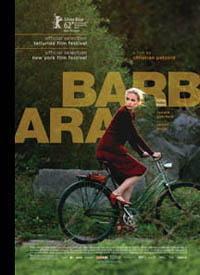
Barbara (2012) New York Film Festival

A razor-sharp cast and moody provincial cinematography don't quite hide the fact that Christian Petzold has remade Casablanca here, but if you're going to riff on the best, do it daringly, with visual style and strong performances. Those are Barbara's magic ingredients, creating a gripping Cold War-era, East Germany-based drama that's a magnetic portrait of human nature.

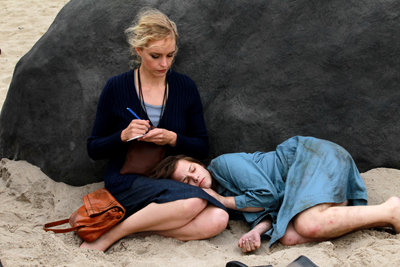
The bewitching Nina Hoss stars as the titular Dr. Barbara Wolff. It's her fifth starring role directed by Petzold but doesn't suffer from an easy familiarity. Barbara is the quietest electric person on the screen, compelling and dazzling without ever being open or glamorous. Barbara has been punitively reassigned to a small provincial hospital for her failed attempt to emigrate to the West; she's stalked and harassed (even molested) by the Stasi agents who take more pleasure in making her uncomfortable and paranoid than in doing their job (Rainer Bock is sensational as the beastly GDS agent Scütz). Barbara has another plan to escape to the west with the help of her rather bland lover (Mark Waschke succeeds in the difficult task of making a sympathetic character appear distant). She's torn, however, with a beautiful irony: the life and the people of her new country are more vivid, empathetic...more human...than what she hopes to escape to. None of this is clear from the start, nor does any one character ever spell out the plot. It's an intelligent puzzler, a puzzle box of intrigue and changing allegiances, Barbara's dilemma as heavy as the mighty winds that buffet the East German countryside as she bikes to and from the hospital and illicit rendezvous with her boyfriend.

Complicating matters is the traditional good-guy third of the love triangle, her mysterious and compassionate medical colleague Andre (Ronald Zehrfeld, in a fuzzy beard that hides his subtle facial expressions). Andre has the difficult task of tilting the balance for Barbara, but Zehrfeld plays it so low-key that we're never certain if his affection for her is genuine or just another false front. To Zehrfeld's credit, this doubt plays out exceptionally in a scene where he explains why he too has been banished to the hospital in the hinterlands; we—and Barbara—are never quite certain if he's telling the truth. Everyone is wearing masks. It's dangerous to let them slip.

Despite the driving force of Nina Hass's performance, an energy kept in check by her need to remain distant from all that surrounds her, this is no edge-of-your-seat, nail-biting thriller. It lags substantially in the middle section and some scenes, such as an illicit meeting in a hotel with Jörg, Barbara's lover, seem to be in the script simply to Make. One. Point. And if you didn't catch it, we focus tightly on Barbara's seemingly impassible face, reminding you to consider what has just been said. But then it is immediately followed with a delightfully fanciful scene in which Barbara encounters Steffi, a young prostitute—the sex partner of Jörg's partner—who's been promised the same reward of a life in the West. She giggles and drinks champagne and shows Barbara the catalogue from which she'll pick out her gaudy engagement ring. Steffi (Susanne Bormann) is only on screen for a few moments, giving the most emotionally open and joyful performance in the film. She's the only character filled with true optimism over the future, even though we and Barbara know she's destined to be disappointed. It's a blip in an otherwise slow section of the film but an important and startling one.

There's other dramatic moments that plunge into seemingly unbelievable coincidence or improvident editing: Stasi agent Scütz is harboring a secret that, of all the people in her small town, suddenly pushes Barbara to her eventual conclusion. A runaway girl that bonds to Barbara escapes her hellish work camp life, immediately followed a scene that gives away (to anyone who's ever seen a movie before, at least) the movie's eventual final plot twist. But all these scenes are illuminated by canny performances that divert attention from any weaknesses in the script.

Yes, in the end it's the same general plot as Casablanca, with the problems of two people not amounting to a hill of beans. The right person gets the prize of freedom, and for those left behind, it's the beginning of a beautiful friendship, albeit one without a kiss that's still a kiss. At least, not now. Barbara reminds you that while there are few new stories still left to be told on screen, there are dynamic and electrifying ways to retell them. That the behavior, actions, reactions, and decisions of the characters both good and bad are immediately identifiable as small but human are the credit to Christian Petzold and his cast. Intelligent and incisively filmed, Petzold brings the human condition alive in Nina Hass, with vibrancy and beauty.

Thursday, October 4, 2012

The next Free Korean Movie Night film is Choked (2011)


We at Unseen are hip deep in the New York Film Festival so we haven't had a great deal of time to focus on the other cinematic events going on in New York and elsewhere. You would think that we'd blow off the Free Korean Movie Nights, but we always seem to remember to at least remind you...however in this case I was lucky enough to have seen Choked several weeks ago.

Choked is the devastating story of Youn-ho. A year before his mother absconded with all of the families money, as well as the money of many other people. He simply wants to forget and live with his fiance.However while he wants to forget other people haven't and they want their money back. Caught in a no win situation Youn-ho has to deal with the damage his mother has left in her wake as he is pressured to pay her debts. As his life begins to crumble is mother is picked up by the police and everything rapidly becomes undone...

A quietly upsetting film, this is the story of how we are forced to deal with problems that are thrust upon us by the people we love, or if not love that we are some how connected to. Its a tale of pain and quiet desperation that many of us are faced with on a daily basis, though more often than not, not on this scale. Make no mistake this is not a happy tale and there were several times where I wanted to stop watching, not because the film was bad, rather because I just didn't want to be in those dark places. I didn't want the characters to be going through what they were. Alternately some of this kicked up stuff from in my life.

Chocked is a slide into Hell. Whether you want to go there is going to be your own choice. If you want to go to a dark place by all means go to the Tribeca Cinemas on Tuesday. If not there is always the next film.

Doors at 630. Movie at 7

Night Across the Street (2012) New York Film Festival 2012

I've mulled Raúl Ruiz's posthumously released Night Across the Street over in my brain since I saw it, and I'm not certain I'm any closer to fully understanding it than I was while seeing it. Certainly it has the air of mortality that was almost likely on Ruiz's mind in his final months—elderly Don Celso (Sergio Hernández) is knocking on death's door himself, almost literally. Dead, alive, and fictional characters mix and mingle while Celso patiently awaits his own death, an appointment-at-Samara style assassination he's foreseen. As his mind drifts to his past life, time and place become fluid and the boundaries between reality and fantasy melt, and Don Celso relives his steps on Earth through his own (in the title of another film by Ruiz) "Three Lives and Only One Death." A film whose modern-day protagonist is best friends with Beethoven and a pirate king? It might be futile to expect a linear plot narrative from such fancies, and Night Across the Street doesn't disappoint on that front.


But creating an empirical timeline to Don Celso's life or determining which characters exist and which are simply imagination is besides the point. Memory is reality, and history is insignificant: the old and the new co-exist and pass each other in the street. This is magical realism of the sort that flourishes in Chile, beating in time with its literary brothers Roberto Bolaño or Isabel Allende. The movie is in fact inspired by the writings of Hernán del Solar, leading Chilean writer but little known in the English-speaking world as his works haven't been translated and published in English. (Get on that right away, New Directions!) What it lacks in linear narrative it fills the senses with color, movement, illusion and the fantastic: the physical freezing of time into floating bubbles, other-earthly ships in bottles, bright warm color and surreal tricks with special effects backgrounds. This is a gorgeous movie, deserving to be seen in a theater. Don't wait for the DVD, and check your reality at the door. Night Across the Street is a determined chameleon of a film that will baffle at the same time it warms the heart.

The 4K restoration Lawrence of Arabia (1962) at the New York Film Festival 2012


On Sunday in Alice Tully Hall  they screened the restored 4K version of Lawrence of Arabia. When the Columbia Pictures logo appeared on screen  a loud "Oh Shit!" could be heard running through the audience.

Oh shit indeed because boys and girls this is the finest  digital transfer I have ever seen. Its also the greatest restoration I've seen.

What can I say? If you want to covert someone to digital projection show them this film. My friend Lou said it was the most amazing image transfer he's ever seen. It also called it one of the greatest movie going experiences of  his life (He may be being a bit mild since he was doubled over with back pain)

The transfer was done by taking the decaying original negative (not the 1988 restoration) and preparing it despite splices, breaks and stripped sprockets. It was then scanned digitally which took 1300 hours. And then the real frame by frame restoration began. Finished just three months ago, it was a process that took over three years of work.

It was worth every minute and every penny.

Its beyond amazing.

Normally I don't care that much about transfers ans such. I grew up watching scratchy prints, chopped TV prints and VHS transfers that are damn near unwatchable. Let me see enough that I can follow the story and I'm happy....

... yea well those days are gone I want all transfers to look like this.

The thing is that while I have always held the film in high regard, having seen it big and in a transfer like this have made me feel even more strongly about the film.

You all know the story, told in flashback, this is the story of TE Lawrence who finagled his way into getting out of the office and ended up helping the Arab Rebellion happen when the various tribes ended up united to fight the Turkish overlords. The war also changed Lawrence  who's run in with various cruelties, including time in a Turkish prison which is only hinted at, from a sunny individual, into something a shade or two darker. Its story that is not only filled with great action set pieces but also some troubling ideas. (Especially now when what Lawrence did is affecting what is happening in the world today).

The film is rightly considered one of the greatest films ever to come out of Hollywood, but seeing it as it should be seen the film is an absolute revelation. Sure I've seen the film on a big screen TV, but seeing the film on a truly huge screen was something else. The size of  the spaces and desolation had me shaking my head. You never realized how desolate some places are, or how big mountains can be. There are shots of people riding in the desert and for the first time I saw things in the distance. There is one shot (when Lawrence returns with a man he's saved from The Sun's Anvil) I thought was a long shot of the distance before anyone showed up- no- someone is there from the start and we watch them ride in.

One of the best of Hollywood?  I'm now considering it for my list of greatest films period.

You want to see this. No you do. Trust me you do.

I know the DVD is coming but you want to see this on a big screen. ...and you can Fathom Events is running this today and tonight across the country in a one day, two screenings event.  It you have the time, and you love movies you have to go see this. It will blow your mind.

Wednesday, October 3, 2012

Savoy King: Chick Webb and the Music That Changed America (2012)New York Film Festival 2012


Mostly pointless documentary on drummer Chick Webb and the legendary Savoy Ballroom in Harlem. Its full of grand words on Webb and the ballroom  but little in the way of information

I have suggested that I could tweet all of the major points in the film related to Webb and if I wanted to I probably could reduce it - but here are the major facts:

-He broke his back and was left stunted and a hunchback.
-He was told to take up drumming to strengthen his upper body
-He was good to everyone and was well respected
-He married
-He discovered Ella Fitzgerald
-He became the lead attraction at the Savoy which was the only integrated club in New York
-He died due to his various health problems.

That's about it. Most other details are lacking.

The first word I heard about the film was a bad word against the film because it had only 6 seconds of film footage with Webb. I thought the person saying it was daft- and then I saw the film and realized that the 6 seconds is the least of the films problems.

The screening I attended, my first public screening at this years New York Film Festival was an odd affair. Some earlier screening had started late and they lined us up in some sort of weird looping way outside of the theater. It actually made sense if you thought about it, it would keep everyone safe it rained, but it bent your mind if you were trying to find the end of the line since there was three ends.

What I liked was that the line was filled with not only people connected to the film, but also people who knew Webb and who had danced at the Savoy. Memories were flowing as everyone talked as they waited.

Inside the mood was expectant. I sat two rows behind Tyne Daley who provided one of the voices for the film.

After an introduction by the director, who introduced a good number of tangentially connected people (Chick Webb's cousins for example) the film started....

Its an enjoyable little film which the audience really seemed to like.


I kind of liked it too, except that the almost complete lack of any real information began to wear on me. Most of the talking heads and quotes read aloud by big celebrities only told you how great Webb was. They gave you a few facts, mostly it was how wonderful Webb was and how wonderful it was to be at the Savoy.

And....?

I had only minimal sense of Webb's life. I learned about the big concerts, the NBC contracts, but  about the man or his family I learned little....worse I have no idea who many of the people quoted are. Who is Tyne Daley's character in the larger scheme of things? How about her husband? Why are they important ? Yes she was his publicist and he was a critic but who are they historically. The same goes for other characters, who is say the person Billy Crystal voices? Why is their word important?

And yes it's mostly stills of Webb. There is only a fleeting shot of Webb in motion at the end. ...

The film is not so much a biography of either Webb and the Savoy rather it's a testimonial to their greatness and importance. It's like listening to a victory celebration where we are told that some one is great... but we never really learn why.

The film ended to thunderous applause and the Q&A started....

...that was a good thing and a bad thing. It was good because after a brief talk by the director, Tyne Daley and a producer,They had  the son of the owner of the Savoy and one of the Savoy dancers come on stage. It was bad because I suddenly realized how much the director didn't know. These two people who began to talk and talk and talk  told all sorts of things about who people were and the way things were. I got a better sense from listening to them than I did from the film....

...and then the audience questions started and somewhere about the point where the people on stage were asked about Webb's wife that I lost all respect for the film and the director. Here's a man who has just made a biography (nominally) of one of the greatest jazz musicians who ever lived and he had no idea what happened to Webb's wife. "Well you know people sometimes just disappeared..." The people he brought on stage knew...

How can you make a film about  subject and then answer the question in such away that makes you sound like you only knew about some of your subject. I've seen many documentarians in my life and I have never once had the feeling they only had a partial knowledge of their subject before. I've seen bad films where after talking to or listening to the director you realize that they knew their subject in the minutest detail which never made it on the screen. I've seen great films where the directors endless knowledge seemed to make a great film better, never until Saturday's screening did I hear a director who didn't seem to know his subject. I mean not only didn't he seem to know about the wife of his subject, he was corrected several times by the very people he put on stage. No wonder the film isn't particularly insightful, the director doesn't seem to know his subject.

I'm disappointed.

And as for the music that changed America, I learned next to nothing since the film doesn't really explain that too well either other than to say that the Savoy was integrated and Webb started to play for white folks...

And?

I'm disappointed. While not a bad film, the talking heads and the music do make it an enjoyable viewing experience, the film is a damn near failure as a documentary about anything since it's 95 minutes with too many platitudes and not enough facts.

Araf - Somewhere in Between(Limbo) (2012) New York Film festival


This is the story of a young woman, Zehra, who works at a truck stop along a highway in Turkey.  One of her co-workers, Olgun, loves her madly, but she isn't really interested.  Meeting a trucker at the wedding of a friend  she finds she has met a man who arouses her passions. After circling each other they crash together and set in motion a tragic chain of events.

An beautiful looking film, this is a film that finds beauty even in tragic events. Its a film that demands to be hung on your wall. I am in no doubt that the locations that are shown in the film never looked this lovely. Certainly a snow storm on a highway never has.

Equally amazing is the cast. Neslihan Ataguul who plays Zehra the young girl is incredible. She breaks your heart as she travels through her life. She also generates more heat than both Noomi Rapace and Rachel McAdams did together in Brian DePalma's Passion which is also screening at the NYFF.  Equally good is Baris Hachihan as the young man who loves ZehraYou understand his rage at being cheated upon, even though he was never together with the object of his affection.

The film contains some wonderful sequences, the illicit couple coupling is incredibly hot, The wedding sequence which rewrites the terms of dirty dancing, the winter driving sequences, and on and on.

Unfortunately the film doesn't complete hang together. The film is full of people who don't talk, and who don't communicate. Resentment grows all around (including in this member of the audience). There is no wonder that the course of events run as they do, with no one talking or trying to communicate. Sadly, so much is unsaid in the film that there are frequent times where I had no idea what was going on. Why does the trucker have an earring from Zehra? I don't know. Why is there a sequence where a dog is poisoned*? No clue. We jump through time and frequently it takes a few minutes to figure out where we are, and occasionally we don't know why.

I kind of liked the film and I kind of didn't. For a while it kind of seemed to be building to something but when it  finally got to the end of the film I was left wondering why I was being told the story. I don't know. I couldn't see the point other than to show case the actors and the landscape.

I do know that there are things that we weren't shown. Questions at the press conference had the director referring to things we never see. Not a good sign. I'll work with you with a movie but do not talk to me of things that happen off screen when explaining the whys and hows of the plot. (One of my biggest pet peeves is a film that is all in the notes and not on the screen.).

This was a long 124 minutes, I thought something happened about an hour in and instead it was early on, there was still 90 minutes to go....  If you must know the film had one of the highest number of times that I wanted to check my watch while watching any movie.


*- (spoilers ahead) It should be noted that the poisoning sequence is one of several instances where the film veers off into a kind of graphic horror. From the slow agonizing death of the dog, to a beating , and a graphic bathroom miscarriage the film is intent on showing us the occasional unpleasant thing.

I mention this because each sequence produced a noticeable reaction in the audience, with the miscarriage resulting in a long discussion about whether to it should have been done that way since it effectively stopped the narrative and made post film discussions about that one sequence, particularly whether you can talk about the film and not at least warn an audience about it. (You can since this note was added several days after seeing the film and writing it up without any mention. I may not have mentioned it but the frigging sequence has hung with me like a road accident hence this footnote)

If you are going in looking for a simple drama or coming of age tale be warned, there be dragons inside...

This plays October 4 and 13

The Gold Coast Film Festival runs October 22-28


With all the Festivals happening around the NEw York metro area I really have to cover the one that is only a couple of miles from my house.

We here at Unseen Films have seen a good number of the films already at Tribeca and elsewhere so I know the films are good.

If you are on Long Island I highly recommend you give the festival a shot.

Here is their press release:


SECOND ANNUAL GOLD COAST INTERNATIONAL FILM FESTIVAL

October 22-28, 2012
On Long Island¹s North Shore

Presented By The Great Neck Arts Center & The Town Of North Hempstead

Stellar Line-Up Includes Films, Awards, Panels, Tributes, Workshops & Parties

The Second Annual Gold Coast International Film Festival presented by the Great Neck Arts Center, with the Town of North Hempstead as Founding Sponsor, will present seven days and nights of bold, dynamic films, programs, panels, tributes, conversations, awards and festivities on Long Island¹s North Shore. GCIFF gets underway Monday, October 22 with two pre-festival events followed by its Opening Night Gala on Wednesday, and then runs at the Clearview Cinemas in the communities of Manhasset, Roslyn, Great Neck and Port Washington through Sunday, October 28, 2012.

Festival Director, Aviva Miller, and L. Somi Roy, Executive Producer in charge of programming, have put together a festival where ³Everyone¹s Invited.² Festival highlights include a sneak preview from Indie icon and festival honoree Edward Burns of his latest film, The Fitzgerald Family Christmas; a classic film presentation in celebration of 50 years of West Side Story with original cast members in attendance; Dustin Hoffman¹s directorial debut, Quartet; a slate of Narrative, Documentary and Short films that touch on everything from suburban soccer moms to great music legends and themes, from Jewish themes to Long Island talent and stories; award-winning foreign films from countries such as Israel, Denmark, South Korea, France, Italy, Germany and India; a touching documentary honoring an unlikely heroine of WW II; a timeless Silent Film, The Mark of Zorro, starring Douglas Fairbanks and presented with a tremendous live musical accompaniment; a filmmaker panel with legendary Hollywood agent Bud Moss and friends; an insider's workshop on making an Independent film; and an animation workshop from two-time Academy Award nominee Bill Plympton. With its broad range of terrific movies, panels and programs, The Second Annual Gold Coast International Film Festival has something for all.

And, of course, those great highlights of any film festivalÅ the parties, honors and galas! This year we will honor, among others, Long Island¹s own Edward Burns (The Brothers McMullen, She¹s the One, Saving Private Ryan), consummate actor, producer, director, and writer with the ³Artist of Distinction Award for Achievement in Film.² In addition, Best-selling author Nelson DeMille (The Gold Coast, The Gate House, The General¹s Daughter, and his latest novel, The Panther) will receive the Festival¹s ³Gold Coast Legend Award² honor at the Great Neck Arts Center/GCIFF Opening Night Gala ­ complete with an entertainment performance by the incomparable KT Sullivan. Venues for many of these events and parties include some of the fabled Gold Coast mansions that were once the havens for New York¹s business and celebrity elite, including NYIT's de Seversky Mansion (former DuPont estate), the Oheka Castle, commissioned by Otto Kahn, and the former Chrysler Mansion (currently on the grounds of the United States Merchant Marine Academy).

Regina Keller Gil, Executive Director and Founder of The Great Neck Arts Center and the Gold Coast International Film Festival says: "I have always believed in the power of the arts to move, excite, illuminate and uplift the human spirit. Among the visual and performing arts, film stands out as the art form that is arguably the most accessible to a wide audience. Film can open the doors to history, politics, finance, ballet, adventure, opera, war and peace and the whole spectrum of the human experience. It can be pure magic. Please join us as The Gold Coast International Film Festival brings that magic to audiences in the Town of North Hempstead and Nassau County."

Festival Director, Aviva Miller says: ³Our region boasts a great cultural diversity, and part of the mission of GCIFF is to celebrate and highlight that diversity. Film is one medium where cultures intersect, allowing viewers to experience new perspectives as well their own, thus creating an enriching, validating and sometimes healing effect. We at the GCIFF are proud of our 2012 slate of films and programs and are eager to share them with our audience.²

The program for The Second Annual Gold Coast International Film Festival includes:

ANDREW BIRD: FEVER YEAR ­ Directed by Xan Aranda (USA)
A rare glimpse into the life of a remarkable contemporary musician and composer. Stirring, soulful vocals, eccentric violin plucking and whistling, and music that ranges from blues to calypso to rock and electronic. With filmmaker Q&A.

BAD PARENTS ­ Directed by Caytha Jentis (USA)
With: Janeane Garofalo, Christopher Titus, Kristen Johnston, Michael Boatman
This witty, satirical comedy exposes the absurd, yet very real world of suburban youth soccer. With filmmaker Q&A

BLISS (Glueck) ­ Directed by Doris Doerrie (Germany)
A black but ultimately affirming comedy about life at the fringes in the changing European landscape of today's Berlin. This film contains nudity and violence.

CHAKRAVYUH ­ Directed by Prakash Jha (India)
A Bollywood action epic about a man who goes undercover and infiltrates the ranks of left-wing revolutionaries, but falls in love with one of the ultra-violent leaders and sees his allegiances begin to change.

DON'T STOP BELIEVIN': Everyman's Journey ­ Directed by Ramona S. Diaz (USA)
A rare behind-the-scenes look at one of America's most beloved rock groups, Journey. Take a trip around the world with band members, fans and the newest Journeyman, Arnel Pineda. With filmmaker Q&A.
ERROL GARNER: No One Can Hear You Read ­ Directed by Atticus Brady (USA)
With: Woody Allen, Ahmad Jamal, the late Steve Allen, and Dick Hyman.
This film follows a career that lasted four decades and tells the piano virtuoso's story through perceptive and revealing conversations with friends, family, and fellow musicians. With filmmaker Q&A.


ESCORT IN LOVE (Nessuno mi può giudicare) ­ Directed by Massimiliano Brun (Italy)
Alice lives with her family in a beautiful villa, when her quiet life takes a turn for the worse and she must find a way to support her family. In the best tradition of Italian comedy, offers pointed political criticism in between its explosions of laughter.

THE FITZGERALD FAMILY CHRISTMAS ­ Directed by Edward Burns (USA)
Writer-director-star Edward Burns returns with this warm, acutely observed story about an expansive Irish clan¹s fraught yuletide when their long-absent patriarch declares his intention to come home for the holiday.

IN ANOTHER COUNTRY (Da-Reun Na-Ra-e-Suh) ­ Directed by Hong Sang-soo (South Korea)
A favorite of film critics, Hong has made one of his most charming and graceful comedies about an irresistible Frenchwoman who finds herself in a deserted South Korean village. A 2012 Cannes Film Festival selection.

LET FURY HAVE THE HOUR ­ Directed by Antonino D'Ambrosio (USA)
With: Billy Bragg, Chuck D., Edwidge Danticat, Eve Ensler, John Sayles and others.
An exuberant mixed media collage incorporating art, music, animation, and performance. Brings together 50 influential creative voices, each revealing that we can re-imagine the world we live in.

THE MARK OF ZORRO: Silent Film with live music! ­ Directed by Fred Niblo (USA)
*Event sponsored by Gold Coast Bank.
Swing into action, drama, and romance! Starring the great swashbuckler himself, Douglas Fairbanks. With live musical accompaniment by Bernie Anderson on authentic 1920s theater organ. Following the film will be a presentation of early classic shorts by Charlie Chaplin (a Gold Coast resident) from his Keystone era.

MOTHER OF NORMANDY ­ Directed by Doug Stebleton (USA)
With Special Panel featuring: Maurice Renaud, Director/Producer Doug Stebleton, Writer Jeff Stoffer, Henry Roosevelt, Dr. Peter Kinney and others.
Madame Simone Renaud spent a lifetime tending to the graves of those American soldiers who perished on D-Day and corresponding with their loved ones back home.

ONE TRACK HEART: The Story of Krishna Das - Directed by Jeremy Frindel (USA)
A young Long Island man leaves behind rock star dreams to search for happiness and fulfillment in India, struggles with depression and drug abuse and ultimately turns to music - emerging as Krishna Das, a world-renowned chant master and spiritual leader who continues to transform the lives of people all over the world. Krishna Das will be attending and participating in the filmmaker Q&A.

ORCHESTRA OF EXILES ­ Directed by Josh Aronson (USA)
Featuring: Itzhak Perlman, Zubin Mehta, Joshua Bell, Pinchas Zukerman
The remarkable story of the 4-year odyssey undertaken by the Polish violinist Bronislaw Huberman, which culminated in the founding of the orchestra that would become the Israel Philharmonic Orchestra.

QUARTET ­ Directed by Dustin Hoffman (UK)
With: Maggie Smith, Tom Courtenay, Billy Connolly and Pauline Collins
The story of retired opera singers and lifelong chums who reside in a home with an entirely musical clientele. Hoffman¹s first effort as director addresses the theme of aging, and does so with grace, gusto and wonderfully wry humor.

THE RABBI'S CAT (Le chat du rabbin) ­ Directed by Joann Sfar, Antoine Delesvaux (France)
In this vivid, lively, and imaginative animated film a rabbi¹s cat swallows a parakeet and begins to speak, soon driving everyone crazy by insisting on having a bar mitzvah. Not suitable for young children, as it includes both violence and subtitles.

RESTORATION ­ Directed by Yossi Madmony (Israel)
Winner of 11 Ophir Awards (Israel's Oscars) this carefully crafted film traces the shifting bonds between father and son as a man struggles to hold on to the antique restoration workshop that has been his life¹s work.

ROADIE ­ Directed by Michael Cuesta (USA)
With: Ron Eldard, Jill Hennessy, Lois Smith, Bobby Cannavale, David Margulies
After 20 years as a roadie for Blue Öyster Cult, Jimmy reluctantly returns to Queens and runs into his high school crush now married to his old nemesis. A film about a generation realizing you can't escape the past but you can't relive it either. GCIFF 2011's hit is reprised to mark Blue Öyster Cult - live at Landmark on Main Street on 10/27.

A ROYAL AFFAIR (En Kongelig Affære) ­ Directed by Nikolaj Arcel (Denmark / Sweden / Czech Republic / Germany)
This sumptuous historical drama chronicles the scandalous love triangle between a queen, her German doctor and the mad King of Denmark. A sharp, contemporary edge to the notorious true story of illicit love and political intrigue.

THE SAPPHIRES ­ Directed by Wayne Blair (USA)
In this fun and uplifting musical, three young, sexy and talented are plucked from the obscurity of a remote Aboriginal mission, branded as Australia¹s answer to ³The Supremes² and dropped into the jungles of Vietnam to entertain the US troops.

SILVER LININGS PLAYBOOK ­ Directed by David O. Russell (USA)
With: Bradley Cooper, Robert De Niro, Julia Stiles and Jennifer Lawrence
An acerbic comedy-drama from David O. Russell (Three Kings, The Fighter), about a former high-school teacher who returns to his family home after eight months in a mental institution and begins to slowly rebuild his life.

WEST SIDE STORY: Celebrating 50 Years ­ Directed by Robert Wise & Jerome Robbins (USA) ­ This pre-festival screening will take place on Tuesday, October 22 at the Auditorium on Broadway of the New York Institute of Technology in Manhattan.
With: Richard Beymer, Natalie Wood, Rita Moreno, George Chakiris, Russ Tamblyn
Special Guests: George Chakiris, Russ Tamblyn
A special screening of the dazzling landmark musical that won ten Oscars, including Best Picture. There will be a Q&A preceding the film with original stars Academy Award winner George Chakiris (Bernardo) and Russ Tamblyn (Riff).

Many of the narrative, documentary and short films in the program will be eligible for the Panavision and Deluxe Audience and Jury Awards.

AN EVENING WITH Director, Actor and Star: Edward Burns
The GCIFFF is proud to honor Edward Burns with our 2012 ³Artist of Distinction Award for Achievement in Film.² This very special event will feature a premiere of Burns¹ latest film, The Fitzgerald Family Christmas followed by a Q&A with the star and an invitation-only after-party. Tickets are available to the general public for the screening and Q&A.

BILL PLYMPTON MASTER CLASS
Multiple Academy Award®-nominated animator and cartoonist Bill Plympton will delight audiences as he talks about his career as an independent animator, screens his classic shorts, music videos, and clips, conducts a drawing demonstration, and talks about how filmmakers can make a living creating short films. Followed by a booksigning of his new book Make Toons That Sell Without Selling Out. Everyone who attends gets a free Bill Plympton drawing! THIS IS A FREE EVENT.

CONVERSATION WITH BUDD BURTON MOSS & HIS HOLLYWOOD FRIENDS
Based on his book, Å And All I Got Was 10%!, Budd Burton Moss takes us from the back stages of Broadway through the end of the old movie studio casting system; all the way up to present-day cutthroat agency deal making and the creation of reality shows. This panel is a true insider¹s view of the entertainment industry and what it really takes to be a talent agent. Also on the panel: actor and model Kiera Chaplin (granddaughter of Charlie Chaplin), actors Andrew Prine and Heather Lowe, and filmmakers Loren Herbert and David Voche. THIS IS A FREE PRE-FESTIVAL EVENT.

GALA AT OHEKA CASTLE
Join us at this very special event at this truly remarkable venue. Honoring Author Nelson DeMille (Gold Coast Legend Award), KT Sullivan (Artist of Distinction: Music), Michael Lamoretti (Man of the Year) and Congressman Gary Ackerman. Cocktails, dinner, awards, and performances.

MAKING OF AN INDIE FILM: A TO Z
Join screenwriter and producer David Paterson (Bridge to Terabithia, Don¹t Stop Believin¹) and Writer/Director Louis Guerra (Emmy Award® Winning television series ³Homeland²) for a true insider¹s view of the making of an independent film. THIS IS A FREE EVENT.

No film festival can do it by themselves, and we are delighted that among the wonderful sponsors of the 2012 Gold Coast International Film Festival are Town of North Hempstead, Jon Kaiman, Supervisor; Nassau County, Edward Mangano, County Executive; Great Neck Arts Center; Prudential Douglas Elliman; AMC Networks; Cablevision; Clearview Cinemas; NYIT; News 12 Long Island; Newsday; Deluxe; Panavision; Katten Muchin; and J.M. Kaplan Fund.

The Gold Coast International Film Festival celebrates the rich culture, history and talent of this fabled region. The ³Gold Coast² was once a haven for New York¹s elite such as the Pratts, Whitneys, Roosevelts, Fricks, Guests, DuPonts, J.P. Morgan, and Otto Kahn, and today their mansions exist as museums, historic spots and party spaces (which GCIFF makes good use of). Great Neck (the hub of the Festival) was home to many celebrities including Groucho Marx, Joan Crawford, Paulette Goddard, Charlie Chaplin, W.C. Fields, George M. Cohan and other titans of the silver screen. Most apropos, F. Scott Fitzgerald wrote his most famous work The Great Gatsby here. Today¹s Gold Coast remains a confluence of culture and class. Those influences from our past combined with the artistry, storytelling and technology of today¹s world, enable the Gold Coast International Film Festival to thrive and soar and present our audiences with a fantastic and accessible festival experience. Everyone¹s Invited!

For Tickets and Box-Office information for the Films, Programs, and Events of the
2012 Gold Coast International Film Festival, visit www.goldcoastfilmfestival.com or the
Great Neck Arts Center, 113 Middle Neck Road, Great Neck, NY 11021 ­ 516-829-2570

For more information, including enhanced film synopsis, times, dates, schedule,
Specific screening and events venues, and more, Please visit: www.goldcoastfilmfestival.com

Tuesday, October 2, 2012

Lines of Wellington (2012) New York Film Festival 2012

Made in order to celebrate the 200th anniversary of the events depicted (The Battle of Bussaco), the film was started by director Raul Ruiz before he died. It was then finished by his wife, Valeria Sarmiento. It's a huge sprawling epic of a population in flight.

The film is the story of the events in the closing days of Napoleon's invasion of Portugal. After winning a battle, Wellington's army is forced to retreat in the face of superior numbers (and as part of a trap to lure their pursuers into a trap). The population flees as well fearful of what the French will do.  The film tells the story of many of the people who are in flight from the French, as well as a few French soldiers as well. We follow several soldiers (one with two bullets in his head), a painter, a young woman traveling with her brother and sick father, a crazed priest, a whore, a widow, a nun, people building fortifications, Wellington. and many others. We get incidents of lust, violence, faith, incest, rape, infidelity, heroism,... you name it it's in here.

I described the film as sprawling and that's probably the best description since the film is so huge that it meanders through its 151 minutes like a drunken elephant. There is simply way too much going on and too many characters. It's almost as if Ruiz was trying to duplicate the complexity of his earlier Mysteries of Lisbon but in half the time.

I was over whelmed. This film just keeps going with several major stars (John Malkovich , Isabella Huppert, Michel Picoli, Catherine Deneuve and Mathieu Amalric,) appearing in cameos. Why are they there? I have no idea since you could remove some of their sequences without it affecting the film.

The film also seems to have endless shots of people traveling. Just long lines of no name characters fleeing...and? I know the point of the film is to tell the story of the people in flight. The point of the film is to show what the people soldiers and civilians experience and not the history so much. Tthose looking for anything approaching a battle after the first ten minutes will be severely disappointed since the end of the conflict is best described as a major let down non-event... history or no it really deflating.

How is the film over all?

Its okay. Its a long 151 minutes. At times the film feels epic and at other times (when it should be epic) it feels rather small. We may get hundreds of people fleeing, but the size of the armies, on both sides, always seems tiny as if they only had so many uniforms.

If you like personal epics or the films of Raul Ruiz give the film a shot. If you don't then you may want to wait for the film to show up streaming. Seeing this on a big screen TV will be fine (the film was shot in conjunction with a TV station).

(A bizarre final word- In a weird way you have to admire any film that can have a tiny, almost throw away, sequence that gets group of  7 or 8 journalists talking animatedly about necrophilia in war films. I did not participate, I was scribbling notes and eating my lunch, but I had to turn to see what was going on when voices got slight raised when someone was wondering why we don't see more necrophilia in war films.)

The film plays October 8 and 9 at the film festival.

Heaven's Gate (1980) New York Film Festival 2012


Heaven’s Gate…oh boy.

Legendary nightmare of film that sank United Artists, derailed Michael Cimino’s career and became a joke and a white elephant. 30 years on the film has slowly gotten a reputation as a lost classic. It’s due for a restoration by the Criterion Collection and is due for screening in its full version at the New York Film Festival Friday night.

Is it worth seeing?

Well that’s what this piece is all about.

The film is what Michael Cimino chose to follow his Oscar winning Deer Hunter. Things rapidly got out of hand with the film’s excess becoming the stuff of legend. Stories of Cimino’s insistence on using a certain small gauge train that had to be routed all over the west at great expense and the moving a specific tree complete with numbered leaves heading the incredibly long list of WTF moments. Costing an astronomical, for the time, 40 million dollars the film sank after playing week long runs to qualify for the Oscars. ( See Steven Bach's excellent Final Cut: Art, Money, and Ego in the Making of Heaven's Gate, the Film That Sank United Artists for wild stories.)

In the wake United Artists was dead as a real studio. There was some effort to recut the film; a version running about 90 minutes shorter was released to theaters about a year later (I saw it and loved it)- and there was talk of cutting it even further down to 90 minutes and even a third cut that would result in two new separate films. No further cuts occurred and the film was quietly released in its full version on home video.

The film is a memory tale of the Johnson Country Wars. Told from the point of view of a US marshal who graduates from Harvard and after being assigned to Wyoming runs into the clash between ranchers and the inflowing immigrants. The war was an ugly bloody affair that left a large number of people dead. Kris Kristopherson’s marshal is caught in between the sides with his best friend from school being one of the ranchers and his girlfriend being a hooker on a hit list.

When I saw the abbreviated film that was released in the hope of making some of the cost back, I was enthralled. Looking over my notes from when I saw it I was utterly floored by it. Sure it was a mess (Due to chopping out almost half the film) but the narrative thread and the surviving pieces were among the best westerns I had seen. I hoped one day to see it full.

And then one day I got the full version on video tape and promptly fell asleep.

As much of a mess as I thought the short version was the longer version, is in its way even worse.

Okay let me pause here and say one thing. As a visual work of art Heaven’s Gate is one of the most beautiful films you’ll ever see. Its an amazingly beautiful film with sights that will bring you to tears. It has some fantastic performances, glorious set pieces and a killer music score…

..it’s also, in the four hour full length, ungodly long and desperately in need of trimming.

This is the film that never freaking ends. Sequences go on and on and on with nothing happening (watch the street scenes which drag on forever.) This should have been the greatest western ever made but it’s done in by a director whose head was so far up his ass that he was navel gazing from the inside. Self-indulgent doesn’t begin to explain it.I will never understand why did Cimino let so many sequences go on forever.

Its not a bad film, far from it, it’s just so long winded all the power is zapped from it.

Should you see it?

If you know what you're getting into yes you should. If you want to see one of the most beautiful westerns ever made on a big screen you should.(And trust me after 30 years the epic vistas haunt me).

Will you get one of the lost treasures of cinema?

Visually, technically and a few other ways you will, but the over length diminishes any notion over all greatness.

Ultimately if you have four hours and love movies go see it at the film festival.

Grave Encounters 2 :Talking to the Vicious Brothers (plus a kind of mini review)


About two weeks ago I stumbled upon the fact that the sequel to Grave Encounters was due to be released on VOD today and in theaters in a little over a week.  Thrilled at the prospect, especially after seeing the trailer, I contacted the PR people and asked them if there was a way of screening the film before release. Not only did they allow me to see the film, they arranged for me to talk to the executive producers and writers The Vicious Brothers.

Grave Encounters 2 is a melding of found footage with conventional story telling. The film is the story of Alex a college film student who posts a negative video review of the first film on line. Alex is a frustrated filmmaker who is trying to push the boundaries of the horror genre, unfortunately based upon what we see of his film, he has very conventional tastes.

Seemingly out of nowhere he gets an email from someone telling him that despite what he thinks, Grave Encounters is in fact real. Using the clues in the email he begins go down the rabbit hole traveling to LA, interviewing the family members of the missing actors and finally traveling up to Canada where the asylum used in the first film stands. What he finds there will change  Alex forever.

I'm going to write a full review later but right now you need to know that Grave Encounters 2  is not the first film. As I said several times to the Vicious Brothers, the fact that the film is so different from the first film, even as it riffs, steals and alters what went before is rather jarring... and it's going to annoy some people. It’s different enough that I have to really see the film again before I can accurately review the film (I've seen it one and a half times but I need to sit and see it on a big screen with popcorn).  I don’t mean this as anything bad, rather that I have such a great love of the first film that I wanted something that was like the first but better, what I got was something unexpectedly different.

It’s a film that begins in a kind of college horror conventionality before flopping everything once our hero and his film crew gets to the asylum. Once there the film becomes a balls to the wall horror film almost from the instant with more monsters, more shocks and more disorientation.

To be honest I don't feel  the same way about as the first film.  I shouldn't be surprised  because it’s own animal. The film also has a few problems I want to sort out and somethings that bothered me the first time didn't bother me the second go round.

I need to stress that the film does have some really creepy moments, and some jump scares but it comes at some of them from a different direction from the first film. I'm intrigued.  Especially after seeing the film for the second time for this piece when I noticed things I hadn't caught before..

As of right now I’m holding off doing a full review of the film until I can sit down and see the film from start to finish again. As I said earlier I've seen the film about one and a half times and there is much about the film, good and bad, that I want to discuss.

If you see the film before I post the full review I suggest that you keep an open mind and see the film for itself and not compare it to the first film.

And now the interview...

Last Wednesday,  I had a brief phone interview with the Vicious Brothers. The interview took place after I had spent the previous 8 hours in the darkness watching things at the New York Film Festival. I thought I had the perfect quiet place to take the call, but found it was closed off due to construction. I then had to rapidly find a quiet place in and around Lincoln Center-with real cell reception- to take the call. Because of the way cell reception is in the area I was sitting on a ledge outside of Avery Fisher Hall, my legs dangling several feet in the air when the phone call came in.

I need to say that I didn’t record the conversation. What follows is a report on the talk with some rearrangement of the order to make things flow better. I also refer to the Brothers as one entity because I don't know who answered which question.
The Vicious Brothers
The talk began with me going a bit fan-boy as I gushed about the first film. I am still in love with the first film and I told them so. I also related to them how many people I know simply cannot watch the film because it scares them so much, it's afilm rapid leapt over on cable

The questioning began with my asking about where the film came from. They said sequel came about rather quickly. The Brothers had been at work on a spec trailer for a film they hoped to make when the opportunity to make Grave Encounters 2 came in. They had had some ideas for a sequel and then unexpectedly financing came together.  Expecting to be unable to fully devote their full attention to the film, at least they wrote the script and drafted a friend of theirs, John Poliquin, to direct.

As it happened, and despite only getting writing and Executive Producer credits, the Brothers were on set for the entire shoot, helping things along, as well as editing as they went (there was an editing suite near the locations so the film was being cut as they shot). The were also the ones who put the trailers for the film together.

The film, which was partially financed by Tribeca Films, had a much bigger budget than the first film. This allowed the for things to get bigger and better.  I asked them about one scene in particular that impressed the hell out of me where one character is sucked out of the asylum through a window. I had thought, based on this film and the earlier film, that it would have been nigh impossible for anyone to have been pulled out of the window like that at the actual location,  but they said that the sequence, which takes place in a single continuous shot, was done via location footage married, via smoke and mirrors to a constructed set. The effect is flawless and, like many of the rapid fire shocks in the film jarring.

We then spoke about the construction of the script. Grave Encounters 2 is essentially a found footage film, but it messes with the conventions and even occasionally breaks the rules, there is a shot into an elevator that shouldn’t be there in a real found footage film. Where the first film was created as a found footage film because that was the way the story had to be told, the second film was constructed as it was in order to shake things up. The film school opening 35 or 40 minutes were intentionally put there in part to get you used to the idea that people were filming their every action. The notion that people are filming what they are filming is a sticking point in many other similar films. People don’t always except that people would be filming everything. By having the film school beginning where the characters are using their I-phones you believe more that they would film everything even as the shit hits the fan. The Brothers said that the fact that the film shifts perspectives, found footage, security cameras, conventional movie footage was designed to keep the audience off balance.

I asked about the Vloggers who open the film (the film begins with several people reviewing the first Grave Encounters before we see Alex's bad review) since they seemed to be actual reviews from the Internet. Most of them are actual reviews that had been posted to the web. A few were people they knew whom they had given copies of the first film on DVD. They instructed them to watch the film and then record their thoughts and up load it. They were not to provide “good” reviews only what they thought of the film. The reviews were then sorted and  cut together.

I asked them their feeling about the whole found footage genre. They said that the genre is here to stay. They  like the convention when it’s done right. For them the trouble is now that the genre is being used by filmmakers who are using it because it’s “cheap and easy” instead of being the right way to tell the story. They made the first Grave Encounters as found footage because that was the way the story had to be told.

They had been working on several other projects when they came up with Grave Encounters. The idea to turn the reality show and ghost hunter  TV series on their ears hadn’t really been done before.  They then commented that there were several similar films out there since other people seemed to have chosen to go in a similar direction. I replied that having seen  several of them that most of the filmmakers shouldn’t have bothered since they didn’t make good films.

It seemed to me that only they, and a very few others, really understood the rapidly being created rules of the genre.This lead into a roundabout discussion of the co-opting by Hollywood of the genre. What did they think of bigger budget films like The Bay that were now being made by big studios? They felt it was kind of inevitable since Hollywood chases the money. They knew there was going to be avalanche of  films  before they would peter out.  They said that the wanted to see films like The Bay because they wanted to see what was done with the genre and because they like the subject matter.

(I believe I was the last interview of the day and I had the feeling they were tired of the same found footage questions as everyone else probably asked similar questions. The lack of originality was my own fault. I had actually over prepared for the interview and had come up with several complicated questions about their feelings about film and horror film in general  which I abandoned because I had the sense that I should stay on point of the Grave Encounters films and because my talk time was more limited than I thought.)

As time wound down I asked one final question- what’s next? A science fiction film called The Intruder. It’s to be a 180 degrees different in style from Grave Encounters

…And as for Grave Encounters, will there be a 3? A 4? A 5? The Vicious Brothers said,  depending upon the reception of the second film, there is a script for a third film. It wasn’t planned but they stumbled upon an idea. As for any further films beyond that, they couldn’t say. They promised that unless they could come up with a really good idea there wouldn’t be more films.


The interview done I hung up and climbed off the ledge and headed home.

I would like to thank, yet again, Brandon at Tribeca for setting up the interview, and the Vicious Brothers themselves. I had talked to several journalists about the Brotherss in the two days between having the interview set up and it actually happening and every one of them to a man had nothing but nice things to say about them. One even said that he wished he could talk to more people like them. From my stand point they were gracious and open and a pleasure to talk to. Perhaps down the road, when the next film comes out we can talk longer.

Monday, October 1, 2012

Memories Look At Me (2012) New York Film Festival 2012


Song Fang's first feature will either thrill you or put you asleep.

I struggled not to join the guy two seats over who was snoring.

The simple plot of the film has Fang going home to spend some time with her parents. She spends time talking to them, her brother, his wife, her niece and some family friends. They talk about death, illness and growing old...and they talk about growing old, death and illness...or they talk about illness, growing old and death.

Told in a series of more or less static long takes (I counted only three scenes have cuts) this is like sitting in some one's room and watching them have the same conversation over and over again for 90 minutes... no wait that isn't true some times they sit in silence, or clean ears, or pick eyebrows, or clean veggies...

Some people were enthralled. Others fled. A few people slept. I fought to stay awake.

The trouble for me is the film is pretty much inert. The camera simply frames the characters and shoots while they sit and talk. The framing rarely varies (see the picture above). There is little movement. What's worse is the dialog really is the same thing over and over again.(Except the chicken scene, which is cool)

I didn't see the point.

If you you like this sort of thing or are in need of sleep pick up a ticket for it's one screening 10/7. Everyone else stay away.

Hyde Park on Hudson (2012) New York Film Festival 2012


There's some fine performances in Roger Michell's Hyde Park on Hudson: Bill Murray is effervescent as a troubled but casually humorous Franklin D. Roosevelt, and Samuel West as King George VI holds his own against Colin Firth's Academy Award-winning performance of the same character in 2011's The King's Speech. The comparison is apt; this is gentle social drama and humor, an American Downton Abbey tale of the United States' elite.

It's frustrating, then, that Michell fumbles the film's parallel plot, the love story between FDR and Daisy Suckley (Laura Linney), sixth cousin of Roosevelt and one of several of his "special companions." The script, by Richard Nelson, doesn't give Linney' a lot to work with. Her narration is flooded with observations straight out of a pedestrian and prim romance novel: "No promises were made made, so none could be broken." "How I longed for him." "I don't think I can share." And, following an awkward scene early in the movie where Daisy manually sexually gratifies FDR: "I knew them that we were not just fifth cousins, but very good friends." Linney is not the most effusive of actors, especially with these flat and clichéd lines. I found it impossible to be patient with the Daisy storyline when much more interesting things were going on with the Royals, but the realization that Daisy defines this as a weekend that founds two very "Special Relationships," we're anxious for her to be locked away in a closet for the rest of the film. Even the movie poster has a problem nailing down this subplot, proclaiming "Bill Murray is Franklin D. Roosevelt / Laura Linney".

Murray plays it straight but with a mischievous twinkle—not entirely FDR, but certainly who a modern audience is comfortable to think FDR was. Constructed to a wheelchair moderates spotlights his deadpan humor and will convince disbelievers that "the guy from Ghostbusters" can indeed give a compelling portrayal of one of America's greats. There's a lovely sadness in the moments that spotlight Roosevelt's paralysis: an aide carries him, FDR's arms wrapped around his neck, across the garden; the world news photographers refrain from photographing him while being carried. FDR confides to George VI that like George's stutter, no one dares to ever mention the absolutely obvious——while he painstakingly makes his own way from his chair to his desk, gripping onto tables and pulling his legs along. It's an uncomfortable movement to watch, and Murray nails it perfectly: strain without panic, the physically demanding journey he must take each day.


Samuel West and Olivia Colman (as the King and Queen of England) have some fine, funny and touching scenes, especially their puzzlement and distress over a series of War of 1812 prints in the King's room showing the American soldiers heroically slaying British military monkeys, and over the announced menu for the weekend's historic picnic—both only rehearsals for the more pressing question of whether the US will support England in the approaching war.

Go to see it for the Royals and the extraordinary chemistry between Bill Murray and Samuel West in their extended late-night pow-wow, for the lush landscapes and glamorous period architecture, for the American-style Upstairs, Downstairs glimpse of the servants eavesdropping at FDR's door. As a love story, it's trite, if well intentioned. Still, this is the finest film out this season in which a major plot point is whether the King of England will eat a hot dog.

Hyde Park on Hudson premieres at the 50th New York Film Festival on Sunday, September 30; subsequent showtimes on October 3, 8, and 13; opens in select theatres December 7.