Showing posts with label john wildman. Show all posts

Tuesday, December 13, 2016

THE LADIES OF THE HOUSE hits DVD today

John Wildman's kick in the ass horror throwback hits DVD today and you have to get a copy.

A wicked little confection this film is going to rattle you cage and then some. I love this film a great deal and I've been telling people since I first saw it last year. There is something about it and it's retro feel that gets under your skin, more so than many modern takes on terror. I suspect that it's because it was all done practically, there is no CGI.  I liked it so much that when it was done I contacted Johns asked if I could sit down with John and his lovely wife Justina and talk about the making of the film. They agreed and what resulted was an amazing interview about the film and horror. (it can be found here: Part 1, Part 2 Part 3)

But enough of prattling- I'm here to get you to go buy the DVD and to that end I'm reposting my original review of LADIES. Read it and then go buy yourself a copy because it's one you'll want in your library. Seriously its just that good...


Before we start you need full disclosure- I know the director of Ladies of the House John Stuart Wildman. I have known John ever since I started covering the New York Film Festival back in 2010. He was the PR person for the Film Society of Lincoln Center and I’ve been running into him around film events or just trips to the movies for five years. I have had numerous conversations with him and I consider him one of the nicest people I know. I have known about his film for a couple of years now and I’ve wanted to see it ever since he invited me to a late night screening of the film about two years ago. I didn’t go to the screening and had to wait until the release on VOD last week

I know many people in the New York film critics circles who know John have worried about how they are going to review the film(they worried if a positive review would be seen as currying favor while a bad one will put them on John’s shit list) I'm not worried about that. I've simply reported my reaction to the film, so what follows is my honest opinion of the film- I genuinely like the film. I have not altered what I say I feel for the film in any way for any reason other than I didn't like what I wrote. If I did that then my word on everything else would be suspect. I always try to speak my mind.

John Stuart Wildman’s Ladies of the House is wild throw back to some of the schlocky horror films and TV series of the late 1980’s and early 1990’s. The press notes talk about how Wildman lifted ideas from Douglas Sirk, but the truth is the film is closer to things like the TV series Tales From the Darkside or Sorority Babes in the Slimeball Bowl-A-Rama in which Wildman starred back in 1988.

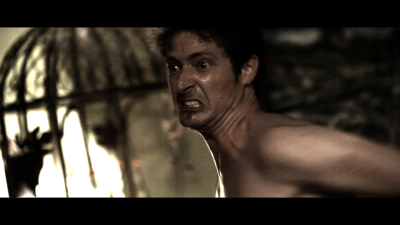
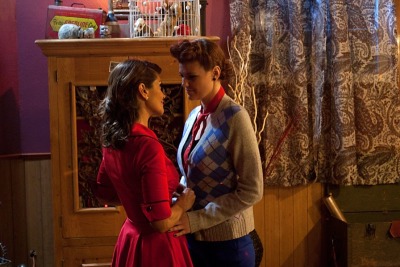
The plot of the film has two brothers and a friend going to a strip club for a birthday party. They follow one of the girls home and talk her into partying with them. When things go wrong with the more socially awkward member of the group, guns are drawn and the girl is shot. Before the guys can flee the girl’s roommates come home and things escalate as the girls hunt the guys wanting revenge and dinner…you see the girls are cannibals.

Wicked mix of humor and horror is a great deal of fun. The film is nicely retro with a seeming complete lack of CGI blood and guts which is a huge plus. I mean I enjoyed the hell out of watching a guy get gutted knowing that it was a really well done physical effects and not computer enhanced gore. As gruesome as it is the fact the props have weight just adds to the proceedings- I mean the way the skin ripples after being peeled back is a detail most films wouldn’t bother with.

Yea, I know that’s really sick, but some of the joys of the film are in the details. For example everyone talks about how the color scheme of the film is done is bright pastels, but no one really talks about how the color drains during some of the nightmarish sequences The bright colors become almost black and white. It’s a great psychological twist. It also gives an indication that had the film lost its humor and had been filmed entirely gritty the film quite possibly have been a complete white knuckle ride from start to finish. I would hate to have to sit through what John come up with on a full on balls to the wall, no mercy horror film.

The film is not without its flaws, largely doing with the budget which keeps some of the scenes looking like the aforementioned Tales From The Darkside. The film also feels so much like the films of the 80’s and 90’s that I suspect that some audience members are going to chaffe at the lack of slickness. While the feel of the film added a charm, some of the reviews I read were bothered by it. (That’s their loss since people should be able to take films on their own terms and not compare them to things they like)

Whether you like the film or not there is no getting around that the four ladies at the center of the film are dynamite. Farah White, Melodie Sisk and Brina Palencia are all wonderful and manage to move the plot along through force of personality. I do have to single out Michelle Sinclair better known as the adult film actress Belladonna as Ginger. Her performance is incredible and quickly short circuits any prejudice you might have about porn actresses playing it straight. Actually the real joy is that how she is here is completely different than she is in Paul Thomas Anderson’s Inherent Vice where she had a small role. Yea she makes an impression in that film but here she does more, she touches the heart as the wronged girl who's shooting cause a shit storm for everyone involved.

This is a solid horror film and it is most certainly worth a look for horror fans, especially with a love for low budget classics of old.

Thursday, May 21, 2015

LADIES OF THE HOUSE: The John Wildman and Justina Walford Interview Part 3

This is the third and final part of my interview with John Wildman and Justina Walford about their film LADIES OF THE HOUSE.

If  you missed either of the previous parts Part 1 is here and Part 2 is here.

Steve: How much did you take into account if the...one of the actors would go, "Let's do it this way, let's do it that way."

John: Well, here's the thing. You know I started out as an actor. I feel beyond comfortable talking to actors about acting. But if you you had four or five people in the scene, each of them would reach that peak performance that you wanted at different times. One of the things I found interesting in directing was balancing each one and trying to orchestrate each one to get there in a different way.

Giving a little hint to one person or giving more of a direct stage direction to another person or having emotional talk with some...everybody who needed something else different. And that was a fascinating process to learn what everybody needed to get there.

But there weren't very specific conversations because of that, because everybody's process was different. Some, had a big need to have a full back history discussion. You know and, um, I saw this, it's somebody...It was like the Louis CK routine where he's talking to his daughter and it's like, "Why?" And he answers it and she goes, "Why?"

And he answers that and she goes, "Why?" And it keeps going. And there were some conversations with a couple of our actors where it was like that.

And you go, "Jesus, how, you know, how much further back do we have to go in your character to get to do this?" All right. And then there were time where in the moment of a scene, an emotional scene, like you know uh one of the actors would go, "I'm just not, I just don't get it. I'm just not there. That doesn't make sense to me."

I think there's one scene in particular, I took three different tacts and it was like, "Well, I'm gonna see if this works on you." And we do that, and we shoot. It is like, "No." And then we talk to, you know, to one of the actresses, again I'd say, "OK, well let's talk about this."

And we'd have this other discussion, and then we shoot it again. They're like, "No, not quite." And then we would do something else. And it was all in an effort of getting that person in the right head space to do that. And yes, you know, those discussions sometimes you know, then took a direction of, "Well, wouldn't we do this instead?"

And you know, and a couple times, we absolutely applied that and it works.

Justina:  I come from theater, so, so theater is a a different process actually even in in pre-production. So for me when I would have a play, I would cast, and then we spend two or three months rewriting together. So actors are actually part of my rewriting process when I do theater.

So it's, it's interesting because I saw that in film actors just go, "I guess this is the Bible." And that's good, because most of the time that it should be the Bible. I think that if we had all the budget in the world, it would be like, uh, we would have like a month long retreat where the actors and the editors and everyone just hung out and talked about it and rewrote the script together.

I thought that will be the most amazing process. No one ever can afford that.

John: Conversations happen before you start shooting, and then a day or two before, or the morning before, or or what have you.

But more often than not, it's happening on the set as you're blocking, and as lighting is being set following that initial blocking. The discussions are really happening there, that you're then applying to you know, pull off that scene.

We shot the film in 18 days. So you're shooting a lot of pages every single day. And in this case we were also combating the deadly Texas heat. I mean, we shot night shoots the entire film, and shot in a studio, and it still was unforgivably hot.

So you're shooting scenes, and in the back of you're mind you're thinking I need to get this scene done, because I need to get these actors off this set and into an air-conditioned room, so then we can set up the next scene, and they won't collapse on you.

So you're not in a perfect situation on a film like this, where you're shooting one scene a day, and you're you know, and you're really, you know, like you know, you know having these these summit meetings of how you can perfectly execute this this one scene or this one moment. You're like going, "You know, I've got nine of these, and that's before lunch."

And as you're watching, you know you're on these headphones watching a monitor and you're going, "Oh, OK great, I got it." Let's do one more just to make sure, but I got it and we can move on. And and you and everything is moving that quickly.

Steve: Did you do a lot of takes, or you just did like you know one, two, onto the next?

John: We do not do a lot of them. I think the most takes we did on one shot was like maybe six. More often than not we were in a happy place of like three or four takes, we weren't doing one take wonders anything.  I certainly did not have the confidence that I was gonna nail it on the first one, and then I was gonna be secure in that.

So there was, there was always an insurance take. And what's also interesting and you say you're fine, a lot of amazing moments that you utilize in the editing process are not even in your filming.

You know, you know people are relaxing or they're just at the beginning of of of a take, or they're just at the end of a take, and sometimes that's where where you find these like little moments that you can work in that you know are are brilliant, and they are very, very happy you know, accidents.

So that's another thing is that you know, you, you adapt to knowing that everything's on the table. Everything could be used at any time. And if you're an actor, then you go "well then I'm not gonna stray to far from what I'm doing performance wise", because who knows what they're gonna capture on camera and you're not able to use it.

And as a director you have your eye on every specific moment, but you're also very, very aware of everything in the background, and everything beforehand or whatever. You should just take it all in and go, "That might be useful. That might be useful. That you know, that works, and this take I'm good. Let's move on."

Steve: Are you in the film? Because if you are I didn't see it.

Justina: Wrong. He's actually in it. He has a Hitchcockian  moment.

John: Yeah.  I'm in the, uh, Crystal's notebooks of her victims if you look closely you can see I make I make it cameo as one of those victims.

Justina: And I, I wrote Lin for myself, but something that I've learned is that you can't be very direct with a spouse if you want to be cast. So, so Farah got Lin.

John: Yeah, so Farah got Lin.

Steve: Are you in the next one?

John: She is, she actually is in my short.

Justina: You're now my manager.

John: Yeah. [laughs] Justina actually plays in the short film I did and I am also in the short film I did. And in fact, that project, one of the, um, one of the goals of it as the experiment was to see how well the shooting process would work if I was actually acting as well.

And, uh, and it turned to off famously. So, so likely either or both of us could make appearances in the next project or the next project after that, yeah.

Steve: Is this going to be, uh, the next one's going to be "Ladies of the House Bounty Hunters?"

[laughter]

Justina: Yes, yes, I, I would like that, too. But I haven't finished the script, so I shouldn't say, but "Ladies of the House Bounty Hunters."

John: [laughs] The next one, the next couple will not be a sequel. Um, but you know, you never know. You know, we could always come back to that world, but, um, but no, we, we have a few ideas, scripts that have already been done that we are anxious to, uh, to take a shot at first.

Steve: Genre?

John: Genre, yes.

Justina: Yeah, I think, I think we've found a home.

John: You know, my thought on getting the chance to make films, is that it's, it's so difficult to get financing, on these for film makers working on the level and the kind of budget that we're doing and what have you, so, the idea is if you do get that money, if you do get someone  who has faith in you, you know, it's a financed film, then, don't just make your version of some film. Don't just go, "Well, this is my romantic comedy" or "This is my message," or...

Go make a film that when you talk about it, when I tell you about it and you go, "I can't wait to see that. I've never seen anything like that," like you're describing it. Make that kind of film because who knows if you're going to get another shot at it. Every chance you get, every opportunity, just seize that and make something that at least nobody can say, "Oh, it's another one of those. Oh, you know. Yeah, it's another cannibal lesbian movie. It's like the fifth one we've seen this year."

Justina: Although actually, as...I was writing this morning. And I actually, as I'm like writing like a tree and like my first, my first skeleton of it, at some point I'm like, "And then they eat the guy...Oh, I already did that once."

Steve: How long does it take to write...

Justina: How lon-, oh, you know, LADIES OF THE HOUSE took quite a bit because we had rewriting and doing table reads and rewriting. I'm the kind of person that when I worked at the theater, I wrote a play like in a weekend, like. So, I'd be writing the first draft usually in about three days. Um, but the rewriting is actually the...

John: Justina can churn them out. When she, when she locks into something, then she becomes very maniacal and jealous over time and, and she's just like nonstop falling asleep with the laptop on her lap. And, and you know, and then waking up and writing more, you know, every moment.

Then I will come in and add my portion to it afterwards. When we tag team, sometimes we can get into rhythm and work very, very quickly. But the time, the extended time, does come in the rewriting process and, and the development process.

Justina: Like the fights and, you know, that type. We need time to fight...

John: Yes. [laughs]

Steve: I can't see you guys fighting.

Justina: Oh!

John: Only on creative stuff.

Justina: I, yeah, I once locked myself in the bathroom. I'm not that kind of person, but there's one time where  I locked myself in the bathroom or the bedroom. So it must have been before I went to New York, where we had a bathroom and a bedroom that had doors. And I just said, "I'm not talking to you."

But I think it's because you said something about how you were Scorsese and I was a newbie or something. So...

John: This makes me sound terrible.

Justina: ...I had, I had to a right.

John: This is...this is, this is a terrible way to present our story...

Justina: ...something about... [laughs] Something about the writing, something about the first draft I did, like...

John:  You know, again  in real life, as I make the quote signs, we never, hardly ever, argue,  but creatively we do. Colors of wardrobes, ... arguments that would, would go to like two in the morning ...

Justina: Our fight, our writing fight is actually"the wizard did it". The wizard-did-it fights are where I'll say, "That doesn't make any sense. Why would that character do that?" and, and he will look at me like, "Well, because it's cool.Because it looks cool, it's going to look cool when I direct it. That's why it's in there."

I'm like, "Well, a character doesn't care about being cool, blah, blah, blah, blah," and basically then we both scream, "The wizard did it," and we, we table it until later.

John: , Justina is unforgiving when it comes to suspension of disbeliefs.

Steve: At the risk of getting punched in the nose or getting your drink thrown at me...

Justina: [laughs]

Steve: I'm going to side with him on one thing. Raymond Chandler...Do you mind if I call up Raymond Chandler on you? They were doing a movie based on a Chandler novel, it was um, Humphrey Bogart and Lauren Bacall, uh, murder, um...

John: MALTESE FALCON

Steve: No, uh, (remembering) BIG SLEEP. At some point in the book one of the characters is shot and when they were adapting the book they didn't know who shot him,  They were trying to figure out who it was when they were doing this script, and they called Chandler up and he goes, he goes, "Why did it happen? Because, because I needed it to happen to make the story go."

Justina: [laughs]

Steve:  That was his story. You had to...like, out of left field. It doesn't have to make sense if it was a good story.

Justina: That is true. However, when you're low budget and you, and you can only do it once...

Steve: Oh, no, no, Only once.

Justina: No more than once!

John: [laughs]

Justina: Now, now, now that's going to be added to our conversation, like this is your Raymond Chandler moment.

John: Yeah, we'll, we'll be talking about this now.

Justina: This is your Chandler moment.

John: Thank, you, Steve. Thank you.

Justina: You get one unexplainable gunshot.

John: We do go through that debate on things where you create a world...Oftentimes with genre films you're creating a world, and you have your own rules and regulations in that world.

And sometimes those rules and regulations stretch the imagination or, you know beg that kind of,  thing. But, as much as possible, you want to at least go, "Well, it's because of this," then you go, "Well, science doesn't really bear that out," and we go, "The science in this movie does!"

You know, you at least have to do that, and Justina is very fiercely protective of that. I'm a little but looser on it because, again, I am looking at it as a movie viewer, as a film fan, like, going, "I'll forgive that."You know, oftentimes, you can do some, some wild stuff and I go, "Alright, I'm fine with that. I'm enjoying the movie. I'm fine with that."

Justina: I think it is...The reason I'm fierce, is before I write the script,  I have an Excel spreadsheet, thats, color coordinated. It has,every beat that has to happen and every emotional thing.

And the reason  is I know that when I make this exceptionally detailed chart of an emotional arc and and character development, and I use "Dungeons and Dragons" alignments to, like, you know, decide how a character reacts to things, I know that as we go down development lane, it disintegrates...

I think it's actually just a way productions work is that, you know, your budget, some things fall away, and then you're shooting and you lose the whole days footage because, you know, lighting didn't work out... It falls away so that by the time you get to the end result, you really only have. this much to work with at the end of the day or the end of the film, and that's why it feels so...

And now that we've done our first film I feel even more protective of it, of, like, no, we have to have everything at the start because we're going to lose half of it and...

John: Right, right.

Steve: Well, I would think if you, if you...If you at least build a strong backbone for the film for everything to hang off, you can do a moment. You know, the one, the one Raymond Chandler moment where, you know, where you can go outside of it as long as it's not too far outside of, you know...

John: Or...You know, and a big lesson we learned on this film also, there's a moment in, in the film where someone escapes, in a situation, and, and because of the way it's set up some people in the audiences go, "Well, he could not have, you know, done that because of this," and you go, "Well, actually, if you think about it, no, that is, that is set up to be, uh, you know, a, a very reasonable thing of how that happened."

And there's an immediate explanation, but, visually, because of the way it's presented, some people are still confused by that even after we explain it. You go, "Well, this person is here. This happened here. That's how that was, that was OK."

And so even when you take great pains to make sure that everything has an explanation or everything has a reasonable science behind it the optics also need to fall in line with that.

Justina: Right.

John: James Brooks talking to Wes Anderson and Owen Wilson, while they were editing together, BOTTLE ROCKET and, apparently there was, there was a shot of  being poured in a cup, and James Brooks told told Wes Anderson  and Owen Wilson, "There better be poison in that coffee. Otherwise, I don't see why you're showing me that damn coffee cup." You know?

And it's, it's that kind of thing where you go, "Everything has to be there for a reason," because, as an audience member, you're going, "Why am I, why am I looking at that?" or, you know, "Why didn't I see that?"

Justina: Until, until you become iconic and then everyone will put whatever meaning onto it that you want.

John: Yeah, we've got, we've got several films before that happens.

Justina: Yeah. That, that'll be exciting.

John: Yeah.

Justina: I just read a whole thing about...

Steve: I always thought that all youneed is a big enough and you're iconic. That's all. You know, that's all. Give THE LADIES a little bit of time, OK, to get some traction.

Justina: Yeah, that's right.

John: Yeah, cult classic.

Justina: Cult classic.

Steve: [laughs] Hopefully that's this.

Do you have something planned where you go much darker?'Cause you balance the humor and the lightness, a lightness and a darkness. Is there a point where you would just throw all the lightness away and just go balls to the wall hard?

Because I'm sitting, I'm watching the film, and that was the one thing where I'm going like, "If this didn't have the humor, if this was played straight I'd walk..." If you did wash out the color, the color scheme and stuff, and you did this straight this would be almost unbearable at times.

Would you want to do something like that?

John: Well, I mean, I...I think the situation would dictate that. Justina and I have a specific sense of humor,  each of us do, that just kinds of comes out of our pores.

So  it would take an effort in what we write, let alone what we, what we shoot, to excise that. Now, in some specific instances, yes, I think, you know, there are moments of dread, there are moments of relentless terror, that, you would want to do that, and I would want to do that, but there would be specific moments.

I don't know what the idea would be where we would just put an audience through that, you know, just keep hammering at them.

Justina: In drama writing when you go into a dark place or a sad, or a very sad place. And you create characters that will react in a human way, at some point, the character needs a joke. The character will say a joke.

But even as a writer,writing the dark scenes I get too  depressed or too scared and I need a joke. So I think I couldn't help but put something in there that would I would say in that, at that moment if I were in that moment.

John: Yeah, I think a couple of the, a couple of the likely suspects that will become our next film, are  filled with characters that entertain us...um, and, you know, and some are badasses, some are cruel, uh, you know, terrible characters and some are cocky bullshit artists.

They're personalities that we want to see on screen, and they're personalities where parts of them come out of both of us in, different characters. And that, that's why I think it, it's natural for us to write either a funny thing that comes out of somebody's mouth or write a situation that has an absurdist humor to it because that's inherent in us.

We have a friend, who is also a filmmaker and  she doesn't have this about her, and, and we kind of, we kind of chuckle to ourselves sometimes. When we're visiting her or vice versa or seeing her at a film festival, you know, we're always amused when we have conversations with this woman because she does not see the humor in that way.

And so when she talks her projects or the themes, you know, our natural inclination is to make a quip or say something, and it'll either go completely over her head or there will be a complete lack of appreciation for the funny that we've just made, because she is deadly serious about what she's talking about. And we talk about it afterwards where we go, "Holy crap! I was just kidding!" You know? [laughs] And, but, but that's the thing is, you know, for us, it's just a natural thing.

Justina: Yeah.

I feel like just we're bombarded with serious horror and, and dark...like, like...

Was it THE BUTCHER that we saw? That I was like, I was just like, "I can't. I can't keep watching," 'cause it was just like, it's just like butcher scene after butcher scene after butcher scene.

Steve: I didn't like it.

Justina: I can't, i can't keep going with it because I'm kind of like, "Can I take a break for just one, one scene?" [laughs]

John: You're an audience member. We can place you or you can be placed in a terrible, terrible, unforgiving world. But, at least for me, I want some kind of hope. Now, I may be thwarted, but I want some kind of hope that I can get out of this thing, you know, because, otherwise, yeah, you're signing... You go, "OK, so let me understand. So I'm signing up for two hours of unrelenting misery and unforgiving torture and, terrible things, and I'm going to pay you for this. What's going on here?" You know, I don't know how many people want to take that.

Justina: Well...I wouldn't mind if they're like MARTYRS. Like, I guess that kind of underlines I kind of would enjoy.

Steve: 'Cause to me, MARTYRS to me is I different...I hate movies where it's essentially torture porn, but there's a point at which MARTYRS flips and you suddenly go, "There's a point to this!"

Justina: Yes.

John: Exactly, there's your difference.

Justina: That I could get into, yeah.

John: There's your difference where you go, "OK, all of this does have a rhyme or reason." I think that is your clear difference. Even FRONTIER(S) which is just a batshit crazy movie, [laughs] even that one, you have moments where it's a terrible, horrible, horrible thing that's happened, but it's so absurdly gross and so absurdly terrible that, that there's almost a humor to it.

Steve: Oh, yeah.

John: You know, INSIDE is, is like that where you go, "Really?" Like, you know, you go, "You had to do that?!" You know? And, and, again, you know, it's, it's a, a monstrous, destructive, overwhelmingly bad thing, but it's so monstrous and so destructive and so overwhelming that there's actually a humor to it. You go, "Oh for heaven's sakes! Well, what are we going to do now?"

Steve: Yeah, it's like, "Alright,"...The ridiculousness of over the top, you know, where are you going with it? [laughs]

John: So, you know, again we've got lots of ideas, we got a lot of stuff that,we want to follow this one up with and like I said, LADIES is a very good introduction into what is in Justina's head and what is in my head. But that's just the introduction, you know, so...

Steve: And I'm still talking to you!

[laughter]

Justina: Just stay in public places.

Steve: Yeah, that's just where I'm going. When we were setting this up I was  was like, "Where,  am I going to meet them and what's going to happen? Will I ever be seen again?"

Justina: [laughs]

Steve: Oh no.

John: That's right. Keep it public places. Keep people around.

Wednesday, May 20, 2015

LADIES OF THE HOUSE: The John WIldman and Justina Walford Interview Part 2


This is the second of the interview I did with John WIldman and Justina Walford concerning their film LADIES OF THE HOUSE.  (The first part is here) 

We pick up here after John explained how the effects people walking off with their weapons forced a change in a fight scene.

John: But, you know, you have to make those choices.

Justina: But also, you know, I come...My big influence is Tarantino as far as dialogue. Like, I love Tarantino-style dialogue and I come from theater. So theater is always dialogue and monologues in many of the first, scripts...And we wrote a lot. There's tons of versions of it.

Buteven after editing that script down and making it through pacing, after we shot, we realized there was even more to trim. So there's things on the cutting room floor that were  really funny or more character-driven. That we, we took out because we needed to actually get  to the depth.

John:  So we had to edit out speeches. We had to edit things,Our editing process, our post-production process took like a year and a half. It took a while because we had edited together version and it just didn't work.

The ending we had just didn't work because it was a traditional ending. It was a much more of... if a studio had done this and what have you, it was the ending that they would have had.

But it just didn't work for us and, um, Justina and I and Farah White, the producer, who also stars as well in the movie, and James Taylor, our editor, and he did an amazing work as far as helping us come up with something that was actually more honest to what we wanted originally.

Um, but not something we ever intended in writing as far as what the ending was. And, you know, and it, it saved the movie, frankly.

Steve: Are you happy, are you happy with the...I'm assuming when you put it out, you were happy. So, are you, you know, you know, you...

John: I'm, I'm very happy with it. I mean,  on a debut feature you have so many things you could just go horribly, horribly wrong. And you also have so many ambitions for the, the magnificence that, that's all going to be. And you know, if you had any kind of practical self awareness at all,  you know you're going to fall somewhere in the middle.

And you hope you're going to fall on the high end of the middle as opposed to the low end of the middle. And I'm very, very happy with the movie. I'm, I'm thrilled to death that this is our first entry and that this is like the introduction for people to what Justina and I...what's in our heads, you know...

Justina: And, and we learned so much from it that the next one, we'll like take that with us as a, it was such a learn...it was such a learning experience. I'm just, I'm just really happy we didn't kill anybody, um, that no, that no one, no one died and, um...

John: Yeah, no one died on set, yes.

Justina: And no...yeah, no one's career was ruined. That's all, that's...I was happy about that.

[laughter]

Steve: Did you know the actors before?

Justina: Some.

John: Yeah, some,  they came from all different places.  Farah, of course, I had known for a while, I literally met her on my red carpet at the Dallas Film Festival. And,  and, befriended her and  we became friends. So I knew her.

Brina Palencia, who plays Crystal, ...early on, when we're going to make the film,  we were going to cast her and I was very excited. Uh, Samrat Chakrabarti, I knew from being the publicist for the Indian Film Festival of Los Angeles and so I was friends with him and had wanted to do something with him.

Gabriel Horn, also met from the Dallas Film Festival,  Reallythe only two people that were kind of late to it, to additions, um, was Michelle Sinclair, um, or Belladonna. Uh, and we met her through a friend of mine, Don Lewis, who is a, writer, journalist, and producer.

I was at South by Southwest with him, waiting for a movie to start. And he goes, "Guess what I'm doing." And I go, "I don't know." He was, "I'm playing Words with Friends with Belladonna's husband. That's weird, huh?" And I go, "What?" And like a week later, Justina and I were in Michelle's living room talking with her and her husband about her being in the movie.

That happened that quickly. She was onboard immediately. We love her to death. She is just the best thing ever.

Steve: She's fantastic.

John: She, she's...

Steve: I mean, she breaks your heart, you know, just it's like, "Wow!"

John: Oh and easily, easily, no debates, the most popular person on the set. Just the sweetest, most wonderful person ever.

Justina: Yeah, so sweet, we had actually written the character to be quite, like evil. And, like as soon as we saw her like perform, like I was like, "No, she's the that character and not evil. She's just like she exhibits too much."

Steve: She's just so sweet, just whatever, it just...

John: And then, the last addition was Melodie Sisk. And we had originally another actress in the role of Getty. And, and that actress had to drop out, uh, very late. And Farah knew Melodie. They'd become friends at the Sidewalk Film Festival in Birmingham. And Farah got in touch with her.  Melodie, like within a day sent us a video of her doing lines from the movie.

And like maybe two days later, we were sitting opposite her at dinner basically saying, "You're hired. Next week, you're on the set." And she's amazing. She was also a lifesaver. Mel-, Melodie Sisk, I mean she's getting notices and deserves like the great great rave review she's getting for her  performance.

Steve: How fast did it come togeth-, how fast did it...once you started, when did you said, "Let's do this?" I mean getting done the whole thing done

John: The whole thing?

Justina: We had some false starts with financing.

John: We...started to make the movie and we're in pre-production and we hit a roadblock at half of our financing. Because we got half of the budget, we just could not score the other half. And I did not want to do that situation where, you know, you're on the set and you're talking to your producer. You go, "We have to shoot this scene, but we can't pay anybody tonight."

You know, and that nightmare. And it always sounds romantic and exciting after the fact,  I didn't want to be in that situation. You know, nobo-, you know, nobody wants to do that, so we shelved it. We shelved the entire thing. And we're back to the drawing board.

A year later, we had another script. We were now...we got the money to make that film. And we were in pre-production and discovered that we needed some additional money. Like we're having...we had our budget, but we weren't going to be able to pull off the movie we were hoping to do.

So, I, we were talking to Farah about going back to our executive producer, Ruth Mutch. And, asking her if she could finance more of the film. And Farah said, "You know, Ruth likes this script, but she loves the other script." And so we immediately, like within moments changed.

And with like a month to go, we changed the film we were going to make, went back to the original film which then was LADIES OF THE HOUSE

Justina: Yeah, so if, if Ruth had not said, "I really like that LADIES script," it would probably never have been made. It would have been something totally different. For which I'm glad because I really like the script a lot.

John: Yeah, yeah. So,then we shot the film. And then it was about, like I said, about a year and a half editing process. And I would say all total is about maybe five or six years from when we, when we went into pre-production originally to now. So...

Steve: You had the screening at the Film Society [of Lincoln Center] like a year ago, two years ago?

John: Two years ago, yeah.

Steve: How was that? I didn't get to go because it was too late at night. I wanted to. Was that a different...

John: That's a different go. Yeah, we, we did, we did a handful of test screenings and, you know, and made adjustments along the way based on those...and some were like literally six people in our living room.

Some were like that, where we actually put a screening together and had about 25 to 30 people. And you know, and every time people filling out forms and questioning, and reanalyzed that stuff.

And it really did help us...it really did help us shape it. And you know, and it was, it was also, it helped us find how people were emotionally invested in various characters or what things confused them, you know, that, that type of thing. I remember at one point, um...and it was just one person, but it was, it was, it was hilarious.

They basically said that...it was like in these gold like letters on the sheet, "This person must die. You must kill him. And he can't just die off-screen. You must kill him on screen." You know. [laughs] And we're going, "Holy crap!" [laughs]

Justina: That's an unlikeable character.

John: Yeah, that person really does not like this character. But that's...you need that becauseyou're living with something for so long as you're developing it and you're shooting it and you're editing it that, that you, you can forget,...

What can make somebody else walk out of the room or what somebody can read into another character, in the film and go, "I really like that guy." Or you know, "I was totally digging that, that woman." You know, and those are the things that tip you off to go, "Oh, I see where this is playing now." And you know,  that really did educate us quite a bit.

Steve: (to Justina) I know you John is listed as director] . Were you there like every moment co-directing, or did you let him alone?

Justina: I'm a spouse, so I have to stay away sometimes. I was only there for, uh, I think a week and a half. And there was actually one day, where it's like, I'm too neurotic. I was going to leave today. Because there're certain times where like certain scenes are shot, where I was too like, "Don't do this, don't...make sure this happens,"  , I had annoyed my own self, so I left.

Steve: Could you, could, do you think you could direct it for him or is it...because I know you've done theater...

Justina: Yeah.

Steve: Which is so, which is so, which is...I know how does it feel, it's different.

Justina: It is. I just started a short film that I wrote, uh, so, yeah, and that's when I learned like, "Oh, this is really like different from theater." Because I love directing theater, but it's such a different beast. So, uh, I'm definitely learning from my short films .

John: Yeah, last year...we were hoping to shoot our second feature last year and things didn't come together. And you know, and we had vacation days saved up. We had, a little money saved up, you know. And so I shot a short film and Justina AD-ed for me. And then Justina shot a short film and I AD-ed for her.

Andthe idea for Justina really was, "OK, we're going to do a couple of these to warm you up so you can direct your feature."

And  we specifically  put her in a place where, you know, there was every support that she could possibly have between myself and the DP and, the other people there.

She could relax into, "OK, this is how, you know, this is how I direct my script and this is how I do this." You know to...and, and we want to do another one of those also. But I would say, you know, as we go on, you know, I could easily see a scenario when I'll do one and she'll do one and I'll do one and she'll, and she'll do one like that.

But I will also say that on this film I was the director, but every aspect of the film is partnership between the two of us, and it would be ridiculous to think  that her influence wasn't in every scene.

And you know, what I mean, you know, from, from wardrobe to the editing process, to decisions on color schemes, like all of that stuff.  I've said this before, but  I romantically like look at this as like maybe, you know, in the future, if we, if we've done enough films, to have that kind of thing of like Bogdanovich and Polly Platt, you know?

Justina: I'm Bogdanovich.

John: Yeah,  she would be Bogdanovich. I'll be Polly Platt. But I've always wanted to make it very, very clear to everybody that the two of us are doing this. And, and how the roles or, or I'd say how the titles, you know, fall is not really that important to me.

When you're on the set sometimes it's easier for everybody to have one person to focus on as far as,  whose lead do we take. But, you know, the truth is I would also put Farah, our producing partner in this, as well, that, you know, every...the decision that we make production wise, we're each weighing in.

And, you know, and it's not a thing of  Justina or Farah are giving me ideas and I'll go, well, "That was OK. Maybe I'll do this." You know, jettison it. It's actually a conversation. And, and oftentimes, knockdown, drag out debates between us of like going casting wise, it has to be this person. Or hiring this production person or you know, this DP, or what have you.

Justina: Yeah, there's actually a strange overlap between director and producer, right? So like Farah and I very consciously wanted to make sure that John was the director. For something that's low budget, directors are often distracted with producing. And so we were trying to pull that from so he could focus on directing. And, there's times where that is the focus. Like casting, is that producing or directing? Like at some point, like, you know, we go, "OK, we're going to go this far what we believe is best."

And then, but John gets, you know, the final say on cast and crew and vision and you know, do we need yellow towels or red towels on the set.

But  I think, for me,I love producing much more. So I love getting the, this stuff done.

John: I got a very good example of this. Um, early on, in the editing process, I was not going to include nearly as much nudity as is in the film. And, and I had, early on, this idea of, um, it, the majority of the nudity would actually come from the guys because it's a women's world and, and I wanted to flip the script.

And Justina and Farah and actually Melodie as well, all three basically ridiculed and made fun of me, and, and, you know, for being a boy scout and said, um, "No, you know, if you have women that look like this, then goddamn it, use them." You know.

Justina: Well, it was Farah and Mel- "If you have a woman like me," you know, like, Farah's like, "If I'm looking like this, you can use that." Um, but I think...yeah, but for me was more like, "I understand the philosophy behind that and the metaphor and the whole, the man naked and the woman clothed."

But here's a thing, the men don't want to get naked, and the women do, so, what are we going to do with that? And that's, yeah, those...

John: And so, and so what you get in the movie, uh, you, you can, you can thank Justina and you can thank Farah and you can thank Melodie.

Justina: You get one boy butt.

John: You get one boy butt. [laughs]

Steve: You know what the terrible thing is? I don't remember any of the nudity. I really don't because it just it's like...it's not...it's like fortuitous. It's not...

Justina: It's not like someone talking on the phone and behind them it's like boobs coming by.

Steve:  I remember the movie. I remember the story. I don't remember..

John: You know, I talked to each of the actresses beforehand. And, and I put it this way. I said that, "Nothing aggravates me more as a film goer that when you have that scene where like a married couple or, or a couple, they have sex, and immediately afterwards, the woman is pulling the sheets up to cover her."

Because I go, "Because I know, yeah, that happens all the time between married couples." Wives are constantly covering themselves up after sex with their husband." And it just, it just...

Justina: I used to take the whole bed with me.

John: Yeah. [laughs] It infuriates me. And I said, "So, I wanted to, you know, to approach it as if...you know, if you would be naked, you know, in that situation, you'd be naked." I said, "But that doesn't mean I'm going to put a key light on your breast. You know, I'm not going to be doing that."

The other thing is I think oftentimes, um, American produced films, there's almost like as scoring card or like a checklist of like topless shot, bottomless shot, full frontal. And they're really checking things off, as opposed to, well, that would happen or that would not happen in the context of the film.

And I said, "That, I definitely did not want to do." And I think, uh, you know, another very, very good, good example is the scene between Crystal and, um, and Jacob, where we'd actually originally written it to have more nudity. And as I was staging it, I, you know, I came to an idea that actually we didn't need to do that.

And it would be very cool to do it a different way. And Brina, I believe, was actually surprised because it was my idea, not...It wasn't her idea, you know, to, you know, to, to take that kind of turn with it. Um, but yeah, that, again, thank Justina, thank Farah, thank Melodie. [laughs]

Justina: For the few seconds that...

John: For the few seconds you get. [laughs]

(The final part of the interview is here)

Tuesday, May 19, 2015

LADIES OF THE HOUSE: The John Wildman and Justina Walford Interview Part 1


Here begins a report of my talk with Justina Walford and John Wildman about their film LADIES OF THE HOUSE. The film is a horror/comedy about lesbian stripper cannibals. It’s very good and highly recommended (my review is here).

I went into the talk uncertain of what would happen. This was the first time I was talking to someone I know, I know John, but I hadn’t met his partner in crime film and life Justina so I wasn’t sure how this was going to play out. This was also the first time I was going in without a time limit. They didn’t ask for one and I didn’t suggest one. I was willing to see where it went… And went it did, the better part of two hours as John and I started talking before I turned on the recorder and then for twenty minutes after. Somewhere in there I recorded 80 minutes of material before I realized it was getting late.

What follows here and in two more installments is pretty much the entire talk. I have been trying for over a week to chop it down but I couldn’t do it in a way that left me happy, so I’m giving pretty much everything to you. That the interview works is entirely the doing of John and Justina who are just fantastic people to sit and listen to. They nailed it. I on the other hand just asked an occasional question and listened to what they said. I wish all interviews were this easy and enjoyable.

While there were some deletions, mostly having to do with things people and things that would mean nothing to you out of context, nothing of value was lost. (Strike that- I had to remove the talk John and I had about the difficulty reviewing a friend’s book/film/art because when I started the recording we were winding down the talk so a large portion of it was lost to the wind)

As I turn you over to the talk I want to ask you to ponder how such sweet and lovely people could make such a horrifying film.

I also want to thank John and Justina for taking the time to do this.


Steve: I have to start with Joe Bendel's question. 'Cause I asked everybody, I said, "I'm talking to you. What was the thing?" And Joe being a smartass, goes... how did he phrase it? "Is the film based on personal experience, and do you have any recipes you want to share?"

[laughter]

John: You had to ask. I know. I do.

Justina: I can give it to you, a TMI answer. One of the ladies is based on my mother, Lynn. My mother's a wonderful person, and she doesn't eat people, but...

[laughter]

Justina: ...but, uh, let's just say a therapist would have a field day with the, uh, Lynn character and my mom stories, um, and, uh...

John: So there's a little bit of tiger mom.

Justina: And, and, at first...A full tiger mom in my mom and in Lynn, and, uh, and then I think, uh, I have known quite a few Crystals.

John: Yeah.

Justina: , I'm hoping you guys don't 'cause that would because, if so, I'm sorry.

John: I think I may have dated a few Crystals in my day,  but, that, all that being, being said the idea for the movie was Justina's. We were trying to come up with something to do together. Because we had both done a lot of theater before we met one another, and we wanted to do a film together, because, you know, we just couldn't get enough of spending time with each other. We wanted to do that, too.

And the stuff that we had written before, screenplays, it just didn't quite work, and Justina, kind of half kidding, a lot out of frustration, said to me, "OK, cannibal strippers," and I said, "That's it. [hits table] That's what we'll do. "

"If you write that, I will figure out a way to get it made." And, after a certain point, she started the script and, and took the lead on it and, after a certain point, I joined in with her to, to work on the script, but that's how it all began.

Steve: Because of...

Justina: As a frustrated joke, frustrated with life.

Steve: You know that's, that's how a lot of stuff starts.  I'm going to  bounce all over the place with this.

How did you decide, how did you decide to just use physical effects?...Because I don't think you used any CGI.

John: None at all.

Steve: How did you decide? Because everybody goes to CGI now. Why? Was that, was it a cost thing?

John: You know I have no experience with, with CGI, and I also greatly respect practical effects. And, budget-wise, we wanted to keep it very, very simple,very specific. I mean, in the original draft of the script, we had some more adventurous things that we were going to do that we cut out or adapted because of, of the lack of funds. But, effects-wise, you know I early on, uh, spoke with, um,  Marcus Koch , from AUTOPSY, who I knew from genre conventions  and was a friend. And  I showed him the script and, one, wanted him to do it, and then asked him, like, "You know, well, practically, what can we do?"

And we went through every single thing and he said, "We can do each one of these, you know, in this way, and it would cost this much."

And I said, "Well, OK then," and I just felt much more comfortable having it right in front of me, being able to direct it and not in my head go, "I hope that we'll be able to make that look like something." You know, that just worries me.

In fact, we have a script right now that, that Justina's working on, that's a brilliant script, but it will involve CGI, and I kind of want to get another movie under my belt...before I hit the CGI. Yeah, I want to do one more movie with practical effects.

Justina: He listens to CDs, so CGI is very high-tech for him.

John: I'm the grandpa when it comes to technology.

Steve: [laughs] Can, can I ask you how old you are? Because it's like the weirdest thing is when I sat, when I realized who you were in SORORITY BABES [In the Slimbeball Bowl-a-rama] and I'm going like, "How old were you, five?"

[laughter]

Steve: You know, because  I managed a video store and that film was like a perpetual renter.

Justina: So we're rich.

Steve: It was the title, and it was just...Everybody's like, "I have to see what this is. I have to see what this is." I'm, I'm sorry to make you feel old.

John: [laughs] Yeah, yeah, that...SORORITY BABES IN THE SLIMEBALL BOWL-A-RAMA" will haunt me till the day I die. Um, uh, I, I am 51.

Steve: OK, you're my age.

John: So...And, and, I, yeah, I...That was one of the very first things I did when I came out to Hollywood, um, as an actor, and I instantly did a handful of films like that, uh, DEADLY WEAPON, LEATHAL PURSUIT um, SORORITY BABES,  FINAL CURTAIN I mean, it's sort of like 80s action or horror movie Mad Libs, where you would put one word with another and you'd make a movie out of it.

But I did that. I had like a year and a half where I thought life pretty much was you acted in a movie, and then you went and played some basketball or went to the beach, and then the writer of that movie directed a movie, and he hired you for that. And I thought pretty much that's how everything's going to work out.

They all came out at once, and some of them became cult favorites, but most of them...

Steve: I've seen a lot of those.

John: ...most of them, like, got thrashed critically and, I got work elsewhere. I stopped acting because of that. But, um, but, yeah. SORORITY BABES has, has a following.

Steve: (to Justina) Have you seen it?

Justina: Oh yes. Yeah, actually, when we started dating, I, I Googled him, obviously, and so I was like, "OK, so either he's actually Canadian and he's done these like, ..."

John: Humongous.

Justina: Yeah.

John: Yeah, that was a Canadian.

Justina: .."or he did some really bad B movies," and then of course I had to watch them all.

Steve: You still talk to him. [laughs]

Justina: I still talk, yeah.

John: And, yeah, and she still called me back.

Justina: Something about that was appealing to me, yeah.

John: Says a lot about us.

Steve: John makes a big deal out of saying that your date movie is OLD BOY

Justina: Yes. At least it's not AUDITION'cause that...

John: Yeah, yeah, exactly. At least it's not AUDITION

Steve: Yeah, that, that I would be worried about.

[laughter]

John: Yes, yes. OLD BOY is our couples movie. Yes.

Justina: I think...I mean, when we started dating, like, he, he's, he's not a big book person and I'm a, I'm a huge reader. So I have tons of books, and he had, like, only like five books on his shelf, and, uh, one of them was "Geek Love."

And I remember being like, "I have to date him if one of his favorite books is 'Geek Love!'" And then I think the next time was, uh, you had a poster of SECRETARY on your wall and I went, "Oh, this guy's perfect for me!" So that...And then OLD BOY was pretty much, like, after we started dating.

John: Yeah, there you go. That was the trifecta.

Justina: That was a romantic thing.

John: Geek Love ,SECRETARY, and OLD BOY

Justina: Yeah.

Steve: I don't know where to go with that.

[laughter]

Justina: And we seem so sweet. Like, we don't, I mean, we don't, you know...Look at us.

Steve: Wellthat was what he said ...It was, it was, it was at a screening, and I remember him saying that and just, like, every head, like, snapped!

Justina: [laughs]

Steve: It was like, "John? OLD BOY?"

John: Yeah we did the different presentation of the way that we look versus the movie, and hopefully movies, that we'll be making..

 I love it...We've gone to a few genre conventions, not, not as guests but just, just, you know, as, as fans or whatever, and, you know, and, and, we dress the way that dress, you know. You know we're not in the, uh, you know, the black thrash metal t-shirts and, uh, you know, and, and, and things like that...

Justina: Not always.

John: Well, not always. I, I don't, yeah. Um, but, you know...And yet that...We just love genre films. We just love 'em.

Steve: Well, that, that's what I love about, "Ladies of the House," is it so much like other genre, you know...It's, it's, it's a throwback to a lot of the stuff that was like currency in the 80s this stuff.

John: Well, you know...

Steve: Was that intentional?

John: Absolutely. Absolutely intentional.  I mean we wanted. to make a loving homage to that style and because we also knew that doing that would give us a, a, a surreal kind of home and platform to do the, the kind of stuff that we do in the film.

You know so, oftentimes horror films have this kind of brownish, uh, grungy, gritty, you know. kind of dirty look to it because there's a horrific aspect of that, of thinking that you're, you're in that kind of world and, and, you know, and it's just dirty and,bloody and, gross. And that's  certainly is effective, but I really and, and we really did not want to stylistically go there 'cause, because people do that very, very well. Plenty of people do that just fine. You know, they don't need another one of those.

But what we want to do is do this thing that is, that is candy colored, you know, kind of '50s, '60s, you know, kind of thing. And, in that, in the strangeness of it, set in our world, that would be horrific on its own, and hopefully that, that, you know, that works.

Justina: And I think my fandom is really '70s horror films, like I was raised on Elvira, Mistress of the Dark. And so what I know is actually that decade, like, you know, basically like the '60s, '70s horror films, and then I...There's some, for some reason a gap for me, so I don't really have a lot of late '80s and '90s stuff in my head, and then it goes straight to Asian, Korean and Japanese, horror.

So, really, I am actually more accustomed to, uh, a certain style or a certain look, you know.

Steve: Was that just because you just didn't watch...like, you know...

Justina: Yeah,  I started, working more and missing out on movies. Like, I mean like, the '90s mainly is what I missed out on. And my movie tastes kind of changed, moved away from horror.

I don't know what turned me off because when I was a child, I was, I dragged mom to Romero films. Like, the first director I became consciously aware of was Romero, so I loved horror as a child and then something happened for a decade where I just went, "Ah, I'll watch romcoms." I don't know what happened. But now I'm back, so...

Steve: My turnoff once you got in the '80s was you had these mad slasher films, which were just endless. Like, that's where it's like...I drifted away for a while for myself.

Justina: Yeah

Steve: But it was the sameness thing.

John: And you also, and you also got to a, a trust where your franchises became the primary direction of horror. Your "Friday the 13th" franchise, your "Nightmare on Elm Street" franchise, your "Scream" franchise, and those really took over as the bulk  of the horror  and genre as far as mainstream films, as far as studios were concerned.

So, yeah, there was a period where occasionally you would get, you know, THE FLY  You'd get some, some kind of thing that would blow your mind, but, more often than not, you were still stuck in, well, here's the next film of this series. Here's the next film of that series.

I think because of the,Japanese and Korean films... and  that wonderful series of films from France, that you had with INSIDE and FRONTIER(S), MARTYRS and, uh, HIGH TENSION...  that kind of opened the door up quite a bit for more adventurous filmmaking here.

And I think we still will see more in the way of the films in the last few years, BABADOOK ,  now IT FOLLOWS last year's THE GIRL WHO WALKS HOME ALONE You know, with horror and genre being used in different ways.

I've been really enjoying the, the fact that a lot of people have been getting a lot of different things out of LADIES. You know, that it hasn't just been one set interpretation of what were trying to do, and many influences cited, um, some of them are absolutely correct. And some of them I'm going, "Well, that wasn't exactly our influence, but I'm happy to, you know, have that in a hopper now."

Steve: Oh, so, so you get the whole thing with the unconscious. If you were willfully aware of it before, you're going to pull it in. You're not going to know where you pulled it from.

John: Absolutely. Absolutely.

But I'm thrilled by that because the one thing that we really, really wanted to accomplish is to create a film that you couldn't just jettison from your subconscious immediately after seeing it. We wanted a film that, when you left the theater, you were still, it was still working on you.

You were still thinking about it. Either you had to debated with it, about it with the person you came to the theater with...You know, you had to talk about it over drinks or, or the next day you were still thinking about specific scenes.

We wanted that kind of film because that's what we like. Those are the films that, that really get to us, those films that, a week later, we're still going, "That thing! What was that?" You know, that. That's what we want.

Steve: I feel bad because it's like I saw the film...The first time I saw it was weeks ago, before Tribeca, when you sent me the link. It was that night. It was like, "I'm watching this movie. I have to watch this movie." And I watched it. But no one else had seen it, everyone else I know who saw it did so in the weeks after that... And I feel like I missed all this time to be able to talk to anybody about it.

John: [laughs]

Steve: There's nobody to show this to. It's like, "Ah!"

Justina: [laughs]

John: Well, that's the thing, you know when you have  a film that, you know, has a VOD release as, as opposed to a theatrical release, you know, you hope that that kind of network develops between people like yourself.

And, you know, whether it be journalists or whether they just be film fans or what have you, where that, that does circulate and where it does become part of the conversation.

And I think it takes a little additional work on,the part of the filmmaker to help to it to live  and to help push that,in those areas where the access is such that that can develop.

You want you and, Alec Kubas Mayer or Joe Bendel. You want you guys, you know, at a screening going, "I love this thing," or, "What the hell was he thinking there?" You know? You want that kind of discussion, but you also want fans to do it because then you know, if you do, then it does live and, and it does continue beyond just that initial release weekend. And then people, you know, a few months later, a year later, they're still referring it to people, and then it does become this thing that goes on and isn't just, like, shelved away and, you know, done, on to the next one.

Justina: And the difference in what you are saying, there's, like, Third Screen is calling it a comedy and there is some who call it, one who's called it a drama and more people call it a comedy.

Is it a revenge film or is it people-stumbling-into-a-bad-place film? And I really think that it's almost a Rorschach test for the audience member, 'cause it's like if you call it a revenge film, why are you calling it a revenge film? Because there's not really any revenge. Those guys would end up those guys no matter what  they did while they were in the house. So, like, if, yeah...Oh, piglet, you know, somebody asked, "What does piglet mean?" and, uh, I was like, "Well," I was like, "Whatever you think piglet means is a lot more about you..."

Steve: [laughs]

Justina: ...and even we don't agree on what piglet means, so...

John: Yeah.

Steve: It just is something that came out of...

Justina: It was something that came out of our, our brain.

Steve: [laughs]  Jumping backwards to the thing about what is the film is, it's like  Is this a feminist film? Is this pure exploitation? Or are you just throwing it out there and just, you know, which is what it seems like you're doing. It's like, "We, we made this film. You decide."

John: Well, I...Ultimately, yes, the audience, the audience member has to decide what they think the meaning of the ending was, who they were supposed root for, what piglet means, you know, or those, those kinds of things. Ultimately that's in the hands of the audience.

We definitely had a specific intention and a specific intellectual idea between every single thing that we did and the choices we made in the writing, in shooting it, in editing as far as what we wanted. But, with that, you still, I, I mean, it, it still delights us to no end.

You know, when one person says, "Well, you know, this clearly is a throwback to the British,films of, the late 60s and the 70s," and then somebody else says, "Well, this is clearly an application of the Dionysian, uh, you know, Gree-, Greek legend," you know, and then someone el-

Justina: That's giving a lot of credit.

John: Yeah, exactly, and you have all these different things and...It makes us giddy to read each one of those different takes 'cause you go, "I'm fine with that. You know, if that works for you, I'm fine with that."

Justina: Yet specifically is a feminist, is it exploitative, I would say, "Is it feminist? Yes. Is it exploitative? Yes," and there are plenty of women who will say no to the first one and plenty of, of people who would say no to the second one. It's not exploitative enough. There's not enough gore, there's not enough boobs, there's not whatever.

I am noticing that my female friends are introducing me now as a feminist filmmaker, as if that's something really unique, and I think, you know, I'm just a feminist who made a film, made a horror movie, um, but you can't help but get that in there.

Like, I can't help but give, my point of view in the script,or my experience with the script,...

Steve: How, how, how much did you change from, like, what you wrote to what you, to what you filmed to what it ended up cut as?

John: Quite a bit of changed.

Justina: Yeah.

John: Our original script was [written as] if we had not unlimited money. But we had plenty of money to do some very, very cool flourishes and effects and, and then that changed with, with budget and, and we had to make decisions and say, "Well, listen, we, you know, we can't afford to build this elaborate set or this kind of thing."

"If, let's just say we happened to be cannibals and we had to do it in our home, you know, how would we do it?" And, and you go, "Well, we, you know, the DIY method would be this," and we go, "Well, that's actually more horrific anyway, so that's what we'll do." And so you make those choices.

Then, during filming,you find out, like, limitations of, of actors. You find limitations ofsets. You know, things happen...

I remember we were shooting one scene and it was a precursor to a big fight scene and, and I'm preparing to, to, to, uh, uh, to stage the scene and somebody came up to me and they said, "The effects guys have left and they took all the weapons," and I go, "What does that mean?"

And he wouldn't even answer me. He said, "I'll show you," and he took me out, and on table were some bungee cords and, uh, uh, like, a machete, and an axe.

Justina: None of which are written in this.

John: And I turned to him and I said, "There's not even an axe in the script!" And he said...He goes, "I know, but I found it on the set."

So I had to go back...Now, mind you, everything had been storyboarded. Everything had been choreographed specifically when it came to those fight scenes and everything, and I had to change everything because we still have to shoot this scene. We didn't have the weapon that was going to appear later, so I said, "Well, I'll take this and I'll take that."

And, the next day, Justina and I got to the set early. That's where the office is, next to the set. And the two of us were in the office basically fighting each other with the weapons that we had, figuring out how we would do this fight scene.

Apparently one one of the gaffers came by with one of the PAs and they passed by us, and they're,  watching us, and, and I was told this afterwards.  the PA said, "What are they doing?" and the gaffer said, "Well, they're married."

Steve : [laughs]

Part two of the talk can be found here and Part three can be found here.

Photos courtesy Wildworks Productions