Thursday, January 9, 2020

The Sonata (2019)

Rutger Hauer plays a composer who kills himself  leaving his mansion and work to his estranged daughter a concert violinist. She is nonplussed by he father's death, however soon after visiting his home she discovers that things were not normal and that he may have connections to a secret society trying to open up the doors between worlds.

We've been here before any number of times (for example this is a kind of musical riff on the same idea behind novel that inspired THE NINTH GATE.) and the film doesn't do much new with the result our interest is lost. Blame both the acting and the script are uneven which resulted in my wanting to see what happened (I hope they would do something good eventually)  I didn't remain glued to the screen.

I'm not going to point fingers, partly because there is enough blame to go around, but mostly because some of the film actually works. The hunt for what the symbols mean and another the ten or fifteen minutes of the film at the end are actually quite good. The problem is as I said at the start we know where this is going. There are no really surprises and even when there are the cast often seems disinterested.

I don't hate the film, but I didn't love it.Watching it as a screener I found that I was doing other things around the room. I most certainly wanted to see where it went but I didn't need to watch it with my full attention since I was ahead of the cast by a mile.

Worth a look at some point when it hits Netflix of an inclusive streaming service.

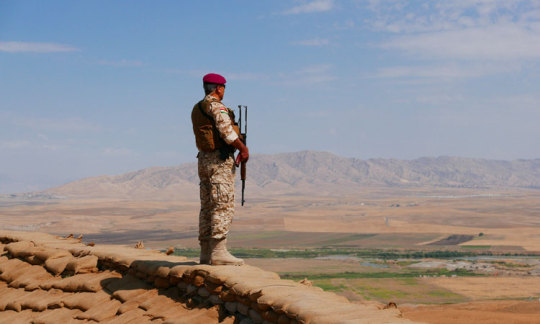
Peshmerga (2016) begins a theatrical run tomorrow at the Quad as part of Bernard-Henri Lévy x 4

What if a philosopher made a war documentary? Bernard-Henri Levy has done just that and the result is Peshmerga about the Iraqi Kurdish forces fighting ISIS in Iraq.

To be honest  Levy has made at least one other war doc, which I'm told is overly pretentious. Peshmerga does suffer from it's director's overly self indulgent navel gazing but at the same time the film does have an effect on it's audience.

The effect is due entirely to the you are there shooting of the film. Beginning with a POV shot of two men running in the desert which takes a sudden turn when one is blown up Peshmerga grabs it's audience by the throat and never lets you go.

I suspect at this point I should warn you that there are images in this film which will bother many. We see the war dead and some footage of the nastiness inflicted on people by ISIS. We see people die unpleasant deaths.

What makes the film stand out, and to some degree lessens the impact of the story is Levy's purple narration. Taking an intellectual stance that kind of puts him outside of the events in the film Levy spins the film in some intriguing ways that make you engage with the film with you brain and not just your gut. At the same time because some of the musings sound overly intellectual some of the connections to the heart are severed and we never completely engage on an emotional level. The upshot of which is that some of the raw visceral power that should cause us to act or react on what we are seeing. instead we look at the tale and nod to ourselves and say - oh isn't that terrible before moving on.

Of course that doesn't prevent the film from hanging around in your brain for several days forcing you to ponder it for a long time after.

For details on the run and the entire Bernard-Henri Lévy x 4 series go here

And for Nate Hood's alternate take on the film go here.

Wednesday, January 8, 2020

The Woman Who Loved Giraffes (2019)

As all the promotional material says -years before Jane Goodall went to Africa Anne Innis Dagg was there doing the dame thing but with giraffes. Dagg spent years studying the animals she loved and getting abused by academia who refused for decades to accept her as one of them., turning her toward feminist causes.

Well done documentary shines a light on a forgotten naturalist whose work in the field and fighting for social causes needs to be noted. Buoyed by a central figure who is force to be reckoned with the film sucks us in early and pulls us in thanks to copious use of letters, recordings and the film footage Dagg shot while in the wild. It is one thing to be told about what a person is doing, it's another thing entirely to see it for yourself.

You will forgive me for not having a great deal to say, but when confronted with a life such as Dagg's it is often better to simply allow it to speak for itself-and director's Alison Reid's film does that and we are better for it.

THE WOMAN WHO LOVED GIRAFFES opens Friday in New York and is recomended.


Nate Hood on The Grief of Others [2015]

Since his 2011 directorial debut In the Family, Patrick Wang has seemingly molded himself into America’s response to Taiwan's Edward Yang with his focus on slow-burning humanist parables set amidst familial and societal upheaval starring huge, multi-generational casts. In the Family, a heart-breaking look at a gay widow trapped in a hopeless custody battle for his dead partner's biological son, raised eyebrows for its three-hour length and languorous pacing, both audacious decisions that rarely bode well for first time directors coming from the theater. Indeed, the first fifteen minutes simply watch the central family putter about their business in the course of a single day from sunrise to sundown. Likewise, his two-part 2018 film A Bread Factory about a struggling community arts space in upstate New York stretched over four hours with much of the run-time devoted to simply watching actors and artists rehearse and perform.

Though superficially concerned with the intricacies of human emotion, Wang is equally fascinated with observing the passing of time, and understandably, he needs a lot of it. Perhaps this speaks to why his second film The Grief of Others is such a disappointment. The only one of his films adapted from existing source material—in this case Leah Hager Cohen's 2011 novel—The Grief of Others feels disoriented by its 102-minute runtime, feeling rushed and incomplete.

The film follows a traditional nuclear family living in Nyack, New York trapped in a maelstrom of unspoken grief after mother Ricky (Wendy Moniz) gives birth to an anencephalic baby that dies shortly after it's born. The usual pain of losing a child gets compounded when her husband John (Trevor St. John) discovers that she knew the baby was braindead in the womb months before giving birth and refused to tell him that it was doomed.

This feels like prime material for Wang whose films all deal with loss in some way, but his inexplicable nonlinear execution here is oddly stunted; we don't even learn the family was recovering from a stillborn baby until almost halfway through. Instead, we get seemingly unrelated character vignettes that start and go nowhere, primarily concerning the red herring arrival of John's pregnant teenage daughter from another marriage which dominates the first half hour. Wang spends much of the film flailing for a direction or emotional center for his story and comes away confused and empty.

Rating: 3/10

Tuesday, January 7, 2020

To Hong Kong w/ ❤️ (To Hong Kong with Love) A Series of Hong Kong New Wave Films Paired with Timely Documentaries About the Current Political Protest Movement at the Metrograph

Beginning Saturday, February 1 (and continuing throughout the month), Metrograph presents To Hong Kong w/ ❤️ (To Hong Kong with Love), a series of HK New Wave films, paired with timely documentaries about the current political events, still unfolding. The Hong Kong protests were in the news for the better part of 2019 and the subject of widespread debate, much of it by outside observers with a vested interest in imposing their own narratives. From its days as a British colony to its present status as a Special Administrative Region in China, small Hong Kong’s fate has been largely decided by great powers, without consultation of its citizens—including the 1997 return of Hong Kong to China. As a corrective, To Hong Kong w/ ❤️ is made up of films that show Hong Kongers speaking for themselves, pairing classic scripted films that explore the soul of the city with new documentaries that give voice to those who are out in the streets, fighting to keep their vision of that soul intact. Co-programmed by Katherine Cheng, Project Hong Kong.

All screenings will have introductions and/or Q&As with journalists, scholars, and front-line activists, to be announced soon.
Saturday, February 1
Comrades: Almost a Love Story (Peter Chan/1996/118 mins/35mm)
The story of a touch-and- go romance between two Mainland expats, earnest Northerner Leon Lai and Guangzhou-born wheeler- dealer Maggie Cheung, Peter Chan’s profoundly touching drama follows its leads from youth to maturity, from upper-class security to the slums, and between Hong Kong and New York City, bidding bittersweet goodbye to the dreams of youth, the old HK that William Holden once visited, and the plaintive voice of Teresa Teng, which echoes through the film.

Hong Kong Trilogy (Christopher Doyle/2015/90 mins/DCP)
For years, Hong Kong was the beating heart of Chinese pop cinema, but reunification with the Mainland in 1997 upset the delicate balance that had fostered the city’s genius. It has been a city in transition ever since. Who better to track that transition than Christopher Doyle, longtime resident, Wong Kar-wai’s frequent cinematographer, and a man with a sure-shot eye for the telling detail? In three docufiction segments, Doyle looks at three generations of Hong Kongers: School children, young “Umbrella Movement” activists, and the elderly. Overlaying recorded interviews onto loose narrative vignettes, Doyle creates sweet, richly textured, free-flowing portraits of a bevy of unforgettable characters.


Saturday, February 8
Nomad (Patrick Tam Kar-Ming & Terry Tong/1982/96 mins/DCP)
Before he became the mentor to Wong Kar-wai, Tam was an iconoclastic filmmaker in his own right, one of the leading lights of the Hong Kong New Wave. His third film, Nomad, is a stylish, Pop Art-inflected knockout made with later Wong production designer William Chang Suk-ping. In an overcrowded city, a quartet of young Hong Kongers—including the great Leslie Cheung—tries to carve out some space for themselves to drift and dream, while the persistent presence of Japanese pop culture comments on Hong Kong’s susceptibility to outside influence, and sets up a shocking confrontation with the Japanese Red Army.
Lost in the Fumes (Nora Lam/2017/97 mins/DCP)
Politician and activist Edward Leung is the subject of Lam’s intimate and disarming biographical documentary, which begins by following the young radical localist on his campaign to win a seat on Hong Kong’s Legislative Council—a contest which he’ll be barred from due to his advocacy for Hong Kong independence. Only 22 when the film was made, Lam is a near-contemporary to rising leader Leung, and their Lost in the Fumes shows the psychological toll—depression, disillusion, and anger—of passionate political engagement on a generation of young people tried in the fires of protest.


Saturday, February 15
Teddy Girls (Patrick Lung Kong/1969/107 mins/DCP)
Champion of the Cantonese-language film in a Hong Kong industry then dominated by Mandarin productions and an ahead-of-his-time cinematic modernist who influenced John Woo and Tsui Hark, Patrick Lung Kong is a figure of incalculable importance in HK film history. Find out why in Teddy Girls, his slam-bang female juvenile delinquency melodrama that starts with a go-go club brawl, moves to the grounds of a lockdown reformatory, and ends on a note of pure pathos. Released in the aftermath of the 1967 Hong Kong Leftist Riots, it immediately became a flashpoint for controversy.
Yellowing (Chan Tze-Woon/2016/133 mins/DCP)
Chan documents the 2014 Umbrella Movement from a boots-on-the-ground perspective, following protest participants from various backgrounds throughout 79 days of occupation, including the first police tear gassing of unarmed protestors. As the action proceeds, bonds form and strengthen between both the four main subjects and the filmmaker, very much a participant in events. Giving a human face to a mass movement, Chan creates a film every bit as grassroots and spontaneous as the protests he is documenting.

Saturday, February 22
Rouge (Stanley Kwan/1987/99 mins/DCP)
Stanley Kwan, who became Hong Kong’s first openly gay director not long after Rouge’s release, crafts an elegant and enormously moving love story that comments on both changing cultural mores and the persistence of the past in the city’s present. Modern newspaperman Yuen (Alex Man) meets a seemingly disoriented woman, Fleur (Anita Mui), dressed in traditional cheongsam of the 1930s, placing a “Missed Encounters”-type ad. As it transpires, she’s the ghost of a woman who committed suicide in 1934, seeking the lover who failed to meet her in the afterlife, played in flashbacks by Leslie Cheung. A beautiful and beguiling paean to a city ever-changing and eternal.

Raise the Umbrellas (Evans Chan/2016 & 2019/119 mins/DCP)
Praised and censored, Raise the Umbrellas brings together a chorus of voices to discuss and define the 2014 Umbrella Movement. Represented are not only recognizable activists like student leader Joshua Wong, Hong Kong Democratic party founder Martin Lee, and Occupy Central mastermind Benny Tai, but also students, Cantopop icons, politicians, and “Umbrella mothers.” The result is a comprehensive portrait in-the-round of the occupation, doing justice to a multifaceted mass action that is too often reduced to one-sided talking points.

Saturday, February 29
Ten Years (Jevons Au, Kiwi Chow, Zune Kwok, Ka-Leung Ng, Fei-Pang Wong/2015/104 mins/DCP)
In this speculative fiction anthology, five young filmmakers—who faced harsh blowback for their participation in the project— imagine what Hong Kong will be like 10 years from the then- present day: that is, in 2025. The controversial “Self-Immolation” imagines an act of fearful, fatal sacrifice for home; “Dialect” sees a cabbie isolated by the elimination of Cantonese; and a tone of anxiety presides throughout. Running through each entry are the very concerns underlying the Umbrella and the current Anti-Extradition Movements—a fear of the erasure of Hong Kong identity by Mainland influence, and anticipation of a dystopian future under an authoritarian state
Umbrella Diaries: The First Umbrella (James Leong/2018/120 mins/DCP)
From the June 4th candlelight vigil to the September 28th mass gathering outside of Government Headquarters, Leong’s Umbrella Diaries tells the story of the beginning of the Umbrella Movement in the voices of those who were in the thick of it, delineating the different camps vying for influence within the mass occupation, divided in their aims while united by a common cause of civil disobedience to the powers that be. Embracing the complexities and contradictions of a political action that’s as complex as Hong Kong itself, Umbrella Diaries is a study in how a broad-based popular protest can, with however much difficulty, actually work.

Hal Hartley at the Metrograph


A Retrospective of the American Independent Giant, with Films Starring
Isabelle Huppert, Adrienne Shelly, PJ Harvey, Martin Donovan, Sarah Polley, etc.
"Hal Hartley’s films are slow meditations. They create on screen an aura of stillness that invites audiences to pause and reflect – to really hear what the characters are saying, to really look at actions close-up." – bell hooks

"Mr. Hartley taps into a universe ignored by a Hollywood obsessed with precocious juveniles and expensive extravaganzas. His loners and outsiders are passionate about the idea of love and desire and survival, even while knowing they might very well end up looking ridiculous." – New York Times

Beginning Friday January 24, a retrospective of Hal Hartley (Trust, Henry Fool, Amateur) will open at Metrograph. Hal Hartley appeared on the scene in the “indie” movie boom of the early ‘90s, but even in these years of mainstreaming, he remained an outsider’s outsider; his independence not a temporarily convenient brand, but an entire ethos. His milieu was a blue-collar, bridge-and- tunnel New York, populated by workaday philosophers expressing themselves in a deadpan, declamatory performance style heavy on aphorism and unusual articulacy. This, combined with Hartley’s austere, geometric mise-en-scene, has invited comparisons to Robert Bresson, but his singular combination of off-kilter humor and throbbing romanticism can really only be called “Hartley-esque.” From breakthrough early works introducing stars Adrienne Shelly and Martin Donovan to latter-day masterstrokes like Ned Rifle, join us in following this remarkable artist through the different-drummer march that his career has been.
The Unbelievable Truth (1989/90 mins/35mm)
Hartley’s first feature announced the arrival of a profoundly idiosyncratic and original filmmaker, an all-American blue-collar Bressonian who found a peculiar beauty and balefulness in the tattier corners of his native Long Island. Here his great early collaborator, Adrienne Shelly, stars as a teenager fixated on nuclear Armageddon, drawn into the orbit of a stranger in town (Robert John Burke), whose air of mystery conceals a dark backstory.

Trust (1990/107 mins/35mm)
Adrienne Shelly returns in Hartley’s strange, sweet, and stark sophomore outing as Maria, a 17-year-old in suburban Long Island who, to the horror of her parents, comes home one day pregnant, and unleashes catastrophe. She finds comfort of a sort with Martin Donovan’s self-taught Mr. Fix-It electronics whiz, and together they try to help one another—he in giving her a home, she in getting him out from under the thumb of his abusive father. A ringing riposte to Reaganite values, and a love story that gives its own definition of love.

Surviving Desire (1991/55 mins)
with The Book of Life (1998/63 mins)
Dostoevsky-obsessed lit lecturer Martin Donovan becomes infatuated with one of his students (Mary Ward) in Hartley’s experimental film musical, which features some of the writer-director-composer’s most piquant and grandiloquent dialogues on the topic love and ambition, and gives a remarkable visual richness to its small-town university setting. With pop musical The Book of Life, Hartley’s first DV film, featuring Donovan as the resurrected Christ returned to earth via JFK airport on the eve of the new millennium, and PJ Harvey as his assistant, Mary Magdalene. 

Simple Men (1992/105 mins)
Robert John Burke and Bill Sage are two very unalike brothers—a brokenhearted bank robber and a fresh-faced, bookish college boy—reunited when their ex-baseball star-cum-anarchist activist father escapes from a hospital and goes on the lam. Following him, they break down in a backwater town, and become enmeshed in the life of the locals, played by Martin Donovan, Karen Sillas, and Elina Löwensohn. Using the familiar form of the classic American road movie, Hartley constructs something wholly unexpected and completely clued into its time, a movie about “average” Americans that reminds us that no such creature exists.

Amateur (1994/105 mins/35mm)
Set in a disappeared downtown Manhattan of twenty years ago, Hartley’s absurdist comedy introduces a never-better Isabelle Huppert as a still-virginal ex-nun trying to make ends meet by writing smut for the likes of Wet & Wild magazine, scooped up in a coffee shop by a bloodied but hunky amnesiac hustler (Martin Donovan) who recruits her into his mission to recover his past—a journey that will lead them into a noir-ish underworld of yuppified gangsters. “Irresistibly strange… A wry look at the social roles people play and the ‘real’ characters hidden beneath them.”—The NY Times

Flirt (1996/85 mins)
Flirt’s three episodes offer triangular love stories set on different continents, fascinating for both the correspondences and the cultural differences that they reveal. Parker Posey puts a romantic ultimatum to Bill Sage in NYC; Black American artist Dwight Ewell considers his relationship with his German art dealer boyfriend in Berlin; Japanese dance student Miho Nikaido gets caught up in a dalliance that turns to deadly intrigue. “Smart, sexy, wafer-light… A jauntily romantic theme and variations on young love international style”— The New York Times

Henry Fool (1997/137 mins/35mm)
A bawdy Faustian comic fable in which a garbageman can become an overnight literary cause celebre for an epic poem, Henry Fool follows the impact of Thomas Jay Ryan’s title character—a drifter, a grifter, and a splenetic genius—on the inhabitants of Woodside, Queens, including transformed trashman Simon Grim (James Urbaniak), his bed-hopping sister (Parker Posey), and their depressive mother (Maria Porter). A portrait of an outsider artist by one who knows the life well, and a caustic comic contemplation of the artist’s place in the modern world.

No Such Thing (2001/103 mins/35mm)
Inspired by the epic Beowulf but Hal Hartley to the core, No Such Thing follows television journalist Sarah Polley as she travels from New York to Iceland to track down the boozing, foul-mouthed monster (Robert John Burke) who killed her fiancé. Providing plum supporting roles for Helen Mirren, Julie Christie, and director Baltasar Kormákur, playing a mad scientist named for Antonin Artaud, Hartley crafts a farcical fairy tale and slapstick media culture satire for the ages.

The Girl from Monday (2005/84 mins/DCP)
Consumer culture, unbound capitalism, and the emergent phenomenon of ubiquitous branding are the targets of Hartley’s prescient anti-corporate thriller The Girl from Monday, set in a near future when the entire U.S. is run by a single, imperial media conglomerate, MMM, who relentlessly mine the populace for data. Leading the resistance is MMM exec Jack (Sage), who finds an unlikely foil—and romantic complications—in the form of an alien creature from a distant planet who splashes down in the form of Tatiana Abracos, and learns of humanity’s plight through binge-watching television.

Fay Grim (2006/118 mins/DCP)
Eight years after Henry Fool, Hartley picks up with the title character, Parker Posey’s spurned spouse to the first film’s grifter anti-hero, raising their now-teenaged son while looking for clues as to where he has disappeared to and who he was in the journals he left behind, also of interest to two CIA agents played by Leo Fitzpatrick and Jeff Goldblum. Provincial domestic comedy meets international thriller and scathing spy spoof, all in Hartley’s signature cadence. “Possibly the most astute allegory about the U.S.’s role in our current war… Posey beautifully embodies bewilderment and melancholy.”— Slant Magazine

Meanwhile (2012/57 mins/DCP)
with My America (2014/77 mins/DCP)
D.J. Mendel, a longtime Hartley supporting player, stars in the brisk, lovingly detailed character study Meanwhile as a down-on-his-luck multi-hyphenate crossing Manhattan on foot after learning that his bank account has been frozen due to unpaid taxes—a movie intimate in scope but rich in everyday incident. With My America, an assemblage of twenty-one short monologues by twenty-one American playwrights, including Anna Deavere Smith, Dan Dietz, Lynn Nottage, and Neil LaBute, delivered in response to the question “What is my America?”

Ned Rifle (2014/85 mins/DCP)
The final film in the tragicomic dysfunctional family trilogy begun with Henry Fool and continued through Fay Grim catches up with Henry and Fay’s son Ned (Liam Aiken), freshly emerged from witness protection and determined to kill his father, only to be dissuaded by a young woman, Susan (Aubrey Plaza) who has her own, very different fixation on the elusive Henry and the Grim family. A sort of summarizing of Hartley’s work-to-date, featuring many of his favorite faces, and a lean, stripped-down work that announces a new invigorated burst of creative conviction on the part of the filmmaker.
Hartley is currently raising funds for his new film, Where to Land. More information can be found here

Origin Stories: Bertrand Bonello’s Footnotes to Zombi Child Starts Fri January 17 at the Quad


French filmmaker Bertrand Bonello selects films that inspired and informed his upcoming Zombi Child, opening January 24

Titles include 35mm prints of Carrie, I Walked with a Zombie, Picnic at Hanging Rock, The Serpent and the Rainbow, Maya Deren's Divine Horsemen: The Living Gods of Haiti on 16mm and more!

For over two decades, French filmmaker Bertrand Bonello has immersed audiences in worlds and time periods spanning a fin-de-siècle bordello (House of Tolerance) to ‘70s haute couture (Saint Laurent). With his eighth feature, he explores the mysterious practices that bridge generations and geography, the living and the… formerly living. As a warm-up to Zombi Child, opening at the Quad on January 24, Bonello has selected a series of titles that have inspired and informed his latest work. From ghastly demonic terrors in Georgetown to coolly occult activities in the Caribbean, swooning turn-of-the-century school girls to treasure-hunting ‘80s teenaged boys, we invite you to navigate currents both light and dark en route to Bonello’s bewitching latest creation.

Carrie
Brian de Palma, 1976, U.S., 98m, 35mm
From its traumatic opening sequence through its post-traumatic closing imagery, De Palma’s adaptation of Stephen King’s novel is shocking, empathetic, and unsparing. Both deservedly Oscar-nominated, Sissy Spacek and Piper Laurie incarnate an unforgettable blood knot as a telekinetic teen trying to preserve her humanity while being raised by a religious fanatic mother.

Divine Horsemen: The Living Gods of Haiti
Maya Deren/Cherel Ito/Teiji Ito, 1985, U.S., 52m, 16mm
Revered avant-garde director Deren (Meshes of the Afternoon) had — with personal and professional partner Teiji Ito — amassed rare footage of Haitian voodoo (also spelled as vodou, or voudoun) over a four-year span and then published a 1953 book on the subject. Decades later, Ito and his wife Cherel shaped the archival trove into a same-titled hourlong documentary feature which goes beyond common (mis)perceptions to illuminate thriving cultural traditions.

The Exorcist: Extended Director's Cut
William Friedkin, 1973, U.S., 133m, DCP
Friedkin set a new high bar for hide-your-eyes imagery and explicit screen shocks with William Peter Blatty scripting from his own best-selling novel. Big box office and 10 Oscar nominations followed, with wins for Best Sound and Best Adapted Screenplay. Movie star Ellen Burstyn, mid-shoot in D.C., finds preteen daughter Linda Blair in the monstrous grip of demonic possession and pleads for hands-on intervention from conflicted priests Max von Sydow and Jason Miller.

The Goonies
Richard Donner, 1985, U.S., 114m, 35mm
Adventure beckons, in this enduring family favorite, for Pacific Northwest kids once they get wind of pirate’s booty buried under their neck of the woods — sending them tumbling through junior-Indiana-Jones-style close calls and face-offs. The teen septet includes Josh Brolin (in his screen debut), Kerri Green (Lucas), and Martha Plimpton. Chris Columbus scripted from a story by executive producer Steven Spielberg; the theme song is belted out by Cyndi Lauper.

I Walked with a Zombie
Jacques Tourneur, 1943, U.S., 69m, 35mm
After Cat People, Tourneur and producer Val Lewton reteamed with film editor Mark Robson and composer Roy Webb for another shiver-inducing tale of the supernatural, forging the screen template for zombie depictions a quarter-century before it was refitted with the walking/living dead. The sunny Caribbean provides little respite for nurse Frances Dee as she proposes radical therapy for spellbound Christine Gordon while pining for the latter’s husband Tom Conway.

Picnic at Hanging Rock [Director's Cut]
Peter Weir, 1975, Australia, 108m, 35mm
The great Weir’s career breakthrough came with this lulling yet roiling fugue into the female psyche as it exists in the material world. Based on Joan Lindsay’s novel — itself purportedly inspired by an actual unsolved case — and breathtakingly shot on Australian locations by BAFTA Award-winning cinematographer Russell Boyd. In 1900, a boarding school for women run by Rachel Roberts sets a field trip from which three students and a teacher do not return…

The Serpent and the Rainbow
Wes Craven, 1988, U.S., 98m, 35mm
Anthropologist Wade Davis’ hotly debated book became the basis for one of Craven’s most divisive chillers. New England professor Bill Pullman visits Haiti to investigate reports of a powerful pharmaceutical tied to rogue magic and/or suspended animation, encountering presumed warlock Zakes Mokae and civil unrest. With Cathy Tyson (Mona Lisa), Paul Winfield (Sounder), Theresa Merritt (The Wiz), and beloved UK genre films staple Michael Gough.


Zombi Child

Opens Fri January 24
Bertrand Bonello, France, 103m, DCP
For his eighth feature, Bertrand Bonello (Saint Laurent, Nocturama) masterfully injects new life into the well trod-upon zombie genre with a tale that criss-crosses between generations and hemispheres, the dead and the undead. Drawing from the true story of Clairvius Narcisse, who was reportedly zombified in 1962 Haiti and put to work in the sugarcane fields, Bonello tracks between the past and present-day Paris, where Narcisse’s (fictional) granddaughter struggles to fit in with the other (predominantly white) girls at her prestigious boarding school. With bewitching cinematography by Yves Cape (Holy Motors) and a hypnotic electro score (written by Bonello), Zombi Child offers a phantasmagorical mix of traditional Haitian mythology and haunted contemporary youth. A Film Movement release

In French, Haitian, and English with English subtitles

Official Selection: Cannes Film Festival, New York Film Festival

“Bonello leaves us hypnotised and hungrily begging for more.”
—Little White Lies

Limmerance (2017)

Limerance is a term describing a sudden deep feeling of affection for someone upon meeting. Think of it as the technical term for love at first sight. In Tammy Minoff‘s film it describes what happens when an artist moves to Venice California and collides with a gallery owner. The film charts the course of their romance as well as the relationship of long married friends.

A nice little film is better in the small interpersonal moments between the lovers. Tammy Minoff and Matthew Del Negro are a sweet couple and they sell the romance wonderfully. They are so good that you really want them to work out.

The problem with the film is that when the film gets away from the central couple things wobble a bit. Things can be a bit too TV sitcomish. Minoff‘s arrival at her friends house is the wrong sort of silly. It’s not bad but it’s not as good as the romance with the result the film is just good instead of being great- which it would have been if it played a bit straighter.

Limerance hits VOD/Digital & DVD today.

Monday, January 6, 2020

Ofra Bloch's masterpiece AFTERWARD hits theaters Friday

This is a repost of the review I ran when the film played at DOC NYC in 2018

 AFTERWARD is by Ofra Bloch a psychoanalyst who wanted to confront the notion of hate within the Jewish/Palestinian communities. She wanted to know what the effect of the hatred was on both communities since she realized that she had been raised to hate Germans because of the Holocaust and to hate the Palestinians because "they were coming to take their land". She soon realized that part of the problem of why she hated these people was that there was no dialog between the groups. Not only hadn't she spoken with Germans or Palestinians- many Germans didn’t know how to talk to Jews because they were afraid the sins of their fathers would get them hurt, while the Israelis and Palestinians seemed to only interact violently. As a result no one talked and the uncertainty bred suspicion and uncertainty. To break the ice she would talk to those she was supposed to hate and hate her.

Ms Bloch has made a film of such incredible power it has left me tongue tied and rambling...

Digging deep into her own life and family Bloch explains takes us on a journey to understand why and how the hatred has been allowed to fester. She gives us example from her own family how stories as a child didn't fully allow her to understand what happened during World War Two. In order to put things right she goes to Germany and into the occupied territories and talks to people and experiences what things were/are like.

And what she finds is troubling. People can not move forward from their own and our shared history. The Holocaust, which sought to eliminate the Jewish people is being used against the Palestinians as a way of shutting them up. The Palestinians don't like that their "oppressors" are portraying themselves as victims in a way that makes it impossible to fight back back. The displacement of the Palestinians, the Nakba, where a million or more people were displaced in a single day, is still an open wound. Part of the reason being the rules laid down by Israel which make the basic process of living difficult even to the point where they can not bury their own dead.

Bloch is confused by it all at times, but she, and we, begin to gather some answers over the course of her journey. Working slowly and patiently she begins to find through lines. There is perhaps a way to begin to heal some of the wounds.

The journey is AFTERWARD and it is an unconditional masterpiece.

I honestly don't know what to say. This is a film I need to see again to due it justice, but because of the sheer weight of the DOC NYC I am going to have to circle back after the festival and take a more detailed look. But you shouldn't wait-you should just go see it.

Know that Bloch succeeds in taking a complex subject and making it personal. By relating everything back to her own experiences she makes her journey our own. We feel her confusion because she makes us understand where she is coming from. Bloch also doesn't shy away from mixing heady subjects with emotion your hear will breaking at some revelation while your brain ponders what it all means..

That this is Ofra Bloch's first film is truly amazing. How this person has managed to make a film of such staggering power the first time out of the box is mind blowing. No filmmaker I can think of, male or female, has ever made a film as nigh perfect and as deeply affecting as this one the first time. Watching the film I kept to IMDB to see what else she has done and only to discover this was her first film.

In a time filled with hate and mistrust and a world on the edge of collapse from all the pain, AFTERWARD is a shining beacon of hope.

AFTERWARD is a must see film for everyone.

In Theaters January 10, 2020 and on VOD January 28, 2020

Sunday, January 5, 2020

See all of Bong Joon-Ho's films at Lincoln Center's Bong Show starting Tuesday


The hottest director in the world right now Bong Joon Ho is getting a retrospective at Lincoln Center starting Tuesday and if you have only seen his sure to be Oscar Winner PARASITE now is the time to get down to Walter Reade and play catch up

His films are wild and crazy and extremely thought provoking. You can't help but end up thinking about his films for days and weeks afterward.

Frankly there is little to say other than go.

The full slate of both his films and some choices he made to screen can be found here.

While I recommend everything here are reviews of his films that we've run at Unseen. (though we have reviewed THE HOST and BARKING DOGS NEVER BITE but I can't pull it up)


And here is one of the ones he picked to screen

Go see everything- you will thank me.

Nate Hood on In the Family [2011]

2019 saw the addition of a new film to the list of great movies about custody battles: Noah Baumbach’s Marriage Story. Despite not prominently featuring dragons, serial killers, or space wizards from a galaxy far, far away, the film became the toast of social media and the bane of overworked content creators the internet over who chugged out think piece after think piece squabbling over its place in the pantheon of court movies.

Of all the films dredged up for listicle duty (thank you for your service Kramer vs. Kramer), one of the most surprising omissions was Patrick Wang’s 2011 indie drama In the Family, a superb, Spirit Award-nominated film about a gay man named Joey who finds himself trapped in a custody battle after his long-time boyfriend Cody dies in a car accident, leaving his biological son Chip from his previous marriage in a state of legal limbo. When Cody’s extended family invites Chip over for Thanksgiving, they de facto kidnap him and serve Joey with a restraining order, claiming custody as per an outdated but still legally binding will Cody wrote years before meeting Joey. Faced with an unwinnable court case—the film is set in a pre-Obergefell v. Hodges Texas—he descends into a pitch blackness that sees him reevaluate his entire life.

At almost three hours, the film is a slow but absorbing sit where Wang assembles scenes and moments together with the assuredness of a filmmaker far beyond his years and experience (though he’d long worked in theater, this was, astonishingly, his directorial debut). His directing is an odd mixture of Yasujirō Ozu and Robert Altman, favoring the static camera and narrative ellipses of the former (we don’t hear about or see Cody die nor do we see his funeral) and the decentralized, character-based drama of the latter where actors wander in and out of shots and scenes seemingly as they please. Indeed, the average scene plays out for almost a minute before it “gets to the point.”

While the whole film is a humanist triumph, the last hour is the most powerful, comprised largely of a Hail Mary custody deposition where Joey (played by a wonderfully understated Wang) pleads his case before Chip’s family while suffering homophobic attacks from their lawyer. As with the rest of the film, its intimacy is almost painful, and all without memeable Driver/Johansson histrionics.

Rating: 9/10

Spiderman: Far From Home (2019)

Returning after the events of AVENGERS ENDGAME Peter Parker and his friends have to redo the school year of the snap. Traveling to Europe on a school trip Parker is hunted down by Nick Fury who wants his help dealing with some elemental beings tearing up the continent. Fury is aided by "Mysterio" a man claiming to be a man from an alternate reality. The truth of the matter is that Mysterio is a bad guy with his on agenda.

Good adventure film deals gets ample mileage out of the wonderful interplay between the characters and wonderful action scenes. While the plot has serious problems owing to too many people knowing what Mysterio is doing and the fact that most of what he is doing is an illusion, it still is entertaining.

Worth a look.

The obligatory annual state of Unseen Films post- 2020 edition

As this posts we are just short of ten solid years of Unseen Films.  February 20th will be our anniversary of at least one post a day for a whole decade. Weeeeeee!

In that decade we've covered around 10,000 films from all over the world, interviewed some the greatest filmmakers from around the world and we've made a ton of friends. It's the friends that is the important thing.

I am in awe of what has been accomplished- a hell of a lot more than I ever thought I would achieve when I just started to post my thoughts on some films I didn't want to get lost.

A decade later it's time to take stock and figure out where we go next.

Actually the real truth was that the plan was to get the website programmed to the anniversary date and then completely step away...but that isn't happening just yet. Right now the site is programmed into the end of July and by the time I finish the New York Jewish Film Festival and Slamdance  things will programmed via the leap frogging of posts into August. (I swap older films for new ones and they get pushed don the road).

Why am I considering going away?  The simple answer is burn out. The volume of Unseen's coverage is massive and because of the shifting nature of the film business it's become more time consuming. Additionally life both in the day job and my personal, have thrown things my way that make the juggling difficult. I don't want to but it may be necessary to step away...

...Or at least cut back. I have been cutting back already. The total number of posts for 2019 was the lowest number in 3 years- and about 200 less than last year.  I'm cutting back on most things and festival coverage even of fests I love- such as the New York Jewish Film Fest which is going to get only limited number of films reviewed this year (an aside- the selection this year is freaking awesome so go buy tickets-its so good I may do more than what I promised would be my limit.)

Where and what we do is going to depend upon if I am having a good time. I used to have a blast meeting with friends, going to screenings and hanging out. The trouble is now friends are being pulled by life, many have stopped writing because right now being a film writer largely doesn't pay (I've never gotten paid for any of this),  and the nature of the business is that unless it's a big Hollywood production or a big film fest most films are send via screeners, so what was once social is now frequently sitting home alone watching movies all night. Yes it means I have seen many more films than I would have otherwise- but it also means I'm not seeing friends. Without friends this no damn fun.

So what's the plan?

Plod on slowly.

I will be giving priority to a bunch of festivals I would go to even if I wasn't writing NYJFF, Slamdance, Sundance, Winter Film Awards, Tribeca,  New York International Children's Film Festival, NYFF, Oxford, Japan Cuts, Blood in the Snow and some others.

I have plans to give coverage to some really good fests like the upcoming Cinematters: New York Social Justice Film Festival and Fantasia which are running a ton of great films. As well as revisiting some new discoveries like the Chain Film Fest which just rocked.

And I am going to try and sort out where I stand with a few others that seem to be a bit lost (like New York Asian). There are some fests I have covered big time because they once were great but now its more misses than hits. And in a couple of cases, it has been too much battling with new press people who make it difficult to do any sort of meaningful coverage.

The plan is to do with the fests the same as I am doing with new releases - cover whatever makes me say yes instantly or make me curious. Anything else gets pushed aside.

Of course I will be covering anything from the  the network of great filmmakers and PR people who I will say yes to instantly.(One of the greatest things I get from doing Unseen is getting to see films from filmmakers I love early)

Beyond that I will continue to do Unseen as long as I am able and as long as it remains fun. That last part is increasingly based on finding good films- so as long as thy keep getting made I'll keep trying to do this crazy thing.

Thank you all for reading- I know return you to your regular lives, already in progress.

Saturday, January 4, 2020

Alita: Battle Angel (2019)

Brilliant doctor rebuilds a cyborg he found in  a junk yard and names it after his murdered daughter. As Alita rediscovers the world around her she begins to realize that she was a former soldier, and she also comes under the notice by the dark forces that run Iron City.

James Cameron produced and wrote this film, giving it to Robert Rodriguez to direct. I can't think of a better person to direct since Rodriguez's touch at mixing comedy and drama is always masterful.

Based on a classic manga story the film spins out mystery, action, romance and adventure in perfectly modulated waves. We are carried along as the story and world grows before our eyes, pulling us ever deeper into the mix. I love how the film keeps moving even in the quiet moments. There are no slack spots and by the end we realize we've had a full meal of a movie that leaves us both satisfied and wanting more.

A sequel please.

One of the delights of 2019.

Friday, January 3, 2020

Winter Film Awards International Film Festival Announces 2020 Edition

Film Festival celebrating diversity in film runs Feb 20-29 in NYC
NEW YORK, January 3 2020 – Winter Film Awards International Film Festival (WFA-IFF), a New York City competitive Festival with a special emphasis on showcasing the work of women and under-represented filmmakers, has announced selections for its 2020 edition. WFA-IFF received more than 650 submissions and has selected 79 films from 27 countries to be screened in February. The films include the following genres: Narrative Feature, Narrative Short, Documentary, Horror, Animation, Music Video, and Web Series.

The Festival will run from February 20 through February 29 at its main venue Cinema Village (22 East 12th Street) in Greenwich Village. In addition to screenings and filmmaker Q&A sessions, WFA-IFF will present an opening night film and entertainment industry networking event on February 20th, a series of educational sessions geared towards emerging filmmakers, including Shooting Difficult Scenes / Sex & Violence for Filmmakers, Distribution 101, All About Music for Filmmakers, Crafting an Amazing Opening Scene with Annette Insdorf, The Art of the Pitch with Seed&Spark, Camera Hacks for the Frugal Filmmaker and more. The Festival comes to a glittering close on February 29th with a Gala Award Ceremony Red Carpet event at a leading NYC nightclub. Details, schedule and additional events can be found on https://winterfilmawards.com/wfa2020/.

WFAIFF’s Executive Director Steffanie L Finn said of the 2020 edition, “Emerging filmmakers with low budgets and no connections are so often ignored in favor of the standard big budget generic action films. Diverse, exciting low budget films are created all over the world; it is critical for film festivals to showcase them. Indie film festivals are often the sole means for the community to share personal stories from around the world, and WFA’s location in the center of the action provides our filmmakers with a dazzling chance to begin their careers in the film industry.

WFA-IFF’s list of sponsors and partners for 2020 includes the NYC Department of Cultural AffairsNYC & Company FoundationJungle SoftwareMagix SoftwareNYU Women’s InitiativeFinal DraftRosco LaboratoriesElvid Cinema and Accenture. Several of the Festival’s networking events will be organized in collaboration with Liberty Coca-ColaBoxed Water and other beverages.

WFA-IFF ensures that each submission receives a fair, complete and bias-free consideration. Festival submissions are viewed and scored by a team of 75 film industry professionals from around the world. Each submission is viewed by 4-6 screeners and scored in 8 technical categories and an overall star rating. Final selections are chosen based upon average score.

WFA-IFF’s awards jury consists of a fresh set of 40 film and festival professionals from around the world. The awards jury will select award winners in thirteen categories: Best Picture, Best Short Film, Outstanding Women Director, Best Actor, Best Actress, Best Animated Film, Best Director, Best Documentary, Best Horror Film, Best Music Video, Best Student Film, Best Web Series, and the New York Perspectives Award for outstanding depiction of New York City.

About WFA-IFF
A group of filmmakers and enthusiasts have been organizing independent competitive international film events since 2011. WFA-IFF’s mission is to promote diversity, bridge the opportunity divide and provide a platform for under-represented artists and a variety of genres, viewpoints and approaches. We believe that only by seeing others’ stories can we understand each other and only via an open door can the underrepresented artist enter the room. WFA-IFF is 501(c)3 non-profit organization.

For more information about the Festival, please visit: http://winterfilmawards.com/

Missing Link (2019)

Laika's latest animated film concerns a great monster hunter in Victorian/Edwardian England who wants desperately to join an upper class society of hunters. When he receives a clue to to the whereabouts of a bigfoot he makes a deal that if he brings back proof he can join the closed society. However the head of society wants no part of him and sends a killer after him. Finding the bigfoot he is talked into trying to find a lost civilization of similar creatures in Asia. A grand chase ensues.

This may have Laika's best animation to date. The sequences are stunning and would be impressive had they been done either in computer animation or live action but the thought of them being stop motion animated boggles the mind. I'm thinking in particular of the Loch Ness Monster and the fight on the steamer sequences. It just amazing to experience.

The rest of the film is good but it never quite has the emotional kick  it should. I laughed at the jokes, and enjoyed the adventure but I never connected emotionally. Things seemed to be a bit too knowing or if not knowing artfully constructed to the point the humanity was lost. I liked everything I was seeing but I never loved it.

Regardless of my lack of emotional connection the film is a blast and half technically and a rousing adventure and as such is recommended.

Thursday, January 2, 2020

Crawl (2019)

A perfect exploitation film is pure popcorn delight.

The set up has a hurricane bearing down on Florida. A young oman races to make sure her dad is okay only to find him unconscious in the crawl space under the house. It seems a giant alligator  has wandered in. As she tries to drag him to safety things become complicated  as the storm hits and she realizes there is more than one beast hunting them.

This is as close to a perfect thriller as you gets. It sets up the characters and then drops them into hell and runs for as long as it can. Its a chilling film that ill not only have you on the edge of your seat but talking to the screen.

Wow, wow and wow.

Seriously this is nigh on perfect and had this come out in the age of the drive in it would have played for decades and influenced generations of filmmakers.

Yea, it is that good.

A must  see.

Wednesday, January 1, 2020

Unseen Film Awards 2019

It's time once again to announce the winners of the 2019 Unseen Film Awards. For those of you wondering this is the fifth year that I have asked the Unseen Films writers and extended family to vote for the best film of the year as well as for other film related awards.

Its been a long and crazy ride that has resulted in some really intriguing results- with a four way tie two years ago and films that no one expected rising to the top of the crop most years. To be perfectly honest even though shepherding all the voters together can make me crazy, I do it simply because the results surprise me every year. And this year is no exception.

Before we get to the actual awards a couple of quick tidbits about this years voting.

Just over 60 people were invited to participate in this years awards.  They were asked to send me the best film they saw in 2019 of any type or length. I also said that if they wanted to help with tie breaking to supply a list of up to five additional films that they consider the best of the year. I also said they could supply their votes for shorts, documentary, animated film and anything else they felt should be noted. Anything that was not clear cut or was not a typical award I ran by random members of the voting body to see if we should include them.  This year about two thirds of the possible voters turned in ballots with a number of them begging off because they didn't feel qualified to vote (usually saying "I didn't see enough films").

For a long time the top spot was a three way battle. For a chunk of the voting period all three films were very close, however some late in the game votes changed everything ever so slightly that one film slipped out of contention and two others ended up crossing the finish line in dead on tie. And while I was tempted to cast my vote and break the tie (for the record while I do run the awards, I do not throw a ballot in) I let the voting stand.

And the Best Films of 2019 as voted by the family and friends of Unseen Films are

Bong Joon-Ho's PARASITE and Lulu Wang's THE FAREWELL.

Both films received the same number of first place votes and ended up tied when all the tie breakers were tallied.

A really close second was ONCE UPON A TIME IN HOLLYWOOD which could have been the winner if tiebreakers had gone differently.

For those curious what the films that were listed as the Best Films of 2019 by our voters were, they are as follows:

ONCE UPON A TIME IN HOLLYWOOD
THE FAREWELL
HIGH FLYING BIRD
PARASITE
MARRIAGE STORY
UNCUT GEMS
HOBBS AND SHAW
THE LIGHTHOUSE
CAPTAIN MARVEL
BOOK SMART
HIDDEN LIFE
JOJO RABBIT
KNIVES OUT
NEVER LOOK BACK
ELEPHANT SITTING STILL
GAY CHORUS DEEP SOUTH
Zhang Yimou's SHADOW
MIDSOMMER
GODZILLA KING OF THE MONSTERS
PERSONHOOD
PAINTED BIRD

This should be considered the Unseen Films Family Best of 2019 list.

This year the BEST DOCUMENTARY award is going to

AMERICAN FACTORY won the award in the outright voting. In a category that resulted in a lot of contenders the film about a Chinese billionaire buying an American factory either topped or was mentioned on numerous ballots.

A special DOCUMENTARY AWARD OF MERIT is going to Jon Kasbe's WHEN LAMBS BECOME LIONS. The film not only in the mix for Best Documentary but was suggested for some special awards as well. When the discussion of the special awards was mentioned a discussion broke out about how to handle the film since many voters saw it in 2018 when it  World Premiered at Tribeca. This resulted in discussion about how we should handle films that cross years- and in this Special Award because a couple of people said that if they could put film into the mix they might have voted for it because it is that good.


The winner of the best FOREIGN FILM is PORTRAIT OF A LADY ON FIRE. I suspect for many of you that is causing a raised eyebrow. I know everyone expected PARASITE to win in a walk however, however while Bong Joon-Ho's film did get some specific votes for Best Foreign Film, most of the votes were simply for Best Film of the Year. PORTRAIT received more Best Foreign Film votes. We might have made PARASITE the winner except that PORTRAIT... was specifically listed on some ballots as the Best Foreign Film which also listed PARASITE as the Best Film

We received a number of votes for the BEST PERFORMANCE of 2019 but the only one that got multiple votes was Maddy Murphy in MISS FREELANCE. For those of you who don't know Murphy plays a woman dealing with the men who pay her for sex or companionship and it is as heartbreaking a piece of work as you will ever see. Anyone who saw it were rocked by it.

This year we are not awarding a BEST ANIMATED FEATURE prize simply because all of the votes were singular. Every person voting for the category picked their own film-and anyone listing an animated film into their ballot as a tie breaking film listed different films. Even if I were to vote it would have just added another film to the mix with no clear winner.

Best ANIMATED SHORT FILM goes to LETTERS FROM EVEREST. This is a joyous little true life tale about the filmmakers grandparents falling in love via letters back and forth while one is at Everest that ill make you fall in love with life.

The winner for BEST SHORT FILM is THE NEIGHBORS' WINDOW. This is the story of a couple who watch their neighbor's across the way and what happens over time. It's a perfectly measured film that you don't think is going to kick the crap out of you, but does so in the final moments. I should also mention it is not a thriller.

This year we are not going to be giving a large number of special awards the reaction to all of those that were offered were mixed when thrown out to the steering body. However a few semi-serious awards did slip through.

The staircase in THE JOKER  gets the award for  BEST PERFORMANCE BY A NON-HUMAN

This year we are awarding THE HARLEQUIN AWARD FOR PERSISTENCE to Alec Kubas-Meyer and his perennial vote for best film Joseph Kahn's DETENTION.  Every year I ask for the best film that people saw in 2019 and every year Alec offers up DETENTION by saying that it was the best film he saw all year. It's been on his ballot every year that the awards have been put together and I suspect it will be on everyone until we stop. (I suspect that Bully the Little Stuffed Bull will be winning this award in a few years assuming he doesn't stop voting for PADDINGTON 2)

And finally this year we are awarding a Special Award to Jason Kartalian's GIANT WOMEN MICRO-BUDGET as the BEST DOCUMENTARY ABOUT GIANT WOMEN OF 2019. Honestly it maybe the only real documentary about giant women of this, or any, year- but the thought of the award made the committee laugh so we're awarding it.

Lastly I want to give a shout out to the films that appeared on multiple ballots but didn't win any awards.

LITTLE WOMEN
THE IRISHMAN
GREAT LAMP
KNIVES OUT
BEAUTIFUL DAY IN THE NEIGHBORHOOD
1917 (which came in hot and heavy at the end. I suspect that had more people seen it it would have ended up in contention for the Best Film award)

As 2020 starts in earnest I'd like to thank everyone who voted, who kibitzed and egged us on. I would also like to thank you for taking the time to stop by.