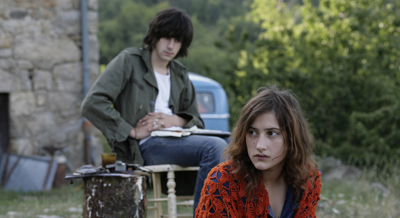
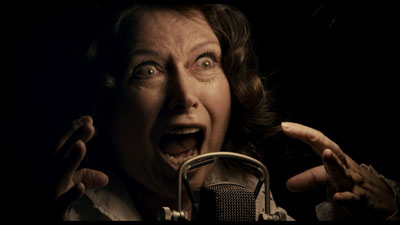
A collection of reviews of films from off the beaten path; a travel guide for those who love the cinematic world and want more than the mainstream releases.
Showing posts with label nyff 2012. Show all posts
Tuesday, January 15, 2013
Hyde Park on the Hudson (2012) Take 2
John already wrote up Hyde Park on Hudson but I wanted to throw my two cents in now that it's in theaters.
The film is the dual story of one of FDR’s many times removed cousins who becomes one of his mistresses and an impending meeting of the Roosevelts and the King and Queen of England.
Bill Murray may very well win a best supporting actor Oscar in his smallish but imposing role as the President. Murray holds the your attention every time he’s on screen. If you want to know when I realized he’s almost certainly an Oscar shoo in , it’s the scene where FDR meets the King in private for a late night chat. Not only does it reveal Murray in full glory it also is the best bit of writing in the whole damn film.
Unfortunately the rest of the film isn’t up to that one glorious scene. The problem is that the film doesn’t know whether it’s a romance with or a comedy of manner with the royals. The film tries to mash them together and it doesn’t really work. The more interesting story is the Royal one partly because that part of the film actually has strong characters, FDR, Bertie and Elizabeth. It also has a strong story with a wonderful sting in its tale- that FDR is the one really in control of the situations and of the PR.
The less interesting story is the romance. The writing here is extremely weak. Daisy is never given anything to do other than lend a hand and to stand in the background as things happen around her. Even if Laura Linney had been a better actress she couldn’t have done anything with what Richard Nelson has given here, which is nothing.
Equally given nothing are the rest of the characters who are cyphers or non-entities. You get not sense of any of them. Richard Nelson has been alleged to be one of the finest writers working today, but in all honesty you wouldn’t know it by the crap that’s on screen.
In everyone’s defense I do get the feeling that this may have been a much much longer film. If there is say a 3 hour version the film I’m guessing it may all make better sense. As it stands now it’s a good half a movie with a brilliant performance by Bill Murray.
My advice is wait for DVD or Netflix
Saturday, January 12, 2013
Three months later Steve sees Holy Motors
Three months on I finally saw Holy Motors. I did not catch the press screening at the New York Film festival, opting instead to see it with Mondocurry. Sadly familial commitments prevented me from seeing it at the public screening and despite my best efforts I never made it until just after New Year. Normally I would have not gone out of my way and instead just waited for DVD but all of the talk concerning the film on year end lists had me curious, as had Mondo’s intriguing and slightly cryptic take on the film.
For those that don’t know the film is a day in the life of Mr Oscar. He’s a chameleon like character who drives around Paris in a white limo pausing now and again to get out in heavy disguise and interact with people. At first the interactions seem to be random, but as time goes on they become more and more complicated and less random as if he is taking part in some one’s life. None of the vignettes are related, though characters from the directors other films appear and there are hints that some of the people are like Oscar, namely they are actors. The film takes us from the beginning of the day when Oscar says good bye to his family to when he returns home-to a completely different family.
Nothing is explained and there is a musical intermission (a highlight of this film year for me).
What does it all mean?
Your guess is as good as mine. To be honest I’m of the opinion that Holy Motors will mean and be whatever it is that you want it to mean. There is enough material here that anything interpretation is possible since there is pretty much enough hooks that you could hang any idea on them. In a weird way you can consider this almost a follow up to Kubrick’s 2001 a film that allows almost any interpretation.
Atheists or agnostics will probably take it to mean something relating to film or the randomness of existence. Deists or believers of one faith or another will assume it’s about the divine with the title, the fact that characters don’t stay dead and the mythic/ seeming angelic nature of some characters and cars playing into that mindset.
Somewhere around the brilliant musical interlude I became convinced that the film is some sort of cinematic jest. To me it’s almost as if director Leos Carax had these random scenes floating around he just decided to film them with the linking device of Oscar racing from place to place. Each scene plays as a kind of mini movie that we stumble into randomly, and on some level I think that’s what the scenes are- randomly assembled bits strung together in a kind of order.
I know the director has gone on record talking about what he feels the film is about or at least giving hints (Read Mondocurry’s report on the NYFF Q&A here) but while that maybe what he feels, I find that what he thinks the film is, especially a film as open to interpretation as this, kind of has to be discounted.
I can hear you all screaming sacrilege! I mean I'm discounting what the directors says , but sometimes you have to throw out what the director, or official spokesman says.
I’m fond of ranting, films have to stand on their own. Films MUST operate on their own, free of explanations. You can’t make a film that requires a cheat sheet to be understood. Several films recently (Corpo Celeste for example) required you read the notes to understand what the film is. You can’t do that. You can’t expect your audience to have access to your notes. Things must stand up for themselves. The cemetery sequence where Oscar takes on the character from Tokyo!, one of earlier films works on it’s own terms and you don’t need to know that where the character comes from, or that he marches through the cemetery to the Godzilla theme. Knowing it only allows you to get the thrown out reference, but it isn't required for understanding of the sequence.
But how is the film?
It’s good. It’s interesting. I like it but I don’t love it.
For my money it’s as I said, a series of random, brilliantly (for the most part) executed scenes that don’t hang together. It’s a grand pastiche made of pieces that have kind of been sewn together but not completely. Its’ like looking at a quilt where you see the whole, but you also see the pieces it was made from. While it will keep you warm, you are still aware of the pieces and the patchwork nature of it all- Holy Motors will entertain and perhaps enlighten you, but you still see how it was assembled.
I would not, as a whole consider it one of the best of this or any other year.
Of course that’s my opinion and while I would normally be more than willing to argue pro or con about the quality or meaning of a film I think in this case it’s pointless, at least as far as making an argument to change someone’s opinion. This is one of those rare films that is impossible to argue as being good or bad on any level but a personal one. One can’t argue the point any more than one can argue your world view is wrong since it’s very clear that how one takes Holy Motors is going to be based on what we bring to it and experienced before we go in. Your view is not mine and mine is not yours. Reactions will be different.
In a weird way I think the best explanation of the film I’ve seen comes from Mondocurry who calls the film an art film in the truest sense of the word. It’s a work that, like any great work of art, is reflective ….
Saturday, October 20, 2012
the hum of Holy Motors part 2: New York Film Festival 2012 screening plus Q & A

Recently I wrote about Holy Motors and, because it was part of this year’s 50th Anniversary New York Film Festival, I’d hoped to write about the movie and the surrounding happenings, namely the q & a with director Leos Carax. But, due to the enormous intrigue around the film itself, a work I felt I could go on and on about while still only touching the surface,I found it more manageable to write about the film and the exchange that followed separately.
What had stood out to me as the most salient idea is that of an individual whose life is intertwined with the world of the screen coming to grips with a disappearing cinema. Interestingly enough, one of the only two other New York Film Festival entries I watched, Berberian Sound Studio deals with the same theme. Both that film and Holy Motors offer a lament,yet the approach is very different. Berberian Sound Studio seeks to bring us back to the days of larger than life filmmaking by reconstructing a particular atmosphere along with the equipment of the time. Devices are large and intimidating, yet even as the images on screen aim to horrify, they are presented with a noticeably endearing awe. Holy Motor’s perspective is one of looking back, as Oscar, the unrelenting actor played by Denis Lavant, recalls earlier days while occupying the present one. It can be viewed as the near future, or perhaps a magic realism laced alternate present. In it cameras are all around, yet have been reduced from the grandiose machines of Berberian Sound Studio to actual invisibility.
The post-screening q & a with Carax helped me to form some of my understandings of the film. Regarding the above, the director’s words pointed to an interesting overlapping of Oscar and Carax’s standpoint. We have the film’s protagonist longing for the older conditions, yet toiling endlessly for the now diminished cameras. Then later, Carax would speak dourly on digital technology (he described it as a cure to a disease nobody is afflicted with, which nobody asked for) all the while explaining its wide use throughout shooting Holy Motors as an economical necessity. Like Oscar, cinema’s change has not reduced Carax’s passion. He is still right there in it.
Not all of Carax’s responses were as equally enlightening. At first Carax proved to be as elusive an interview subject as word of mouth has suggested. Some attempts at pinning Carax down to political or topical agendas led to amusing retorts. When asked if a scene involving a supermodel being veiled with a makeshift Burka (by Carax’s pet idiot savage, Merd) was a kind of statement on Muslim relations in France, Carax shrugged, “how should I know?” He equated explaining the thinking behind his filmmaking decisions to having a discussion after sex with one’s partner about the choice of positions and movements. Demystifying. Uncomfortable. After another audience member explicated at length the similarities between Holy Motors and David Cronenberg’s recent Cosmopolis (namely that both films show their protagonists riding in a limousine throughout most of their duration) and asked if Carax had read the novel that movie was based on, he answered with a succinct, unapologetic, “no.”
At times, though, the director seemed a bit less guarded and more revealing on the nature of his much-discussed spectacle.One idea that was put forth about the appointments that comprise the film (a series of scenes involving the main character altering his persona and engaging in situations ranging from breathtaking abstraction to eye-moistening melodrama) is that these are supposed to represent the spectrum of genres that appear before us in films . It is most likely an interpretation that many viewers will grasp at. While Carax did not dismiss the notion entirely, he insisted the collection of scenes were more intended to show the range of human experiences a man goes through in a lifetime.
Considering how well versed the director is in the language of film (Holy Motors alone providing plenty of evidence that), it seems entirely plausible that there are aspects of truth in both interpretations at the same time.
Holy Motors is still playing in theaters.
Me on twitter = @mondocurry
Wednesday, October 17, 2012
The hum of Holy Motors at New York Film Festival 50

I had planned on writing about both the film Holy Motors itself,and its screening at The New York FIlm Festival (which treated attendees to an appearance by actress Kylie Minogue and Q & A with its director Leos Carax), which has only just wrapped up. However, the piece has rambled on enough, and in fact I have only scratched the surface. Transcending the question of whether I liked or disliked the film, I have found myself in awe of it. I will write about the Q & A with Carax in the near future. In the meantime here is a bit of a look at the much talked about film. A week long engagement at Lincoln Center’s Walter Reade Theater begins today, October 17, and Carax will attend the first 6:45 and 9:30 screenings.
Leos Carax’s latest film gives rise to a question that has not been on my mind for quite some time: is it possible for a so-called ‘art film,’ which challenges conventions and gives our interpretation skills a workout, to at the same time be wildly entertaining? By the time it concludes Holy Motors answers with boisterous cry of ‘Yes!’
However deeply one decides to delve into the meaning of Carax’s often times mystifying film, it will still be a bells and whistles variety show that spans a wide spectrum of moods, visual feats, and unexpected bouts of humor. There is even a musical intermission.
The wildly varied scenes unfold around one Mr.Oscar, a wearied shapeshifting individual who is shuttled around Paris by limousine to a number of “appointments” (by actress Edith Scob, whose straightlaced chauffeur is a perfect counterbalance to Denis Lavant’s animated performance as Oscar. These appointments are dizzyingly diverse in their nature, the only constant being the vivid cinematography and Carax’s soaring, ever playful imagination.
The narrative structure of Holy Motors makes for an interesting exercise in film literacy. After what some will regard as a puzzling jostling between appointments in the first half of the film, a conversation occurs that establishes, crystal clear, the meaning of these scenes and the main character’s (plus, presumably,Carax’s own) point of view. It may seem like a concession to viewers whose diets consist of more conventional narratives, but it also shifts our way of perceiving said scenes, both backward and forward. Early signs of Oscar’s position as a fixture of the realm of cinema (the light-adorned mirror he changes his appearance in front of, his name), which may have been missed for taking in the dazzling set pieces, become apparent. And as they occur throughout the movie’s second half, our thoughts are freed from untangling meaning to processing, truly feeling the emotions expressed in each scene.
Throughout, Carax indulges an impish sense of humor with unpredictable and delightful results . Sometimes it is by way of setting up an amusing visual caper. At others, it is a sudden left turn taken in the midst of a dramatic scene, thus changing up the mood completely. Just as we are lulled into the logic of one of Oscar’s appointments, the rules are changed, we have been taken for a ride, but can’t help but grin in appreciation of Carax’s craft.
If it seems I’m being overly vague about these appointments, It’s because they will be best viewed as surprise presents, to be unwrapped with the enjoyment that comes from unspoiled anticipation. Every single one may not resonate with the same level of wonder and excitement. But after taking them in all together, the collective experience proves to have been both thrilling and exhausting.
I will tell you about one of them, though. It involves Merde, who many of you likely recognize as the gleefully nihilistic neanderthal-like sewer dweller that appears in Carax’s segment of the Japan-centric triptych Tokyo. Carax may chalk this up merely to his enjoyment of using the character, but I feel it is an instance of his double edged mischief and vision. Seeing Oscar change into Merde, his character enters a realm somewhere beyond the constructed reality of Holy Motors and our own.
I hope, if one thing is evident, it is the abundance of ideas that Holy Motors has left me thinking about. I could go on, but you get the point. I will, however, mention what I think is the film’s most impressive feat. With a fluidity that seems effortless, it draws us into the short and seemingly disconnected vignettes to the point of high emotional investment, not once but several times, even after bringing us out of them and breaking the spell. If you are thinking this sounds akin to the experience of going to the cinema itself, you have a sense of the thematic game that Carax is playing while putting on his fantastic show.
It is a spectacle rarely in this day and age, which is reason enough to step up and buy a ticket.
Me on twitter = @Mondocurry
Monday, October 15, 2012
Deceptive Practice: The Mysteries and Mentors of Ricky Jay (2012) New York Film Festival 2012
Well, another year, another New York Film Festival. It ended last evening with six, count 'em, six screenings of Robert Zemeckis's Flight...so if you got confused by it, you could have just darted out and duck into another screening so you could catch up on what you missed. But after that, call it a wrap: NYFF12 is over. It's time to roll up the red carpets, put the films back in the cans, and sweep up the mountains of popcorn on the floor. Time to start thinking about the Tribeca Film Festival, that marathon of a movie extravaganza, and to reflect on the movies we've just seen this year at NYFF, both the good and the bad.
Except...I don't think I saw any bad films this year. Some were definitely stronger than others, some delighted and tickled me and drove me to sympathetic tears, but there was never a moment when I was tempted to walk out and just get a sandwich. In fact, the time I did have to walk out...when they cancelled the screening of The Last Time I Saw Macao for technical reasons...both DB and I were anxious to see the rest of it, compelled and hooked from just the first twenty minutes. (Alas, it wasn't to be, as the re-screening passed us both by at an inconvenient time.) I saw many more movies than I did at the 2011 NYFF, and yet I wasn't able to see everything I wanted. There wasn't enough time; there never is.
Which brings me to my last review for New York Film Festival, and my clumsy segue of Go make time to see this film : Deceptive Practice: The Mysteries and Mentors of Ricky Jay. Jay is one of the greatest playing card handlers alivethere's a reason why one of his successful stage shows was called Ricky Jay and His 52 Assistants. Magic is a tough sale on TV or film. It often lacks the same astonishing immediacy and intimacy of see a conjurer or a sleight-of-hand artist on stage. But Molly Bernstein and Alan Edelstein's visually innovative and cleverly edited documentary does the (ahem) trick.

Deceptive Practice is a biography. not merely and not mainly of Ricky Jay, but of sleight-of-hand magic itself, through Jay's education of magic at the hands of, and inspired by, the greatest twentieth-century card illusionists, the last generation of vaudeville magical entertainers, forgotten to most of us: Slydini, Al Flosso, Dai "The Professor" Vernon, Charlie Miller, Francis Carlyle, Cardini...and Ricky's grandfather Max Katz, who taught Ricky and introduced him to the world of magicians. There's a large assortment of great clips of these mentors in the film, as well as archival footage of Jay himself (including the young long-haired Ricky appearing on that archetype of the 1970s variety show, Don Kirshner's Rock Concert). If you're not going to go see the movie (and you really should, you know), go educate and entertain yourself by looking up the above magicians on YouTube, and prepare to be baffled and delighted. There's interviews with Ricky Jay's friends, contemporaries, and collaborators (including an almost perpetually awestruck David Mamet), and wonderfully, warmly filmed close-ups of Jay practicing his card handling. It's visually hypnotizing and compelling: you don't want to take your eyes off the screen.

This is a movie that is joyful but without snark, and a grand celebration of a unique art form that can only be appreciated visually. Sure, it's a documentary and you may say to yourself I'll catch it when it comes on PBS or Sundance or Ovation, or I'll rent the DVD or Netflix ii...but stop, listen here. This movie doesn't require a big screen, true. Jay's card-handling is impressive close-up, but many of the historical clips are blown-up YouTube quality, grainy and old, and yet the effects and the magic are perfectly displayed. No, go see it in the theater for the joy of it: the shared laughter when a trick or move is performed perfectly (or flubbed), for the cornball yet earnest routines of the mentor magicians, for Ricky's acerbic and low-key wit, for the pure joy of learning from these men. Deceptive Practice will leave you grinning, and this is a movie to be shared among an audience, much like a great magic act itself. In that way, actually, it's much like the movies themselves: fine at home, okay on an iPhone, but you're missing out on the true community experience of sharing the emotions of the rest of the audience. That is the magic of film itself, the very heart and soul of what the New York Film Festival itself has celebrated and honored over the past fifty years, and hopefully for many, many more to come. I'll see you at the Festival next yearI'm the one gazing in wide-eyed wonder at the moving pictures of the screen, taken to another world, the magical world of the motion picture.
Sunday, October 14, 2012
A wrap up and thank you for the New York Film Festival 2012
As this posts the New York Film Festival will be over. All that is left is for a few films to finish unspooling.
From my perspective I’m decompressing film festival by being curled up in a ball in my bedroom trying to get to sleep. I haven’t slept much in the last month.
How was it?
For me it was a blast. This was the best NYFF I’ve ever attended.
Sure the movies were good, but what made the festival wasn’t the films themselves, it was other things:
- It was the small moments at the public screenings. It was Ricky Jay getting teary at the thought of his mentors. It was the heated words at The Gatekeepers Q&A, Talking to and listening to the audience full of people who danced at the Savoy Ballroom at The Savoy King screening, the ripple through the audience at seeing the beauty of the restored Lawrence of Arabia, the history of African punk at Punk in Africa, and it was the unending discussion after Oliver Stone’s history of America.
-It was the audiences who were actually there for the films that were being screened and not because they were a package. Usually I run into people who have no idea what they are seeing or why, only that the film is at the festival and it must be good. This year everyone was really there to see the movie being shown. Bonus points for everyone I dealt with being erudite and well spoken. I actually could have a real conversation about the films with them.
Actually the reason this was the best New York Film Festival for me was the unending discussions I had all through it at the public and press screenings and elsewhere. This was a film discussion group that went on for a month or more. Not only did I talk to the people on line I spoke with John, Mondocurry, Peter, Chocko, Lou, Ed , Chris, Hubert, Kenji, Randi, Alec and numerous other critics and journalists, and members of the general public. Everyone’s discussions helped to form my thoughts and feelings for the films we were seeing. Thanks to these great people the film going experience was a communal event and not something done in vacuum.
Even as the festival wore me down to the bone I had fun. I’ll need a year to recover.
I’d like to thank John Wildman and the rest of the Film Society press corps for letting John and myself attend the festival as members of the press. I hope you like what we did and hope that you’ll let us back next year...because if next year is like this year I have to come back.
Here’s to hoping that there is another 50 years in the offing…
For those curious about my best and worst films and experiences of the festival I’m finishing off with my lists of those exact things:
The Worst of the Fest
Tabu- This made me want to go to the day job. Not a good sign
Passion- If this is a serious thriller and not a satire this movie is one of the worst of the year. (If it's a satire it's off this list)
Memories Look at Me- Who needs Nyquil? The same conversation over and over again in single takes.
Saint Pierre - as dull a short as I've seen all year
Native Son - The poor reputation is true. Of historical interest only and otherwise laughable
Levithan- Even with the occasional beautiful image it's sound and fury signifying nothing
Disappointments
While enjoyable, The Savoy King isn't very informative- more so when you realize that at the Q&A the Audience ended up answering the questions better than the director
Not Fade Away- David Chase makes as cliched a film as we are likely ever to see. This man changed TV as we know it with the Sopranos? Not with plotting and writing like this.
The Best of the Fest- Moments
Oliver Stone and panel talking for about 75 minutes about the history we really didn't know after 3hours of films.
Ricky Jay letting the mask slip and the unflappable artist proves to be human with tears as he speaks of his mentors lost.
The Best of the Fest- Films
Amour- Michael Haneke makes a touching love story that breaks your heart
Celluloid Man- The history of not only Indian film but all film in a the person of one man. Is it possible to love film more as the result of seeing a film?
The restoration of Lawrence of Arabia - great movie- great film going experience
Elle Fanning in Ginger and Rosa - I don't have any other words than WOW
Punk in Africa - You are there and then some. This was like being let in on some great secret. Great music, great people and I hope the DVD extras run ten hours
You Ain't Seen Nothing Yet- This had me blissfully watching great actors effortlessly do their thing. This is a film acting master class
Final Cut Ladies and Gentleman- This probably shouldn't be here but the technical wizardry and odd moments makes this a film I keep coming back to
A Brief History of John Baldessari - A perfect 6 minute biography of a man and his art. One of the best films of the year of any length. All our lives should be narrated by Tom Waites
Nothing Can Touch Me - Gut punch tale of a shooting left me shaken for hours after. Game set and match to this half hour dissection of not so random violence. One of the best films not only of the fest, but of the year, period.
NO - Excellent story of how a dictator thought he could play the system and stay legally in power only to get non-violently deposed. (And there are mimes)
(And keep reading reviews the Ricky Jay film and Holy Motors will be appearing over the next couple of days)
Photo of Alice Tully Hall courtesy of Lou Macaluso
A review in the style of Leviathan (2012) (or impressions arranged to form a review) New York Film Festival 2012
If Hieronymus Bosch made an abstract film on fishing you'd have Leviathan.
If you want to turn people people off to sea food show them Leviathan.
If you want to be cinematically abused watch Leviathan.
What amounts to images from a fishing vessel from a fishing voyage. Told frequently in an up close style that puts you not so much on top of something, or in your face, rather too damn close to your eye that it takes ages to find out what anything is. (It appears they used head mounted cameras that just saw what the fisherman saw-kind of)
There is no dialog, there are just the amped up sound, and at Alice Tully hall it was amped to a deafening level, of the ship,machines and the ocean. All human voices are pulled into to the background, to the point of meaning nothing. Its more an industrial symphony kept in time by the constant whir of the engine (which is might put you to sleep)
My first thought was what is this?What am I looking at?
My second thought was I understand why they used the images of the birds in the promo material, its simply that they are frequently the only ones that seem to be recognizable.(Well that and the dead and dying fish with the bulging eyes)
Outside of of some stunning fleeting images I hate this film. Its like being abused for 90 minutes. The loud noise for a sound track and the almost abstract images are not a documentary, it's a arty avant garde vanity project. I can't really explain to you what the film is other than lots of POV shots mixed with images from close up cameras or cameras placed in places to create intriguing and annoying images. It means nothing it goes no where. Its just an abstract trip into an industrial hell. (If it's not a documentary then I'll consider other options- but I still won't like it)
I have no idea what many people thought but I've never seen so much watch checking in a film. I have to report the film also had the only walk outs I saw in all of this years festival. about 20 people left in the balcony around me and I caught sight of a few others in the orchestra. When it was done some people applauded, others booed. Many stayed for the Q&A, I'm guessing in the hopes of having what they just saw explained.
I just watched the film hoping to have it all come together, other than it showing fishing as hell. It never came together so I have no idea what the point of it all was. Though I have to admit the post credit sequence of the seagulls in the dark helled people mesmerized and stopped them from leaving.
If anyone can eat seafood after watching how these guys process the fish is beyond me. Ididn't need to see them hacking up rays with machetes while they were still alive.
The film has one of the most aggressive surround tracks I've heard with the rear speaker simply pouring out the sound of the boat motor. (I want to know who wanted to play it at rock concert levels?)
To be honest my view of the film keep softening as I remember some of the amazing images, but then I realize they are fleeting and for every image like above there is so many more that are just bad.
One of my least favorite films at the NYFF this year.
Like Someone in Love (2012) New York Film Festival
Abbas Kiarostami said at the press conference for this film that people don't go to the movies to see stories they go to see truths. Yea maybe, but they want their truths to be wrapped in stories.
This is the story, eventually, of a college girl who turns tricks on the side. She is sent by her boss to a special client who turns out to be one of the boss's old teachers. He simply wants to have dinner. She wants to sleep. They begin to bond even as her possessive boyfriend comes around.
Beginning in a bar with a long sequence of the hooker on the phone to her boyfriend and working out from there this is a very deliberate film which for a long time seems to be about and heading toward something. The trouble is that when the film ends...no when the film STOPS, suddenly and unexpectedly, you're left wondering what the hell it was that you just saw.
Yes the film is good, to a point, but the film falls apart since it doesn't seem to have any point.
One the other hand once the film gets going and the three characters are interacting the film is pretty good-until is just stops.
The real reason to see the film is Tadashi Okuno as the teacher. According to Kiarostami he has only done supporting roles and extra work. He never had a lead before. Kiarostami tricked him into taking the role by telling him it was only a small role and then built the whole film around him. He is a marvelous actor and a real find (who never wants another lead even though Kiarostami told him he has another starring part for him)
My feeling when it ended was "yes and?". Actually my feeling was I should have watched Certified Copy yet again.
Saturday, October 13, 2012
No (2012) New York Film Festival (2012)
This is the true story of the campaign to get Pinochet out of power in Chile. It's one of the best films at the NYFF.
The story is that Pinochet, in order to legitimize his regime decided to put to a vote whether he would stay in power for 8 more years. The opposition parties (there were 17) were given 15 minutes every night on TV to express their side. The Pinochet side would follow. When the month was done they would take a vote, Yes to keep them in power, not to force them to leave.
Desperate as to what to do the "no" group hire an ad man to bring the parties together with a unified message. Working surreptitiously, his boss is connected to Pinochet and eventual takes over the "yes" campaign, our hero sets about to effectively change history via commercials.
I really enjoyed the film a great deal. This is a film that brings history to life- even to the extent that it casts several real life players as themselves (we see their younger selves in the actual programs). Not to put too fine a point on it this movie made me smile from ear to ear and laugh out loud several times. To be certain there is tension since Pinochet was a tyrant and scare tactics are used but at the same time there is something so wonderful about how the system was subverted.
I can't say enough nice things about the film.
I can say one not so nice thing, I'm not sure about how it was shot. It was filmed on videotape from the period in order to be able to blend in archival footage as well as to give a period feel. The film certainly has it's own unique feel but at the same time I kept noticing it too much. I was aware of how it was shot all through the film and I never fully lost myself in the film. It also has a few bumps with some odd motions due to the use of video. Its distracting enough from the film that I'm not willing to be completely over the moon about it.
Still, this is definitely worth seeing when it comes back around since the screenings at the NYFF have passed and it's due for a future release from Sony Classics
Olivier's Richard 3 (1955) New York Film Festival 2012
Yes I own Olivier’s Richard 3 on DVD. I have the Criterion DVD, more for the extras than the film.
The film, a rather faithful version of the play, is good, but unremarkable. I know why it’s generally considered the red haired step child to Olivier’s Shakespearean film (Othello, Hamlet, Richard 5) There is a formalness to it, a stage boundness despite being opened up that keeps me from really liking it. For my money I’d rather see Ian McKellan’s version (and I’ll elaborate when a review runs in a couple of weeks).
The problem is that the costumes and many of the sets feel like costumes and sets. They feel like they belong more on the stage then on the screen. On the the other hand they do create a nice artificial spectacle that will look great on the big screen. The fact that they will look great big is enough to make me consider going to see the film when it runs on the last night of the festival at the Walter Reed.
The real interest in the film are some the behind the screen tidbits associated with the film. For example it’s the first film that was shown on TV on the same day it was released to theaters. The result was not a good one for the theater going audiences since some theater chains refused to show the film.
Is the film worth seeing? Yes. Is it worth seeing at the film festival? Only if you can't score a seat to the closing film Flight.
Friday, October 12, 2012
The Gatekeepers (2012) New York Film Festival 2012
A look at the Shin Bet, the Israeli Secret Service which is charged with keeping the country safe from terrorists. Once that was the PLO and Hamas, but now includes other threats including it's own people. The discussion comes in the form of interviews with 6 former heads of the organization and is both troubling and enlightening.
The film follows the growth of Shin Bet from 1967 until today. We see how the organization first went out and tried to find out as much as the Palestinians in the hopes of keeping things peaceful. We watch how wars, illegal Israeli settlements and other factors and events began to crank up the violence between the Israelis and the Palestinians.
This is a great film. What I like is that the men being interviewed put it all on the line. They are speaking the truth as they see it and discuss their fears and worries. They also try to explain what they did, what worked and what went wrong (One man,after feigning a failing memory talks about the aftermath of a terrorist attack where the surviving terrorists were beaten to death, their heads bashed in with bricks.) These are men who speak their minds. They have seen and done things that clearly bother them and they have all had time to reflect on what works and what doesn't- their conclusions will surprise you.
This film will stun you into deep thought. The issues it raises are the sort of things that are any country dealing with terrorism or occupying another will have to face. As several of them comment it's all well and good to be making these decisions and knowing their cost, but the decisions they make are being implemented by teenagers who are being asked to go into frightened peoples homes in the middle of the night and who knows how it will all turn out. When it was done I sat for a good long while in silence, despite the gentleman next to me wanting to talk. I had much to think about.
If the film has any flaw, it's that you have to have at least a little bit of knowledge of Israeli history since events are mentioned and it assumes you know what they are.
After the premiere the director, Dror Moreh, came out with Amy Taubin from the Festival Selection Committee to do a Q&A.
Taubin asked about where the film came from and how did he get access to the men profiled. Moreh said that the film arose out of his feeling that the wake of the death of Prime Minister Rabin the country was going wrong. Making contact with one of the men (forgive I don't remember which one) interviewed he said that he wanted to do a film like Errol Morris's The Fog of War. Would he be willing to help? The man said yes, and he said yes to helping to wrangle to other heads of Shin Bet.
Taubin threw a few softballs Moreh's way before they opened it up to the floor... and turned up the heat in the auditorium.
The first man who asked a question was way at the front and it was clear from the reaction from the stage that it was more a statement then a question. It had something to do with Moreh's point of view. Why didn't he show the other side of things? I think he wanted to know why he was challenging the way thing done to keep the Israeli's safe...it was hard to hear but it something about his grandson who was in Israel. (Forgive me no one was miced except those on stage so it made hearing some of the people damn near impossible.) The response to the comment was that Moreh said that he understands the man's concern because his own son is about to go into the military but that he found that it was still necessary to make the film.
One person asked about Iran (much to every one's annoyance). Moreh tried to explain that he didn't know about the Iranian situation and that he hadn't discussed it with his interview subjects so he couldn't give an answer.
He was asked about how people should view events in the Middle East in this country. He said that we should all stay as informed as possible and consider very carefully who we vote for.
Another Iran question or two began to get things heated as the director tried to explain that that wasn't what the film was about and that it was off topic. Despite recording I think someone said about 70 hours of material it didn't cover every topic. (Moreh also said a great deal was cut including the story of one of the former directors life from pre-Nazi Germany onward)
What was supposed to be the last question brought screams from all sides. Some woman began a long monologue about Iran and Israel and began to rant about things. Both Amy Taubin and Moreh tried to stop her and say it had been covered but she went on going as the people around her began to shout her down. One man walked up to her and began to shout in her face and ear to be quiet, he walked away and then came back when she refused to be silenced... I heard some of what she was saying before she was shouted down but I still don't know what she was going on and on about.
To try and gain control of the situation Amy Taubin asked the audience for one more question as the woman continued....
The question was When is the film coming out in the US and how was it received in Israel? It appears the film will get a spring US release. As for the reaction in Israel, it had only two low key showings at the Jerusalem Film Festival, where the current head on Shin Bet attended. He said that the film will be released there before the next election there (due in a matter of months).
The last question asked, the event was over. Some approached the director for autographs others spoke to the lady who was shouted down...
I headed home to search for a good nights sleep.
Decidedly one of the more important and thought provoking films of the festival I can't wait to see it again so I can try to get even more brain food from the film.
A must see.
The final Festival screening was tonight- but it is coming back so keep an eye out.
Fellini Satyricon (1969) New York Film Festival 2012
Fellini…now there is a an enigma...
Until this year’s screening of Satyricon the New York film Festival never screened one of his films.
What’s up with that? I mean he was considered, along with Bergman the greatest European filmmakers all through the 1960’s and 70’s.
Actually it’s completely understandable since Fellini has always been acquired taste. Back in my pretentious film days I remember seeing a couple of near fist fights when two equally pretentious people decided to let their passions run over as to who was better Fellini or Bergman. I tended to side with Fellini since there is an openness a sense of life and hope that Fellini had that Bergman didn’t. To me Bergman was sturm and drang and death where Fellini was absurd life even in the face of death.
Sadly Fellini seems not to have aged well. I’ve been re-viewing several of his films over the last year and a year and a half and I’m finding that times and tastes have changed and moved away from Fellini. He has largely fallen out of favor. The change started in the late 70’s when his films began to fail to get US release. Even though we’d occasionally get a film like Ginger and Fred, there were two or three other films that we never saw. ( I still don’t think you can see everything he directed in the US, and even if you can it won’t be easy since his films released all over the place)
For me Fellini is a mixed bag. I still think things like 8 1/2 and Amacord play well, but many of his other films just don’t work as they should. I was always a huge fan of Juliet of the Spirits, Fellini’s love letter role for his wife Giulietta Masina, but watching it recently I found it painful and obvious. Masina is quite good but the film seems pretentious. I think on some level he let he let his perceived style color what he was doing and it over whelmed his ability to make timeless films
A Digression- I think part of the problem with Fellini- stylistic oddness aside, is that he’s too tough a director for today’s audiences. I think while Fellini rose to heights of world cinema when people were hungering and willing to work with a director and his visions of the world. I think that willingness fell away, starting in the early 1970’s as filmmakers like Bergman and Bertolucci started to make films in English. I think many audiences, even today, want to see foreign films, in part because they want to seem cultured, but they don’t want to have to really work to be cultured. Films can’t be too complex, nor can they be films that require any amount of work. Most of Fellini’s films require work, so people don’t want to be bothered.
All of this brings me to Fellini Satyricon.
Based upon the fragmentary work Petronius, the film was described by Fellini as science fiction in the past. It’s the story of two friends who split up after arguing over the ownership of a slave. The film then follows both of them and various characters through some adventures.
I’m not going to lie I haven’t seen the film in years. I do have it on DVD , and the plan was to pull it out and watch it for a review, but I am so buried with other New York Film Festival films I haven’t gotten around to it (mostly because I have no idea where I buried the disc). My impressions based on my memories of the film are ones of visually overpowering wonders mixed with a story that rambles all over the place. The film is one that blows your mind moment to moment but in the end never really hung together. If I close my eyes and think of the film I see various images from the movies, the vast majority of which seem to generate a kind of tactile response. I can feel the and smell the locations. I don’t think I have ever had such a strong sensory response to any film.
Do I like the film. I don’t know. I can’t really remember the film , beyond the visuals and the sense that the film is perhaps the most Fellini like of any Fellini film.
Should you see it? If you haven’t seen it, yes you should. This is a film that looks and feels like no other. It’s a film that is for many people the high point of a great filmmaker (though for others it’s the start of his decline- which simply means he’s as high as he’s ever been). Seriously if you have never seen a Fellini film, or if you have only seen say Amacord, or 8 ½ or one of the Criterion released films, you need to see this because this film is the very definition of what a Fellini film is.
I’m not going to promise you that you will like the film rather I’m going to promise that if you go see the film, which is being shown in a super duper restored version, you will have a cinematic experience unlike any other.
The film plays the NYFF on October 13
Thursday, October 11, 2012
Caesar Must Die (2012) New York Film Festival
When I was studying for a semester abroad in London during my junior year in college (bear with me, this story does go somewhere), I was able to see, for astonishing student cheap rates, a lot of theater every week, and a lot of that was Shakespeare. This was 1983: the Royal Shakespeare Company had just opened their season at the spanking-brand-new Barbican Center, where they were able to offer several rotating plays. The National Theatre had been in its new home on the South Bank and offered a series of live plays on three distinct stages of different size and configuration. I saw some grand (and a few not-so-great) performances of A Midsummer Night's Dream, Much Ado About Nothing, Measure for Measure, The Taming of the Shrew, Henry IV Parts 1 and 2 (with Patrick Stewart as Henry IV and Timothy Dalton as Hotspur), and, at the RSC's base in Stratford, Julius Caesar. It was thanks to this total immersion in the plays of Mister Shakespeare that I became even more of a devout fan than I had been, and study of the Bard, his works and contemporaries became field of study in undergraduate and graduate school.
Still naïve and young then in 1983, however, I asked my drama professor why companies modernized Shakespeare. Why were productions of these Elizabethan area plays produced in later historical, or even modern drag? He gave me one of the most important lessons I've learned in college or after: "You tell me." He set this for me as my final term paper and opened doors for me at theater companies and production offices. I dug into the productions we'd seen, but traditional and contemporary, watched films of Shakespeare's plays: my first exposure to Peter Hall's amazingly way-out A Midsummer Night's Dream, Roman Polanski's Macbeth and Orson Welles's bafflingly brilliant Chimes at Midnight I'll spare you the length of my final paper and sum up the conclusion succinctly: Shakespeare is of the ages. His words and characters speak to our times as well as his own. Through modernized set design or post-Elizabethan historical costuming his stories become more than just a comment on the sixteenth century. Since then I've seen dozens of Shakespeare productions in this mode and come to love them: a later RSC production of As You Like It updated to the Edwardian era, Akira Kurosawa's Japanese Lear in Ran, Kenneth Branagh's bubbly and infectious Much Ado, Ralph Fiennes's brilliant Coriolanus as modern war tragedy, and the BBC's recent series of modernized Shakespeare Retold, especially the Damien Lewis/Sarah Parish newsroom re-setting of Much Ado About Nothing, with Billie Piper playing Hero as a weathergirl. Purists may scoff. I believe Shakespeare, however, would have loved it. His plays were for his audiences, to enjoy and laugh and cry, and if they weren't careful, they may just have learned something. We still do that today.

Which finally brings me to this grand re-imagining of Julius Caesar, Paolo and Vittorio Taviani's powerfully innovative Caesar Must Die. 1983 me might have been puzzled by it. 2012 me was captivated. We're among a group of prisoners in a high-security Italian prison. As they do each year, they're preparing to produce and act in a play, and we see Julius Caesar come to life as they rehearse in the cells, hallways, and yards of this grey concrete prison. The rehearsals present the events of the play in chronological order, in stark black-and-whitethe Tavianis only use color for a wrapping sequence that presents the actual performance. They clown about, egos clash, they make breakthroughs. The director encourages them to play this in their own Italian dialects. Prison guards comment like a Greek chorus on the action and the characters. They take the events of Caesar and apply it to their own situations and lives. The text reminds one prisoner too much of his life outside, and he's morose and irritable. This is Shakespeare not only as drama but as a play itself; the microcosm of a closed community that mirrors the events of the drama. Is the prison Julius Caesar's stagnant Rome? Is Rome a prison?

The Tavianis's direction and design is majestic; the prison is more impressive and expressive than any stage. We come to know these men through an innovative technique: as they audition for their roles, they give their names and family histories in two different ways: defiant and despondent. It's brilliant shorthand for introducing us to the prisoners as players; their personalities and strengths are "on stage" immediately before us, even for such guarded men as these. You would say that this is the a brilliant portrayal of actors as prisoners, but... These aren't actors. These men actually are prisoners, and the annual drama production is a real-life program. What looks like a documentary is more powerful that we know (from the first, so I've misled you a bit) that these are real prisoners, in a true jail. The Tavianis's film is not a documentarythey given a fictional script to surround the eventsbut all the actors are playing themselves. And they are absolutely brilliant. I've told you previously about my so-far-favorite film of the New York Film Festival (Life of Pi), the most thought-provoking (Something in the Air), and the most beguiling story (Barbara). Caesar Must Die takes it for me in the Performance category, especially Salvatore Striano (Brutus) and Cosimo Rega (Cassius). They moved me to genuine laughter and freely-weeped tears, more than Branagh or Olivier or Barrymore.

When the company stands, shoulder to shoulder at the curtain call of their performance, there's great jubilation, infectious wide smiles and laughter, backslapping camaraderie and pride. Then, they're locked up in their cells again. Shakespeare and Rome is the only freedom they will have. "Since I got to know art," one of the prisoners says, "this cell has become a prison." Ironic how it opens our world for us too. Truly, Shakespeare is for the ages. Even fifteen to twenty-five years, or life.
Tabu (2012) New York Film Festival (2012)
I had not intended on seeing Tabu at the NYFF. The film didn’t sound interesting to me. Then glowing word started to filter out of the Toronto Film festival I became intrigued.
I became more intrigued because Kenji, a writer whose opinion I respect didn’t like it. While that in and of itself should be a clue that I shouldn’t see it, he said, even as he dismissed the film, that he could be wrong and that there could be something to the film. Indeed when I got to the press screening he was sitting waiting to go in.
I should have trusted Kenji’s first impression.
I was bored.
Billed with talk of absurdism, surrealism, Murnau,Bunuel and others, this is a multi- part story about love and other things, I think. I freely admit that I left 90 minutes into this 118 minute movie so that I could get back to my day job. Let me say that again, I would rather be at my desk going over never ending streams of names and numbers on a computer screen rather than seeing how the film came out.
The first part of the film tells the story of a great white hunter going into the bush to forget lost love. He ends up meeting his destiny with a crocodile.
Part two follows a woman living alone and her interaction with an older woman living next to her. She has lost all her money in a casino , her daughter has ignored her and she claims her maid is a witch.
Part three is a flash back to some 50 years earlier to the story of her in Africa where she meets a man she has an affair with.
Shot in moody black and white in Academy ratio the dialog is loopy, the performances distant and the attitude is detached. I didn’t care about anyone because everything was so forced. I kept feeling like I was being rammed in the ribs by an unfunny friend who wanted to get his unclever and unfunny jokes…at least that’s what I felt like when I would open my eyes to read the subtitles. Nothing is shown to us in a way for us to discover it, it's held up as if to say This is important.
A Polish student comes to Lisbon and tells one of the characters she's some one else. Its done so that we laugh at the situation, and it's framed as if to seem important.
Aurora has a long rambling speech in a casino after losing everything and it's done so in such away as to seem important (and as if Gena Rowlands were doing it in a Cassavettes film- whip off those glasses girl)
The absurdity is forced inan attempt to mimic an early Jim Jarmusch or Guy Maddin film. The mopey hunter that opens the films, the odd off camera leap to the crocodile reminded me too much of other better films and filmmakers.
To me the film fails, especially in the supposedly better second half because there are no characters. We have actors dressed up in clothing that doesn't seem to jibe with when the film is taking place. It seems more like dress up. The voice over narration over the improvised silent footage drains the life out of everything because those aren't real people up there. Its over done not in the style of Murnau, which is often quoted, rather like some bad home movie made on super 8 by someone who had no clue about what they were doing or aping a style they didn't understand.
People are raving about this? Really? What film are they seeing? No wait the woman behind me was laughing through much of it. ..one hopes that she really found something funny and wasn’t dropped as a child.
This movie is terrible. I’m sure that this might have worked if the filmmaking hadn’t been so affected.
Seriously I was bored silly. I would have walked out a half an hour in but I had read about a miraculous second half. The second half just bored me further as I kept wanting to ask lots of questions, not the least of which being why are you taking so long to tell me this story?
I am convinced that anyone who found the film enthralling and worthy of an award is simply afraid to say that they didn’t get it or that the director is full of crap. I suspect someone said they liked it and everyone went along with it because they didn’t to seem stupid…
This is the sort of art film I hate.. stupid, full of itself and dumber than even pretentious twaddle. The film played last night and again on the 13the at the festival and opens in theaters December 26, but I’m sure you’re smart enough not to bother.
Twenty Minutes of The Last Time I Saw Macao (2012) New York FIlm Festival 2012
Earlier today (Thursday the 4th) John and I attended what was supposed to be a the press screening for the film The Last Time I Saw Macao.
It began with what looks like a transgendered woman dancing in front of a lion cage and then spins off into the story of a man returning to Macao after decades, and several murders. It intrigued the hell out of John and me as well as the rest of the audience at the screening.
Unfortunately because of an issue with the digital projection the screening had to stop and we were sent on our merry ways with a promise the let us all know if there was going to be a rescheduled screening. Based on what I saw the rescheduled screening should be crowded (Sadly neither and John nor myself can attend)
I know I shouldn't really say anything, but the first 20 minutes were intriguing enough that I just wanted to say if you're so inclined go see the film when it screens on the 12th and 13th.
Wednesday, October 10, 2012
Something in the Air (2012) New York Film Festival
Gilles, Christine, and Alain are pretty much like your normal American teenagers. They stay out late, drink and smoke, sneak into movies, have furtive sex. Then, ten minutes into Something in the Air they're being brutally beaten and tear-gassed by French police for protesting in the streets. We're definitely not in John Hughes territory: this is suburban Paris in 1971 and the winds are blowing change. It's the height of the student protests following the May 1968 general strike. There's only a little context given in the film to these historical events: despite being a major motivation for the characters, writer/director Olivier Assayas plays the social aspect economically, spurring Gilles & Co. into action, but for the sake of the film's forward motion they could just as well be marching in the streets for civil rights, against the Vietnam War, or for that matter, to stop the wicked machinations of Voldemort. That they believe in their cause is a background; that they believe in it so utterly passionately is. You could do your homework and spend a few hours on Wikipedia getting yourself edumacated on the subject, but it really doesn't matternot any more than it would take being Shelby Foote to appreciate Gone with the Wind.
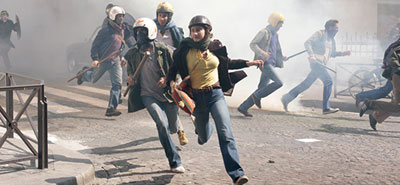
Turns out this semi-autobiographical film by Assayas (director of one of my favorite contemporary French films, Irma Vep) really isn't that different than Harry Potter: the kids are both exceptional and purposeful (extraordinarily so) about their beliefs, suspicious of grown-ups (when they appear in the film), and drawn deeper and more seriously into the activism throughout the movie's first half. Gilles pretty much has it all: he's a gorgeously shaggy-maned, dewy-eyed student, an artist and activist with a beautiful girl friend. He's an intelligent and voracious reader, a junior fatalist with apparently no parents (indeed, few adult authority figures appear until much later in the movie). The conversations of Gilles and his friends are all political, and their after-hours civil disobedience escalates from graffiti on their school building to firebombing, an attack which inadvertently results in the brain damage of one of the guards trying to catch them.
That's only the first act. An entire film about these cigarette-smoking passionately argumentative youths might have been dreary. Their conversations are all political and they go through life with hardly a happy look...smiles are reserved for their "we're happy we'll be having sex and/or acid soon" moments. Gilles is a poster child for the adjectives earnest and intense. After showing his girlfriend one of his paintings, he immediately burns it. "This was for you. You saw itno one else must." You just want them to go ride g-karts or play pinball for a while. You damn kids get off my lawn!
It's in the film's middle section that the poignant and powerful heart of Something in the Air is revealed. Gilles, Christine and Alain flee to Italy for the summer to avoid being arrested. Their political trip gradually becomes more aimless both in locale and ideology, a physical and mental wandering despite their resolute intentions to join up the Italian left. Assayas hits these story beats with well-timed energy and without preachingChristine and Alain follow new lovers and Gilles meanders. Desperately trying to find meaning in their lives and the world, they wind up ultimately doing silly hippie things. Assayas not only perfectly captures that pretentious idealism we all have when we're young but the times when the scales fall off our eyes. It's one of the more subtle coming-of-age films I've seen: Assayas convincingly, touchingly reverses the usual path of growing maturity: sexual, social, and political awareness, their entire lives at the beginning of the film, gradually give way to creativity and self-interest, and their activist lives sputter as they move into mundane but happier worlds.

By the end of the film Gilles is still arguing with his father, but now it's about the portrayal of Georges Simenon's detective Maigret in his film adaptations. He leaves France again, but now to go to London to work as a gofer at Pinewood Studios on a science fiction film. Assayas risks breaking a cardinal film rule by inserting this admittedly more visually compelling film inside his own: Nazi! Dinosaurs! And a bikini babe! It looks like the best film ever, but Assayas has us right where he wants us: we're more interested to follow Gilles through his Very Important Year of 1971. He probably grew up and became a filmmaker and made a movie just like Something in the Air.
This is a dense film but a captivating one: the young leads are very impressive and despite the usual few historical anachronisms (music from a 1972 Robin Williamson album appears in the soundtrack; London Underground "Way Out" signs are entirely modern), Assayas has built and captured the authentic looks, sounds, and feel of an uncertain age that wanders between hard military violence and languorous stoned bliss. The hefty dose of politics is never beside the point, but it's never a political film. It's a film of youth and love and realization and discontent and disillusionment, echoes of life played out on the backdrop of history but ultimately upstaging its grimmer reality. The kids' intensity and energy, both social and romantic, are utterly infectious and I cared for them very deeply. This is the movie from the New York Film Festival, more so than the others (including the I-loved-it Life of Pi), that I've thought about the most, and become more appreciative of on each contemplation. Something in the Air doesn't have the splash of commercial accessibility of Life of Pi or Lincoln, but it's one of the most important films of the festival. Maybe the most important.
Something in the Air premiered at the 50th New York Film Festival on Friday, October 5; subsequent showtime on October 12.
Outrage Beyond (2012) New York Film Festival (2012)
Takashi Kitano follows up 2010's Outrage with Outrage Beyond.
If you've seen the first film you're probably wondering how that is possible, but I assure you it is, as is the possibility of a third film.
This film starts off five years after the previous film. The survivors of the power plays in the first film all find themselves being played by a police detective who is hoping to set every side against each other in order to have them all kill each other. Add to the mix Otomo, played by the director, and a seeming goner at the close of the previous film, and you have yourself the making of a pretty violent mixture.
Two things you should know going in:
First I don't think you need to see the previous film. Yes it helps, but you don't need it.
Secondly the film starts slow and builds to a violent series of gun downs. These aren't big shoot outs but bloody assassinations. You'll see what I mean when you see the film.
I really liked the film a great deal. While not as complex as the first film, it holds together better. Somethings are clearer than before. While it's probably not the absolute best of Kitano's films, it is a damn fine crime film, especially if you're the sort of person with a dark sense of humor...
I do have to say that by the time I saw this film at the press screening I was worn out. I had just seen Michael Haneke's heavy masterpiece Amour and it took it's toll on me, and I don't think I was fully engaged with the film...even so I had a blast. I suspect that down the road, after I see the film again I'll like it even more.
And only because I am a notorious nit picker, I have to say that for me the only real flaw worth mentioning is the sense that the film is aiming for another dip at the well. As the bodies began piling up and things were moving in the second half I was struck by how much I suspected this was not going to end neatly. It didn't completely and when it was done I wanted to see what happens next. I suspect you'll want to too.
This plays Friday at Midnight and Saturday at 9PM and is worth seeing especially with a stoked audience of Takashi Kitano fans (which the press screening was not- though I could tell who was from the scattered reaction).
Tuesday, October 9, 2012
Ginger and Rosa (2012) New York Film Festival 2012
Sally Potter's Ginger and Rosa contains a performance from Elle Fanning that is almost certainly going to earn her an Oscar nomination, if not the Oscar itself. It's a great performance that grows even more amazing when you see Miss Fanning in person and listen to her decidedly American accent.
Set in 1962, when the world is on the brink of nuclear annihilation, this is the story of Ginger and Rosa, two friends who's mothers gave birth to them at the same time in the same hospital. Stumbling through their lives the pair is trying to find their ways. Frightened by the brinkmanship of the superpowers, the pair take their youthful zeal and get involved in anti-nuclear protests in the hope of ending their fears. Things begin to come apart when Ginger's parents separate (yet again) and a betrayal threatens to rip the friends apart.
Beautifully acted and stunningly photographed this is as well made a movie as you are ever likely to run across. This is one of the best produced films I have ever seen where everything you could ever want is in a movie...
...unfortunately writer/director Sally Potter has crafted a film with a screenplay that only has one real character Elle Fanning's Ginger.
Now, before I talk about Potter's script let me wax poetic about Elle Fanning. This is performance for the ages. This is a performance people are going to be talking about. This is a performance that may get her an Oscar. Fanning makes Ginger a confused, frightened and very real young woman. She is every young woman who ever was frightened by life and wounded by it. You can see her pain in every look and gesture...
Watching the film I was blown away by how good she was. Frankly I had no idea who she was. I kept wondering where Fanning was because I couldn't find her. I mean she's an American, isn't she?
Yes she is...a fact that was driven home when at the press conference the blond young lady answered questions with an animated excitement that I've only seen in young girls who are at a rock concert. I kept looking at her and going this blond haired young lady was the red head in the movie...no...no... but it was it really was.
I can't tell you how amazing this young lady is. Anyone who can vote for the Oscars should be given a DVD which not only has the movie but a copy of the New York Film Festival press conference so you can see what she has done...
And I want to be on record that I will be willing to smack any Academy member who doesn't vote at least an Oscar nomination for Fanning on the grounds she is too young and can win it later. Screw any Academy member who has that attitude, if she's this good again she deserves to win multiple Oscars.
Okay, now on to Sally Potter's script... I'm annoyed with it. The film, which creates one of the most wonderful central characters as you are likely to run across, really doesn't have any other characters.
Well it kind of has two others. Rosa, is a force in the early part of the film, but she eventually grows silent and kind of becomes a non-entity even before her betrayal of Ginger. Roland, Ginger's Dad, is definitely a presence, but after a certain point his say one thing do another attitude becomes one note.
Strangely the three most memorable people aside from Ginger are the characters played by Timothy Spall, Oliver Platt and Annette Benning. The two gentlemen play friends of Ginger's mom and Benning is a friend of theirs. The characters as written are little more than wise sages or a Greek chorus that Ginger talks to about her troubles. There isn't much there... except in the hands of these three grand thespians who turn the weak writing into three of the most memorable characters in the film.
To me the lack of characters outside of Ginger is what undercuts the film and makes this just a good film instead of a great one.
The film premiered last night at the New York Film Festival, It played earlier today and has one more screening tomorrow at 9PM. The film is getting a brief week long run in theaters for award consideration before getting a full release in the new year.
Berberian Sound Studio (2012) New York Film Festival
Pity the poor vegetable: the watermelons, the celery, the cabbages that are smashed, chopped, torn and crushed, all in the name of horror. Pity even more the mind of poor Gilderoy (Roy Kinnear-lookalike Toby Jones), which is put through the metaphorical shredder when he goes to work at the Berberian Sound Studio. Gilderoy has been hired as the sound engineer and effects man for a cheap 'n' sleazy Italian horror and gore film, overseen by an overbearing producer and an insanely self-absorbed director. Shy, withdrawn Gilderoy is lost in this world of mayhem at first, then slowly forced to become part of it, still lost in the veggie-maiming turmoil. Berberian Sound Studio is a fine psychological thriller with strong direction by Peter Strickland and a keenly subtle performance by Toby Jones. His dive into the macabre is gradual but inevitable, and as his easy-going, timid nature is buried by stress and uneasiness, the beast begins to come out, but never manifests itself strong enough to even get his travel expense account taken care of. The design and setting is macabre and spooky. Gilderoy is trapped in a maze of featureless grey halls and tiny recording rooms, surrounded by out-of-date reel-to-reel tape and audio recording equipment. Close-ups on the machinery make them especially grotesque and menacing. Never before on the screen has a reel of unspooling magnetic tape lookedand soundedso sinister. The Italian flat Gilderoy is staying in is likewise dismal and drab, and there are absolutely no outdoor scenes (we're left wondering how Gilderoy gets to and from the studio or if he just dreams his way there). The tight set design creates a creepy unease. I experienced claustrophobia nearly as strong as Gilderoy did.
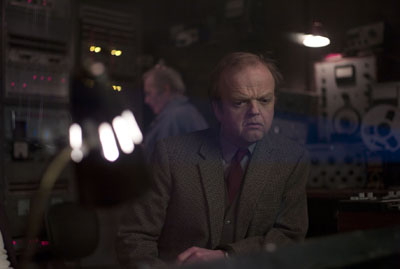
Strickland uses his tiny spaces effectively. The sets are tight and precise and the actors barge forward, pushing Gilderoy into tight corners; Chris Dickens's quick editing is exceptional when Gilderoy is cornered or dressed-down by his Italian employers. Fittingly enough for a movie about a sound engineer, we never see the film (The Equestrian Vortex) within the film (Berberian Sound Studio), with the exception of garish giallo opening credits. ("I thought you said something about equestrian?" Gilderoy asks, as we hear the gut-wrenching shrieks of a woman being brutally tortured. "It is," the producer replies casually, "she's just not horse-riding anymore.") The Equestrian Vortex is left to our horrible imaginations. We only hear it: the tearing and chopping of vegetables as audio stand-ins for severed limbs, the searing bubble of pork on a hot griddle to simulate a sexual assault with a red-hot poker, and the horrific screams of the unenthusiastic and frequently replaced actresses in the sound booth.

Berberian Sound Studio winds in on itself with a cryptic and potentially crippling ending: is Gilderoy trapped in the film he has been helping to make? Is the movie hell? Is the sound studio hell? Are we all just vegetables ready to be crushed for the entertainment of others? There's certainly no escape for Gilderoy, not to mention the poor vegetables. But we're left with a curious and growing belief that nothing's really happened, and several plot threads are completely dropped (was Gilderoy's flight to Italy a dream or real?). Is this the movies equivalent of "The End? title that accompanies so many horror movies?
Despite this weak ending (and unlike Santini's gorefest), this is ultimately witty, sophisticated suspense. There's beautifully and intricately designed close-up and technical cinematography and a sound performance by Toby Jones. Forgive its insubstantial conclusion with a thought of these and that for the first two-thirds Berberian Sound Studio is gripping and captivating. I recommend it. But to avoid causing them undue distress and terror, please, folks...leave your vegetables at home.

Berberian Sound Studio premiered at the 50th New York Film Festival on Friday, October 5; subsequent showtime on October 9.
Monday, October 8, 2012
Liv & Ingmar (2012) New York Film Festival
Liv and Ingmar! They're bad cops on the loose! No, wait, sorry, I've made another one of my silly mistakes. This is not a buddy-cop film. Liv & Ingmar are of course Liv Ullmann and Ingmar Bergman, one of the great actresses of the twentieth century and one of the world's greatest film directors. Director Dheeraj Akolkar's debut film is a fine crystal of a movie magnifying the professional and personal relationship between Ullmann and Bergman over their forty-year relationship, making twelve films together, becoming lovers, splitting, becoming friends again, and defining their relationship not only upon the screen but in real life, as told through illuminating and touching new interviews with Ullmann plus clips from many of Bergman's films, giving them real-life significance and import.

This is not a thing for someone reviewing movies to say, but I honestly admit it: I have never seen an Ingmar Bergman movie. I went into the movie knowing Bergman from reputation (and parodies) and Ullmann for the one film I've seen her in, 1973's horrible car-wreck musical remake of Lost Horizon. I deserve all the accusing comments you may care to pelt me with below. Still, consider this: without having seen those famous classics like Persona and Scenes from a Marriage, I found Liv & Ingmar to be an incandescent and joyful celebration of their lives and work, thanks to top-notch direction by Akolkar, who captures the tempestuous relationship through film and TV clips and especially in the series of moving and personal interviews with Ullmann. This is a great and beautiful document of both their working and personal lives, especially visually coming alive in footage shot on the gorgeous and rugged island of Fårö off the coast of Sweden, where they shared their home.

Ullmann's interviews are the centerpiece of the film, her quiet but warm personality beautifully captured, and it's for her performance that I highly recommend Liv & Ingmar, whether or not you've seen or are a fan of Ingmar Bergman's films. This documentary has intrigued me enough to see them and rectify my above-confessed lack of personal exposure to these two giants of cinema. And if you don't think that Chekhov's gun can make an appearance in a documentary film, keep your eye on the small stuffed teddy bear in the window of their home, and be ready for a beautifully and subtle emotional payoff.
Liv & Ingmar premiered at the 50th New York Film Festival on Monday, October 1; subsequent showtime on October 9.
Subscribe to:
Posts (Atom)