Showing posts with label italian. Show all posts

Friday, October 7, 2022

Unrest (2022) NYFF 2022


The exact sort of film you don't really see much but which has been a staple of the New York Film Festival for decades. A beautifully constructed historic film this is a film who has it's roots in the work of filmmakers like the Taviani Brothers, Luchino Visconti and Roberto Rosellini. Five minutes into the film my thought was "of course this is at NYFF, this is the sort of film that makes the film makers go crazy"

Cyril Schäublin’s UNREST is centered around the story of photographer and political  thinker Pyotr Kropotkin who in the 1870’s was introduced to Anarchism while taking photographs in Switzerland and a watch factory.

Finely structured and tuned the film feels like one of the watches made on screen. This is a film where every detail no matter how small has been perfectly crafted for maximum effect. As I said at the top it’s a film that reminds me of the art films of the 1970’s and 80’s that filled my film classes of my youth. This is a film that is very much about something beyond just the story. For me film was a blast of nostalgia of the sort I haven’t felt in a long time.

And yet the film gives as moments where the various characters, most without names come alive before our eyes. As you watch the brief exchanges between people or the way the actors interact, say bumming a light for their smoke,  we realize that these people are more than just a facade. The cast here magnificently creates a whole  world where everyone is part of it. This is in contrast to most Hollywood films where anyone not a named star just is filler.

I really liked UNREST a great deal. I went into it out of obligation to cover it because it was part of the New York Film Festival and instead came out with a film I ended up recommending to friends.

Worth a look.

Tuesday, February 2, 2016

I Knew Her Well (1965)

Wonderful poisoned Italian confection that has been loving restored and hit theaters starting Friday before being released by Criterion. This is a film that really should be seen on the big screen so that you can get the full effect of it's power.

The story follows a beautiful girl named Adriana who moves to Rome in order to become a celebrity. As she makes her climb up the ladder, we watch as she is battered about by the men in her life, who are forever fleeting and who are just out for a good time.

A damning portrait of society's morals and double standards this film is a real poke in the eye. Let's face it we haven't changed all that much and if you really watch TV or read fashion/celebrity magazines you'll realize that we are just as vapid as ever. Watching Adriana bounce through her life with ever changing hair styles and dresses in order to follow the latest fashion you realize just how little things have changed. Frankly it may very well that we've grown more vapid as a society.

The real star of the film is the music. A broad selection of popular songs from the time the film was made, their frequent up beat nature runs counter to what we are seeing on the screen. This is especially true in the films final moments where the  music gives one a kind of whiplash as it goes against the tragedy of it all.

I know some of you are going to wait for the film to be released on DVD and Bluray by Criterion but don't do it.  This is a film you need to see in a theater on a big screen with big sound. Yes its essentially a small scale drama, but like so many Italian films from the same time they were designed to be seen big. I can't tell you how many films I've seen in film class or at a repertory theater, classics of Italian cinema in particular that look fine on a big screen TV but don't play as well as they did when I see them on the big screen. Frankly I'm convinced that the reason that the films of Fellini have fallen out of favor is not because they are bad but rather they don't have the emotional kick in the ass they do on a big screen (Watch 8 1/2 on a big screen and then try to watch it small- it doesn't work). I KNEW HER WELL is going to be like that. trust me I know,  Long ago I saw some of I KNEW HER WELL in a film class and it had power. The problem with the film class was that we only saw part of films because of he way the school rented them (we only saw as much as we could see in one class period). It wasn't until recently when I was given a a chance to see the film streaming that I saw the end. Seeing the film complete again on a small screen I realized not only how great the film is but also I realized that this would have been so much better big-this is film about trying to be larger than life and it really need to be seen big.

I KNEW HER WELL opens Friday at film Forum and its a must see.


Monday, March 30, 2015

Curtain Raiser: The Film Society of Lincoln Center presents Obscure Pleasures: The Films of Walerian Borowczyk

Walerian Borowczyk's Behind Convent Walls

This week: a chance to see a stellar line-up of films directed by Polish/French surrealist Walerian Borowczyk, at The Film Society of Lincoln Center in New York City. Obscure Pleasures screens a dozen Borowczyk films, including his cult classic The Strange Case of Dr. Jekyll and Miss Osbourne (1981), 1979's Immoral Women, his animated Theatre of Mr. and Mrs. Kabal (1967), 1976's rock-scored The Streetwalker. 1977's Behind Convent Walls is chock-full o' sexually-frustrated nuns, and The Story of Sin (1975) mixes passionate eroticism and a scathing attack on the Roman Catholic church.

That's not all: more Borowczyk films (several in new digital restorations), a compilation of Borowczyk's shorts, and series co-curator David Bird presents his documentaries on Borowczyk in A Dazzling Imagination. On display in the Film Society's Furman Gallery is Walerian Borowczyk: Posters and Lithography, a collection of rare and dazzling movie posters and art.

A master of blending Dadaism and sexuality, Borowczyk both built upon and challenged the mores of the Sexual Revolution, resulting in his much-discussed, often-banned body of work. (Step aside, kids, this one's a little too hot for you!)

I still don't know how to pronounce "Borowczyk," but I'm sure I'll discover how at the series. Find out too, won't you?


Obscure Pleasures: The Films of Walerian Borowczyk runs April 2-9 at The Film Society of Lincoln Center in Manhattan; see the full schedule and details at the Film Society website.

Saturday, November 29, 2014

Tiger of the Seven Seas (1962)

When the Tiger of the Seven Seas decides to retire, his ship is up for grabs. While many people want it, its won by the Tiger's daughter, Consuelo, who bests the man she secretly loves. When the Tiger is killed later that night, Consuelo's love is framed. However before he can be hanged the men of Don Indigo attack the pirates. Its all a plot, hatched by the Don's evil wife, to find out where Tiger's vast treasure is. What follows is a grand game as loyalties are tested and everyone tries to find out who has the loot.

Epic pirate adventure is a great deal of fun. Exactly the sort of European film that played endlessly in the late night hours for decades on free TV until cable over took everything and we ended up with hundreds of movie channels- none of which run films such as this any more.

For my money this is a kind of perfect entertainment. Its a film with few pretensions beyond telling a good story and being entertaining this film manages to create a wonderful place of comfort. Watching it we don't have to think. We don't have to worry about if the good guys are going to win or if the bad guys are, we know that with certainty, everything will be okay in the end . The highest praise is that the film is a kind of cinematic comfort food.

Highly recommended for anyone tired of big over blown Hollywood productions

Tuesday, January 21, 2014

The Last Shark (1981)

Steven Spielberg's timeless classic Jaws has inspired so many films since it's 1975 release. Given anytime you have a huge success like this, you are opening the flood gates for countless imitations. Deadly Piranha, a killer Orca whale & a gigantic mutated Alligator. Of course numerous Shark knock-off films followed suit after Jaws and it's direct sequel. So many of these came from Italy: Bruno Mattei's Cruel Jaws, Joe D'Amato's Deep Blood, and the ultimate Jaws rip-off, Enzo G. Castellari's The Last Shark (aka Great White).

If you have never seen The Last Shark, you might ask yourself just what makes this the defining Jaws inspired knock-off. Very shortly after the 1982 theatrical release of The Last Shark, it was quickly pulled from U.S. theaters. Universal Pictures (the distributors of Jaws) sued to have the release of The Last Shark blocked from North American distribution. Universal's claim was that the makers of The Last Shark were guilty of plagiarism. Needless to say, Universal easily won the case.

Just how blatant is that plagiarism? Well let's examine it. The Last Shark takes place in the community of Port Harbor. In Jaws, it was Amity Island. Ok not a huge deal but let's continue. Back to The Last Shark, after a young teen dies from a deadly shark attack, our main characters Author Peter Benton (James Franciscus) & the grizzly shark expert Ron Hamer (Vic Morrow) look into the case. They discover the community is under attack by a man-eating Great White Shark. With no help from the greedy, ignorant governor they are left to...well you can guess where this is going. It feels as though Castellari literally took Spielberg's script and simply switched a few things around.

Where do I possibly start?!  Our main player, in other words our Chief Brody, is named Peter Benton. Who just happens to be a writer. Let's connect the dots: the author of the novel for Jaws was Peter Benchley. Benchley...Benton...I can certainly appreciate if that was a nod to the book. As cheesy as it may be. Oh and the fun fact of it all, actor James Franciscus was the guy that stepped into Charlton Heston's role in the first of many sequels to the original Planet of the Apes. Now he's The Last Shark's Roy Scheider. Always the bridesmaid, never the bride.

Enter Quint, the old professional who knows everything that...I'm sorry I mean, enter Ron Hamer. The old professional who knows everything that is going to happen before it happens. With an epic name like Ron Hamer, he should know what type of shit is about to go down. I have nothing against Vic Morrow. He was a fine actor and certainly tried his best to live up to Robert Shaw's incredible role. Despite failing miserably.

The governor in The Last Shark, the mayor in Jaws, it's ultimately played out the same way. Though comparing the believability of both actors is day & night. Replace Richard Dreyfuss with an Italian actress/model. Throw away any bit of suspense, production value and a memorable film score. That in a nutshell is The Last Shark. The filmmakers even managed to imitate a few memorable scenes from Jaws 2.


So where does this rank on the Shark film list? Well it's certainly no where near the top/best. However I can't claim that it's the worst either. It's not in the 'so bad-its good' category (Ex: Deep Blue Sea). It's not even in the 'embarrassingly awful' category (Ex: Jaws: The Revenge). The Last Shark is just sort of stagnant. It's a cheap film who's only intention was to capitalize on it's predecessors success. Certainly no worse than what Universal did with the later Jaws sequels.


Thursday, October 11, 2012

Caesar Must Die (2012) New York Film Festival

When I was studying for a semester abroad in London during my junior year in college (bear with me, this story does go somewhere), I was able to see, for astonishing student cheap rates, a lot of theater every week, and a lot of that was Shakespeare. This was 1983: the Royal Shakespeare Company had just opened their season at the spanking-brand-new Barbican Center, where they were able to offer several rotating plays. The National Theatre had been in its new home on the South Bank and offered a series of live plays on three distinct stages of different size and configuration. I saw some grand (and a few not-so-great) performances of A Midsummer Night's Dream, Much Ado About Nothing, Measure for Measure, The Taming of the Shrew, Henry IV Parts 1 and 2 (with Patrick Stewart as Henry IV and Timothy Dalton as Hotspur), and, at the RSC's base in Stratford, Julius Caesar. It was thanks to this total immersion in the plays of Mister Shakespeare that I became even more of a devout fan than I had been, and study of the Bard, his works and contemporaries became field of study in undergraduate and graduate school.

Still naïve and young then in 1983, however, I asked my drama professor why companies modernized Shakespeare. Why were productions of these Elizabethan area plays produced in later historical, or even modern drag? He gave me one of the most important lessons I've learned in college or after: "You tell me." He set this for me as my final term paper and opened doors for me at theater companies and production offices. I dug into the productions we'd seen, but traditional and contemporary, watched films of Shakespeare's plays: my first exposure to Peter Hall's amazingly way-out A Midsummer Night's Dream, Roman Polanski's Macbeth and Orson Welles's bafflingly brilliant Chimes at Midnight I'll spare you the length of my final paper and sum up the conclusion succinctly: Shakespeare is of the ages. His words and characters speak to our times as well as his own. Through modernized set design or post-Elizabethan historical costuming his stories become more than just a comment on the sixteenth century. Since then I've seen dozens of Shakespeare productions in this mode and come to love them: a later RSC production of As You Like It updated to the Edwardian era, Akira Kurosawa's Japanese Lear in Ran, Kenneth Branagh's bubbly and infectious Much Ado, Ralph Fiennes's brilliant Coriolanus as modern war tragedy, and the BBC's recent series of modernized Shakespeare Retold, especially the Damien Lewis/Sarah Parish newsroom re-setting of Much Ado About Nothing, with Billie Piper playing Hero as a weathergirl. Purists may scoff. I believe Shakespeare, however, would have loved it. His plays were for his audiences, to enjoy and laugh and cry, and if they weren't careful, they may just have learned something. We still do that today.


Which finally brings me to this grand re-imagining of Julius Caesar, Paolo and Vittorio Taviani's powerfully innovative Caesar Must Die. 1983 me might have been puzzled by it. 2012 me was captivated. We're among a group of prisoners in a high-security Italian prison. As they do each year, they're preparing to produce and act in a play, and we see Julius Caesar come to life as they rehearse in the cells, hallways, and yards of this grey concrete prison. The rehearsals present the events of the play in chronological order, in stark black-and-white—the Tavianis only use color for a wrapping sequence that presents the actual performance. They clown about, egos clash, they make breakthroughs. The director encourages them to play this in their own Italian dialects. Prison guards comment like a Greek chorus on the action and the characters. They take the events of Caesar and apply it to their own situations and lives. The text reminds one prisoner too much of his life outside, and he's morose and irritable. This is Shakespeare not only as drama but as a play itself; the microcosm of a closed community that mirrors the events of the drama. Is the prison Julius Caesar's stagnant Rome? Is Rome a prison?


The Tavianis's direction and design is majestic; the prison is more impressive and expressive than any stage. We come to know these men through an innovative technique: as they audition for their roles, they give their names and family histories in two different ways: defiant and despondent. It's brilliant shorthand for introducing us to the prisoners as players; their personalities and strengths are "on stage" immediately before us, even for such guarded men as these. You would say that this is the a brilliant portrayal of actors as prisoners, but... These aren't actors. These men actually are prisoners, and the annual drama production is a real-life program. What looks like a documentary is more powerful that we know (from the first, so I've misled you a bit) that these are real prisoners, in a true jail. The Tavianis's film is not a documentary—they given a fictional script to surround the events—but all the actors are playing themselves. And they are absolutely brilliant. I've told you previously about my so-far-favorite film of the New York Film Festival (Life of Pi), the most thought-provoking (Something in the Air), and the most beguiling story (Barbara). Caesar Must Die takes it for me in the Performance category, especially Salvatore Striano (Brutus) and Cosimo Rega (Cassius). They moved me to genuine laughter and freely-weeped tears, more than Branagh or Olivier or Barrymore.


When the company stands, shoulder to shoulder at the curtain call of their performance, there's great jubilation, infectious wide smiles and laughter, backslapping camaraderie and pride. Then, they're locked up in their cells again. Shakespeare and Rome is the only freedom they will have. "Since I got to know art," one of the prisoners says, "this cell has become a prison." Ironic how it opens our world for us too. Truly, Shakespeare is for the ages. Even fifteen to twenty-five years, or life.

Tuesday, October 9, 2012

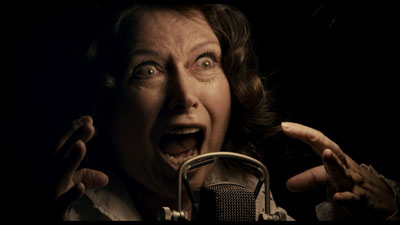
Berberian Sound Studio (2012) New York Film Festival

Pity the poor vegetable: the watermelons, the celery, the cabbages that are smashed, chopped, torn and crushed, all in the name of horror. Pity even more the mind of poor Gilderoy (Roy Kinnear-lookalike Toby Jones), which is put through the metaphorical shredder when he goes to work at the Berberian Sound Studio. Gilderoy has been hired as the sound engineer and effects man for a cheap 'n' sleazy Italian horror and gore film, overseen by an overbearing producer and an insanely self-absorbed director. Shy, withdrawn Gilderoy is lost in this world of mayhem at first, then slowly forced to become part of it, still lost in the veggie-maiming turmoil.
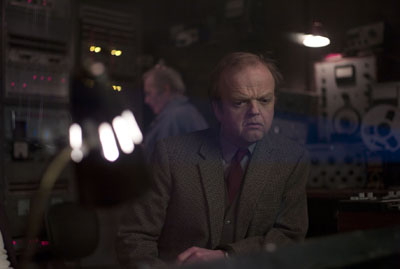
Berberian Sound Studio is a fine psychological thriller with strong direction by Peter Strickland and a keenly subtle performance by Toby Jones. His dive into the macabre is gradual but inevitable, and as his easy-going, timid nature is buried by stress and uneasiness, the beast begins to come out, but never manifests itself strong enough to even get his travel expense account taken care of. The design and setting is macabre and spooky. Gilderoy is trapped in a maze of featureless grey halls and tiny recording rooms, surrounded by out-of-date reel-to-reel tape and audio recording equipment. Close-ups on the machinery make them especially grotesque and menacing. Never before on the screen has a reel of unspooling magnetic tape looked—and sounded—so sinister. The Italian flat Gilderoy is staying in is likewise dismal and drab, and there are absolutely no outdoor scenes (we're left wondering how Gilderoy gets to and from the studio or if he just dreams his way there). The tight set design creates a creepy unease. I experienced claustrophobia nearly as strong as Gilderoy did.


Strickland uses his tiny spaces effectively. The sets are tight and precise and the actors barge forward, pushing Gilderoy into tight corners; Chris Dickens's quick editing is exceptional when Gilderoy is cornered or dressed-down by his Italian employers. Fittingly enough for a movie about a sound engineer, we never see the film (The Equestrian Vortex) within the film (Berberian Sound Studio), with the exception of garish giallo opening credits. ("I thought you said something about equestrian?" Gilderoy asks, as we hear the gut-wrenching shrieks of a woman being brutally tortured. "It is," the producer replies casually, "she's just not horse-riding anymore.") The Equestrian Vortex is left to our horrible imaginations. We only hear it: the tearing and chopping of vegetables as audio stand-ins for severed limbs, the searing bubble of pork on a hot griddle to simulate a sexual assault with a red-hot poker, and the horrific screams of the unenthusiastic and frequently replaced actresses in the sound booth.


Berberian Sound Studio winds in on itself with a cryptic and potentially crippling ending: is Gilderoy trapped in the film he has been helping to make? Is the movie hell? Is the sound studio hell? Are we all just vegetables ready to be crushed for the entertainment of others? There's certainly no escape for Gilderoy, not to mention the poor vegetables. But we're left with a curious and growing belief that nothing's really happened, and several plot threads are completely dropped (was Gilderoy's flight to Italy a dream or real?). Is this the movies equivalent of "The End? title that accompanies so many horror movies?

Despite this weak ending (and unlike Santini's gorefest), this is ultimately witty, sophisticated suspense. There's beautifully and intricately designed close-up and technical cinematography and a sound performance by Toby Jones. Forgive its insubstantial conclusion with a thought of these and that for the first two-thirds Berberian Sound Studio is gripping and captivating. I recommend it. But to avoid causing them undue distress and terror, please, folks...leave your vegetables at home.


Berberian Sound Studio premiered at the 50th New York Film Festival on Friday, October 5; subsequent showtime on October 9.

Saturday, January 1, 2011

Unseen Turkey Day, Hours 15-16: Outlaw (#519, 1993)

MST3KPerhaps...no, certainly...Mystery Science Theater 3000's watershed moment came halfway through season 5 when series creator Joel Hodgson left for the greener fields of TV Wheel and a website about ants. (But I kids the Joel, whom I loves.) Enter Mike Nelson, playing Mike Nelson, the new human aboard the Satellite of Love and a new kind of foil for the bots. It's been said that if Joel is a father figure for the bots (well, literally; he built them), then Mike is the genial but clueless big brother, prey to the bots' tricks and japes, usually willing to go along for a laugh, and decidedly more energetic and animated than the generally-laid-back Joel. "Joel or Mike" flamewars claimed the lives of over fourteen thousand MSTies in the great Discussion Wars of '93, and for years after the watchword on discussion groups was "Don't mention the war. I think I mentioned it once but I got away with it."


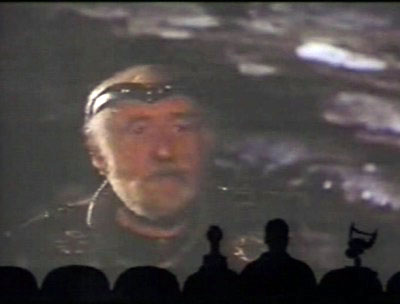
Me, I'm a huge Mike fan: I believe that his fictional and real personas energized and goosed the show into some of its best shows (for me, the Golden Age of MST is the fifth and sixth seasons), and while Outlaw (1987) is certainly one of the worst films MST3K's ever riffed on, it's become one of their most-loved experiments. It's definitely not a show that should be shown to a newbie for their first intro to the series, but once you've got the tropes and beats down, well, roll out the Outlaw, I says.

Outlaw very loosely adapts John Norman's infamous and misogynist "Gor" sword and sorcery series that inspired approximately one bajillion naughty fan fiction stories on the internet, into a fantasy movie that could only be sexy to young teenagers sneaking a peek at it on Cinemax After Dark. Featuring quite possibly the world's most unlikely barbarian hero, Tarl Cabot:

MST3K


Like Solo and Chewie, like Frodo and Gollum, like Kate and Allie, every fantasy hero needs a weird, creature-like comedy-effect sidekick, and Cabot's is the sleazeball coward Watney Smith. That's him on the right there, of course.

MST3K


Sheesh, he looks like a slimier, Earth-3 version of my pal John.

Thanks to convenient flashback to an earlier film we've never seen, our brains are infodumped the backstory like a garbage truck backing up to a landfill: Cabot was once magically whisked away to a mysterious barbaric land called Gor, where the ladies dress in leather and he met Rufus from Bill and Ted.

MST3K


Now, in a desperate attempt to have themselves a sequel, Cabot and Smith wind up in Gor again, where Cabot's reunited with his albino dwarf pal Hup...

MST3K


...and with his one true love, warrior princess and professional hair product model Talena:

MST3K


Meanwhile, high priest Jack Palance, wearing hats only Jack Kirby could have designed...

MST3K


...and crazed killer queen Donna Denton...

MST3K


...plot to overthrow the kingdom, kill the king and the princess and exile Cabot and Hup to the Moon Zero Two set.

MST3K


That's pretty much the whole plot of the movie right there. Cabot, armed only with his dwarf and loincloth, fights back against the city's army, the forces of evil, and freaking Jack Palance to win the day and keep sexy fantasy B-movies safe for late night cable.

One creepy remnant of the original John Norman novels is the subplot that on Gor, women are possessions, and once Cabot reluctantly rescues a model-perfect slave girl, she belongs to him. "No thanks, I've already got one," should be the proper response, and you should ask if there's a gift receipt so you can exchange it for a blender or perhaps that boxed DVD set of David Attenborough's Planet Gor you've got on your Amazon.gr wishlist.

MST3K


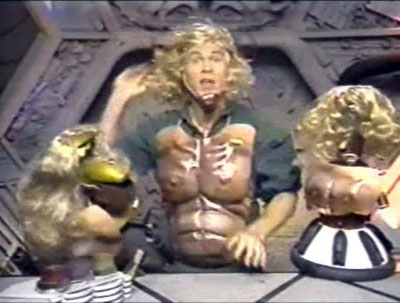
All the flesh on display in this movie doesn't go unnoticed by Mike and the bots. Even before they've settled down in the theater they're cosplaying as Fabio. Well, it gives Crow a chance to strap on the Jay Leno chin again!

MST3K


But by far the highlight of the host segments, and one of MST3K's most beloved musical numbers, celebrates the expanses of epidermis on display throughout Outlaw:


Eh, it's got Palance in it, but don't hold that against him. Guy had to pay the bills somehow.

Oh jeez, I just looked up the Gor series on Wikipedia only to find out it's still being published. Curse you, John Norman! From Hell's heart I stab at thee!

Unseen Turkey Day, Hours 11-12: Operation Double 007 (#508, 1993)

MST3KZzzzzz...zzzzzzz... wub wub wub wub...zzz, zzz... snort..uh! Oh! Uh! I'm awake, I'm awake! Sorry, it's getting into the wee hours of the morning and I'm dozing off a little while I'm staying up all night watching 25 straight hours of Mystery Science Theater 3000. And I'm afraid I just had the strangest dream. It was a really weird one, almost like a fever dream. Seriously, you couldn't even believe have the stuff I thought I was seeing.
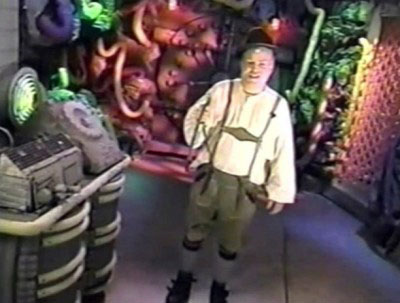
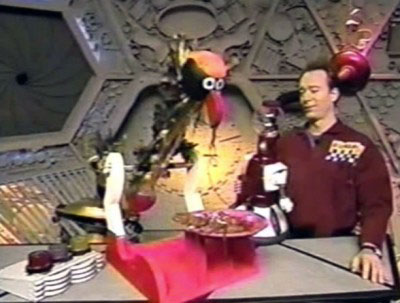
I dreamed I was watching an episode of MST3K, but none of it made any sense! TV's Frank was in lederhosen...

MST3K


...and Crow had invented a buzzard toy that bobbed up and down to get at rotting raw flesh...

MST3K


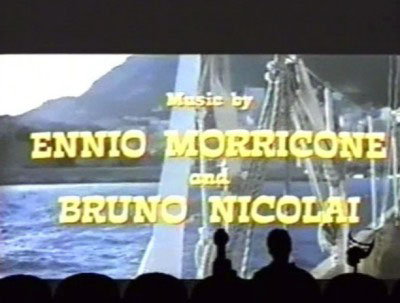
Clearly I must have been dreaming, because a prestigious composer like Ennio Morricone would have had nothing to do with a cheesy film that's fodder for MST3K.

MST3K


At that point in the dream Emile Largo from Thunderball came in wearing his bathrobe accompanied by scantily-clad vixens...

MST3K


And Sean Connery's brother Neil was there, too! Man, my dreams have a low budget.

MST3K


Around that point, things really started getting surreal...

MST3K


Especially when "M" and Miss Moneypenny showed up to meet with Neil Connery. What's up with that, REM sleep?

MST3K


Also, Lady Gaga was in my dream.

MST3K


Then Miss Moneypenny started firing a machine gun. Hmmm, I wonder what Freud would have to make of that dream? Oh well, sometimes a machine gun is just a machine gun.

MST3K


And no reputable dream therapist would find anything unusual at all about a group of old west showgirls hijacking a nuclear missile.

MST3K


This part of my dream tells me I'm a little obsessed with Marlon Brando's portrayal of Jor-El in Superman: The Movie...

MST3K


...then there was something about radioactivity being woven into marketplace bazaar carpets...

MST3K


You could tell it wasn't a real movie, because at the end, the villain escaped.

MST3K


Then, Torgo showed up.

MST3K


So, that was a pretty weird-ass dream, and not at all an episode of Mystery Science Theater 3000. That will teach me to eat toasted cheese before bedtime. Let's see if I can stay awake all night for the next exciting MST3K episode, or if I fall asleep and dream about a fat gluttonous private detective in bed with Krystle Carrington, some generic beer, and a bottle of baby oil. Hah! Like that could ever be a movie!