Showing posts sorted by relevance for query bigfoot. Sort by date Show all posts

Thursday, March 12, 2026

Capturing Bigfoot (2026) SXSW 2026


When I was talking to Marq Evans about his previous film THE DIAMOND KING, he said that his next film was going to be on Bigfoot and specifically the Patterson/Gimlin film. He told me a reel of film had come to light that was going to change everything. I asked him not to say anymore because I didn't want to have any preconceived notions when I saw the film.  We left it there until the film was listed as part of this year's SXSW when I reached out and asked to see the film.

CAPTURING BIGFOOT is the story of the best-known film footage of Bigfoot, the Patterson/Gimlin film that was shot in 1967 when the pair was out looking for the creature when one showed up and Patterson was thrown from his horse but held on to his camera. It's the tale of what happened as told by Patterson's son, Clint, and the other people involved with it, as well as the people who believed and those that didn't. It's a very bittersweet and melancholy film not just for its revelations but because it's the story of lives broken apart by the a few feet of film.

Shot in a style that at times mirrors the "true life" documentaries of the 60's and 70's. The film recalls a bygone era when you had to go to the movies to see real life monsters on the big screen. The film then hooks us with Clint Patterson watching the newly discovered film for the first time and his saying that it was going to change everything.

The selling point of the film is that recent discovered reel of 16mm film that had been locked in a vault for decades. We know the film exists at the start and it is hinted that the revelation, borne out later in the film, that it reveals the film we all know is a hoax.

Most of the film is a look at the life and times of Roger Patterson told by his son and some of the people who knew him. The film explains the whole story of the film of bigfoot that we've seen for almost 60 years, how it was supposedly shot, how it was marketed and how it tore families and friendships apart. I was not expecting the melancholy that the film creates in the viewer. There is a great sadness not only in seeing the lives of people whose whole existence is a short piece of film, but the way that piece of film wrecked lives as friendships were broken, money was stolen, and families were destroyed as family members said things to each other that should never be said. (And that is before the sadness that occurs when you realized how this film is going to break hearts and destroy the worlds of people invested in Bigfoot.)

When we finally get to the final half hour things are not as we expect. There is no grand "ah ha" moment, and the result is a film that leaves us unsettled for a variety of reasons.  The first being that the revelations shift the bigfoot board largely irrevocably. There is no going back now. What does this mean for our thoughts on the Patterson film? What does that mean for those whose lives kind of depend upon it? What of the destruction that the film has laid out? Interestingly there is no grand triumph. Other than writer Greg Long, who feel triumphant, no one is particularly happy or delighted. Damage is done.  You can't really be a feeling person and walk out of the film and feel good. Even if you felt the film was a hoax, you can't feel happy at what transpires, too many people have been hurt. The huge strength of the film is that Evans doesn't paint the ending as something glorious but allows the moment to be colored by sadness as everyone realizes that the last 6 decades were ultimately empty. Patterson's nephew's declaration of it being cool to be part of the hoax rings hollow and the efforts of a man to try in find something good in spoiled goods.

As an emotional ride this film is something special. The film packs an incredibly strong emotional punch; unlike anything Evans has done before and I absolutely love that.

If there is any flaw in the film is that there may be one or two niggling points that can be picked at, and which will be picked at, by the bigfoot true believers who will not want to accept the truth, despite Patterson's widow and others saying it was faked. Some people are not going to accept the truth, for example special effects man Bill Munn is seen refusing to accept it as a fake even after being given all the evidence. It is something many people are going to choose to do because they simply can't let go.

CAPTURING BIGFOOT is ultimately a great film. It's literally a game changer. If you have any interest in bigfoot or popular culture, the film is a must see.

Tuesday, April 8, 2025

The Bigfoot Club (2025)


I have been trying to write up BIGFOOT CLUB for a couple of weeks now. It’s not a matter of it being a bad film, more that how I view the film and what I like about it shifts from day to day. Some times I love the nostalgic turns in the film, and on other days I love the films look at loneliness and friendship over time. Each time I focus on one aspect and diminish the other and then when I go back to it I rip up what I wrote and refashion it into what I feel at that moment. 

That my friends is a rave. I say that because it’s an indication that director Steven Tsapelas has made a living breathing film that once you see it you continue to engage with. It's that very rare film that doesn't just sit there with each viewing but engages with you with each pass, inviting you to not only find the hidden goodies but to also see it through a new set of eyes.("Why not look at it THIS way")

A rough description of BIGFOOT CLUB would be to say it tells the story of a woman named Dorothy March who was the driving force behind the Bigfoot Club, a group of teens who investigated weird mysteries like bigfoot. They were also the subject of a PBS series. Two decades later Dorothy finds herself and her friends caught up chasing the hairy beast once more. There is more to it than that but it's enough to gt you started

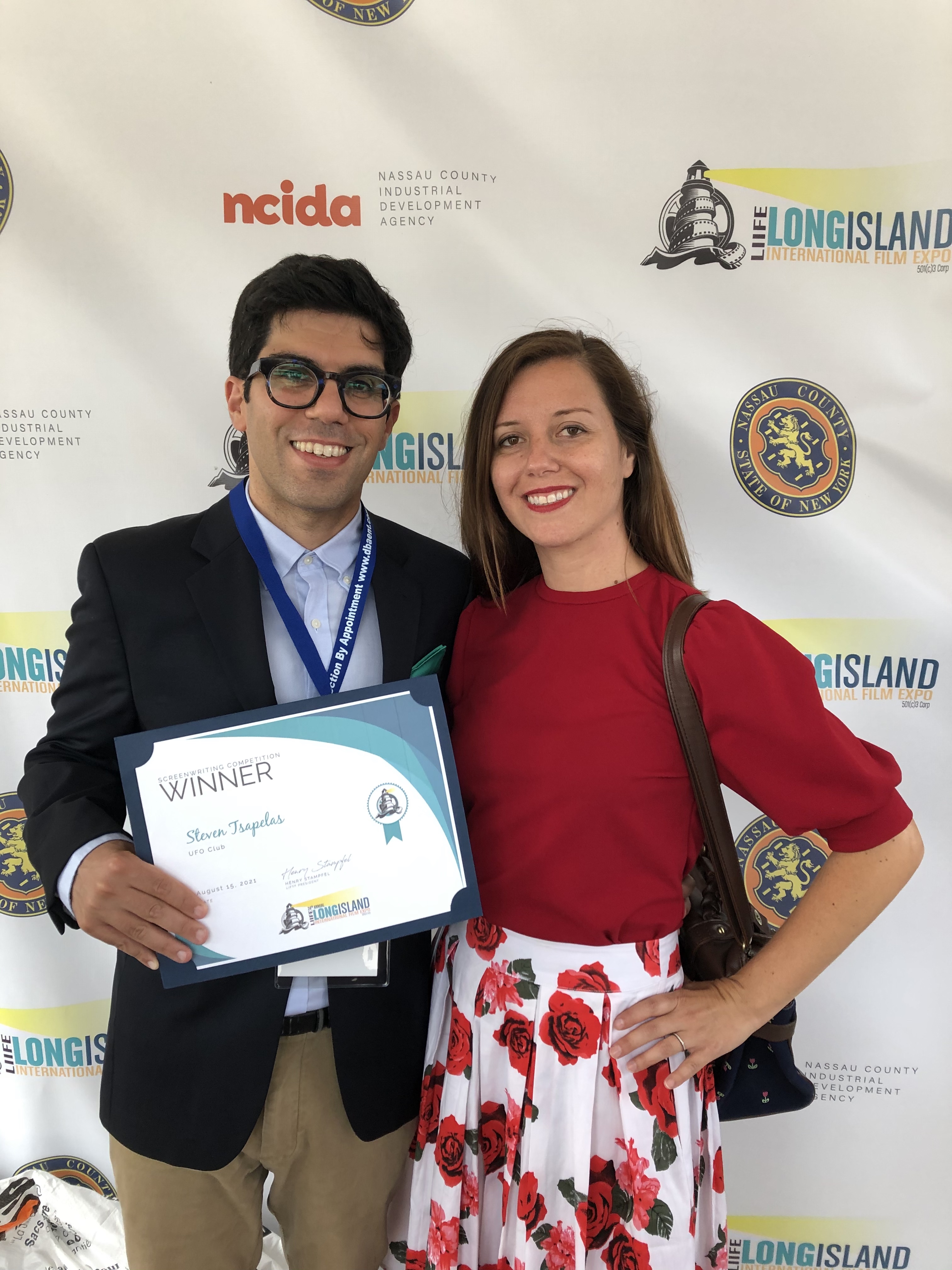
Tsapelas is another member of the In the Garage Productions group.  This group of filmmakers are near and dear to my heart because they are based on and around Long Island where I live.  They are also a group of filmmakers who grow exponentially with each new film. I've seen all there films to date and these guys and girls just get better every time out. I will tell their story later but know you need to track down all of their films including Steve's previous film UFO CLUB.(You should also track down Steve's work for both Marvel and Archie comics)

This is sweet film. Not only is this the story of a young woman reconnecting with her past and her soul, but it is also a film that is full of nostalgia as  flashbacks from the Bigfoot Club show and references to other TV shows.  These little pieces  will set your mind going and will make you want to see either more bits or to see what’s here expanded. Essentially Tsapelas has constructed a film that is like a Sunday drive, where you pass neighborhoods that you want to revisit.

But there is way more going on here. Tsapelas has fashioned a strong character study about a woman lost in her life. It's a touching examination of finding our place in the world and the importance of friends in our lives. Most importantly it's a film that doesn't take the expected turns, with the result that when the end comes you may very well find yourself misting up. I mention this because the first time through I fought the film for a bit since, me the smart ass film writer who occassionally thinks he nows everything,  found he didn't.

This is a wonderful film that is going to grow in your heart and become a favorite.

Playing soon at a festival near you, BIGFOOT CLUB is going to be one you will want to make an effort to see.

Wednesday, July 9, 2025

The Big Foot Club (2025) premieres July 10 at LIIFE


I have been trying to write up BIGFOOT CLUB for a couple of weeks now. It’s not a matter of it being a bad film, more that how I view the film and what I like about it shifts from day to day. Some times I love the nostalgic turns in the film, and on other days I love the films look at loneliness and friendship over time. Each time I focus on one aspect and diminish the other and then when I go back to it I rip up what I wrote and refashion it into what I feel at that moment. 

That my friends is a rave. I say that because it’s an indication that director Steven Tsapelas has made a living breathing film that once you see it you continue to engage with. It's that very rare film that doesn't just sit there with each viewing but engages with you with each pass, inviting you to not only find the hidden goodies but to also see it through a new set of eyes.("Why not look at it THIS way")

A rough description of BIGFOOT CLUB would be to say it tells the story of a woman named Dorothy March who was the driving force behind the Bigfoot Club, a group of teens who investigated weird mysteries like bigfoot. They were also the subject of a PBS series. Two decades later Dorothy finds herself and her friends caught up chasing the hairy beast once more. There is more to it than that but it's enough to gt you started

Tsapelas is another member of the In the Garage Productions group.  This group of filmmakers are near and dear to my heart because they are based on and around Long Island where I live.  They are also a group of filmmakers who grow exponentially with each new film. I've seen all there films to date and these guys and girls just get better every time out. I will tell their story later but know you need to track down all of their films including Steve's previous film UFO CLUB.(You should also track down Steve's work for both Marvel and Archie comics)

This is sweet film. Not only is this the story of a young woman reconnecting with her past and her soul, but it is also a film that is full of nostalgia as  flashbacks from the Bigfoot Club show and references to other TV shows.  These little pieces  will set your mind going and will make you want to see either more bits or to see what’s here expanded. Essentially Tsapelas has constructed a film that is like a Sunday drive, where you pass neighborhoods that you want to revisit.

But there is way more going on here. Tsapelas has fashioned a strong character study about a woman lost in her life. It's a touching examination of finding our place in the world and the importance of friends in our lives. Most importantly it's a film that doesn't take the expected turns, with the result that when the end comes you may very well find yourself misting up. I mention this because the first time through I fought the film for a bit since, me the smart ass film writer who occassionally thinks he nows everything,  found he didn't.

This is a wonderful film that is going to grow in your heart and become a favorite.

Playing soon at a festival near you, BIGFOOT CLUB is going to be one you will want to make an effort to see.

Steve Tsapelas talks THE BIGFOOT CLUB


I first came in contact with Steve Tsapelas on Twitter a decade or more ago. We'd follow each other's exploits and comment on them. When Steve made his first feature, THE UFO CLUB, I jumped to review it. I loved it.

Despite being in internet contact I didn't meet him in person until a few months ago when Ken Frank had a screening of HOW I SPENT MY SUMMER VACATION for friends and family. It was at that screening Steve told me that he had his new film BIGFOOT CLUB close to being finished.  He sent me the film, I fell in love with it and it's story of friends new and old, and asked for an interview.

Steve is an interesting man. He's made TV shows of his own, written for others, written for Marvel Comics and done enough things that I need to do another interview with him just to cover all of the things he's done away from feature films (And that is before we talk about how he shoots his projects). While talking to him about BIGFOOT CLUB he kept referencing these other projects that he did and which I couldn't fully explore lest I get off the topic of his new feature. As it is I had to do some trimmins so that what follows is primarily focused just on BIGFOOT CLUB and not all over the place.

A couple of quick notes:  

First Steve is part of the the kick ass collective In The Garage Production. Founded by Ken Frank and Chris Mollica, In The Garage is a tight knit group of people who just want to make movies. They have honed their craft and are able to make micro-budgeed feature for very little money.  They are one of the best studios out there today and their out put of films, from Steve, and Ken and Chris and others, is as consistently good, in it's way, as Pixar or Ghibli. (No, really.) Because Steve mentions Ken several times I wanted to give context. They are best friends. The pair met at the Long Island International Film Expo years ago and they became friends and co-consprirators in cinematic confections. (BIGFOOT CLUB is premiering this year's edition of LIIFE this weekend).  

Second, because two Steve's were talking to each other I had to list my side of the talk under UNSEEN.

I want to thank Steve for taking the time to talk to me. Hopefully we will talk again soon.


Stev and his wife, Ana.

UNSEEN: How did you how did you  come to meet Ken Frank? 

STEVE:  Ken's movie FAMILY OBLIGATIONS was playing at the Long Island Film Expo and I had a TV pilot the self-produced called HOT AND NERDY that was also playing there And I saw him on a panel and I thought we had similar attitude towards filmmaking. Then I was the awards ceremony, which is a very long ceremony, a lot of films get awarded. It's like a really great showcase. The clip that really stuck out to me was the clip from FAMILY OBLIGATIONS. I just I loved the tone of it. I could tell right away that it was well-made and that he had a great sense of how to make a movie that was independent, but didn't have like the kind of trappings of an independent movie It it felt really real and it had a point of view So after the the awards when he actually won Best Picture, I contacted him on Twitter and I was like, "hey, I was at the award ceremony You know, your movie look great Congratulations" He immediately responded and sent me the link to the movie and like we've become friends

 UNSEEN:  You've had an interesting career. You've had an interesting career. You've written for Marvel, TV stuff, and you've stalked David Duchovny from the X-Files.

STEVE: It's my wife [Ana Aflorei] who is a huge, like gigantic X-Files fan. She has a podcast about the X-Files. She's a big X-Files person. I just go to be supportive and to keep her from kidnapping him. You know like there's a community around the show  and  they're really nice people So when we go to events we see all the same people.  

UNSEEN: Were you always the Bigfoot guy, the UFO guy? 

 STEVE: I wouldn't say I'm like the world's biggest UFO or Bigfoot fan, but I thought it was a good way to frame a personal story around a genre It had a little bit something different.  By doing that with Bigfoot with the with Bigfoot Club you have a community You now have a starting point and then you you can work out from that into all sorts of directions

 It's kind of a true story, in some ways. I was in a UFO club in high school. Someone did come and raffle off a tape of a UFO crash on Long Island and a girl did drop her own name In the raffle and then the guy was arrested for trying to kill local congressperson

 UNSEEN: That's the Smithpoint Park crash...

 STEVE: Yes. The funny thing to me was that like my friends and I were gonna if one of us got it we were gonna hang out together and watch it. But once the girl got it, we're like, oh man, we're never gonna see this tape There's no way a girl's gonna invite us to her house, so that was kind of a funny jumping off point. 

As a kid, like most kids, I was obsessed with like Bigfoot and Loch Ness Monster and would read books about it and like the Patterson Gimlin film and then you know, I wanted to tell another personal story and I needed some sort of element and on the set of UFO Club. We were joking like Well, what's the next one's called Bigfoot Club, why don't we make a sequel called Bigfoot Club?

So I had that in my head and I was like, well if I was to make another movie I want to incorporate Bigfoot. How would I make it?

 Also when I was younger my friends and I made a web series. It was successful and we sold it to a network and then like, you know when success happens different people have different feelings about it and  different dynamics blow up. That was kind of in my head. It was pretty personal and everyone has a different angle and reason why they wanted to make something, like why we wanted to make our own TV show.  And I turned 40 and I started to reflect on my life and my   friends who had gone away and I wondered what was the cause of that? And so I was exploring that but through the lens of cryptid just as I wanted to find  a different element so it wasn't just a straight dramedy. 

UNSEEN: It seems like you were the sort of person who like spent too much time watching TV. Because watching  the film I could see where you lifted  the pieces. It feltit wasl like a real PBS show. This the sort of thing that would have run on PBS.

 STEVE: When I was a kid, I think I watched from like 6 a.m. until I went to bed.  I was obsessed with TV And you know TV never let me down. It was like my best friend and I felt connected to it. When I was making this I was glad that I edited it because I was such like a maniac for those details That I couldn't explain like the way like those commercials should be paced or like those TV show inserts should be edited or or things like that. I had to be very hands-on with it because in my head I could hear the beats of those commercials But like to explain them to someone else would have taken way too long So it was just very second nature for me to like dive in on that

 UNSEEN: When I was talking to Ken he said you two have a simpatico. You'll tell him what you want and he's thinking "I don't know what he wants But he tells me what he wants and I know that's  what he wants" And you don't have to explain it beyond that  he just goes with it. And it works. I've only rarely heard of that really working among filmmakers.

STEVE:  Understand that Ken and I talk all day long. Our friendship like really developed quickly. We have a lot of like similar touch points.

We're both total movie nerds. He is a Criterion collection kind of guy. I love that too,but I leave more room for other genres. But I do think we have these connections that like we can shorthand it with each other. We were both the kind of kids who are watching like the Marx Brothers and the Three Stooges. We have a lot of like touch points that aren't necessarily even like normal for guys our age, but like it's a real connection and I do appreciate that even sometimes he thinks I'm crazy when I say these things like that I want to recreate an old commercial that he always like goes with it and trust me. That's really great. And why I think we work together so well is that Even though he thinks I'm nuts. 

I don't I don't think I would be making features had I not met Ken. He was the one who really talked me into it. So I feel very fortunate that I met Ken and Shauna. They've made this possible. Otherwise, I would not have known how to do this without them and their whole infrastructure that they built.

UNSEEN: I'm gonna ask this even though it is none of my business, how how micro are your budgets?

 STEVE: So you have a UFO CLUB was about ten thousand and BIGFOOT was almost fifteen thousand And that's all from our executive producer David Rheingold who is very generous and also a huge movie fan, and very supportive. So like he gives us these funds.  I like making the film for a much smaller budget, I think there's less pressure, even if it does have its limitations.

 UNSEEN: I find it  interesting thing because I just saw a film for Tribeca It's a six-minute film It cost $40,000 and it looks good. But I'm sitting there and I'm aware that both your and Ken's films cost considerably less than that and you've actually got a feature. Everyone wants to make a short that will get them a feature and you guys are making that feature.

 STEVE: Making it look really pretty and like making it like a calling card is nice, but  I'm so frugal about money that  I just think if I have this kind of money and if I can really dedicate it to a feature I'd rather do that. Because at the end of the day we don't make any real money off of it. It's just kind of us telling the stories that we want to tell And I'd rather do that for less knowing that I won't make any return.  I think that's the sensible way to do it

 UNSEEN: I say this as a guy who sees a couple thousand films a year, your films do not look as though they were made as economically as they are. I can't tell you how many films I see where they spent hundreds of thousands of dollars that just look terrible. Your film looks like you spent a lot of money, or to refer back to what I said earlier, looks like a PBS series.

 STEVE: Ken is a master with camera. We also had a great color correct person Andrea Dove, who did an amazing job  making this movie look really cinematic.  We were very fortunate with actors I think our cast is always really strong and that also gives you the sense that it's a bigger budget than it is  because like their performances are so rich and they all do such a good job.

And Ken and I like are meticulous planners before we film. We don't want to waste anybody's time. We don't want to waste any of part of our budget. So like we go in with these very detailed shot list. We've talked about it for months before we shoot. And we work pretty efficiently. I think most actors and crew can tell stories about working on films for ungodly hours and for no money and  terrible catering. We really try not to do that. We try to keep our schedules very tight and keep people happy. We respect that they're doing this for not for not a lot of money., so we don't want to push it and make them suffer.

UNSEEN:  I want to ask you a quick question because you're talking about the meticulous planning that you do.  I've read about Hitchcock who said that at times he would plan and plot everything so detailed That when he direct it when he got to the set he just was sort of just sitting around.He didn't have to worry about anything. Do you do you ever feel like? You know, that you've done it all in the planning and you don't really have to worry when you're actually shooting

 STEVE: The cast was so good that once we set up the shot they just went and it was incredible to see like they'd all done so much character work. They just had had planned it all so well  on their own, but it  just it made what we did so much easier. They didn't require a lot of takes It's just like they all had their own unique vision for their role and it just made It just made all so much smoother. 

But I think it kind of depends. Sometimes you can play it is as tightly as you think you have and all of a sudden it's like you're two hours over schedule and you're cutting things and trying to make the day work, and then other times, it's moving very smoothly and and you wrap exactly when you said you'd wrap and and everyone goes home But it's good. 

Yeah, it kind of depends. I think like the more you plan it the more you can be flexible when something is not going a hundred percent.  

UNSEEN: You were saying that the cast did the character work.  Did you did you like have everything set  when you started shooting? Were they allowed to improvise? How much input did they have into their roles?


Kathryn Mayer, the star of BIGFOOT CLUB

STEVE: We did a couple of table reads, virtual table reads before we started. And it kind of just depends on the person. Some people just went off and did their own thing. I will say our lead Kathryn Mayer  is just incredible. She did so much homework. So much character research. She like zoomed with me months before we even started just to start asking very specific questions. And kind of asking like " am I allowed to...." 

So I kind of let her go off and make her own choices.   I was like "look this movie is right on your shoulders, for better or worse. So you go off and make any choice you want. You  need to feel comfortable in this role. You need to make this your own. So whatever that takes, you should do that." e She just really did so much homework and it was when she came to set it was like seeing this Character come to life.

It was just amazing to see, and then everyone else worked so well off of her.  I mean, it was just from top to bottom like everybody was perfect So I just felt very very lucky and I felt like we made all the right choices in this cast.

UNSEEN: How do you cast?  I mean because  you talk about making the right choice, but with this and UFO CLUB you've put casts together where everybody fits, and not only do they fit when they're giving their performances, They're not nobody's phoning it in and nobody's bad.

 STEVE: Different methods. 

Paolo [Kossi], who plays the mystery man and who was also in HOW I SPENT MY SUMMER VACATION  and UFO CLUB, I had worked with originally seven years ago on that pilot that I made where I met Ken. He is such a unique character and  such a hard-working actor. So when you find someone like him you keep him around; and you  want to keep working with him. So I try to work with him on everything. Most of the cast of people that we worked with before in some capacity. There were two new cast members, Kathyrn, who was the lead.  I found her on backstage and it's again. I just poured through  hundreds of people's profiles until you find someone who looks right and I emailed her and told her about this and asked her if she was going to audition.  When I watched her audition tape and I knew instantly that this was it, this is the person She got it. 

Then Olivia [Hellman] as well. She played the fan, was also from Backstage and again similar. She's ended on the tape And she had the character and I don't think we had a single conversation about it she just showed up  in the wardrobe and  had made her decisions and they were all right and Yeah, you know it's a little bit of like holdovers and a couple of new people.

 UNSEEN: How long does it take you to put a project together?

STEVE: Pretty quickly after I wrote the script. I want to say I started writing it like right after UFO CLUB. So like 2021 And we didn't shoot it till September 2024 so that took a little while But yeah, I mean it kind of varies this was a couple years To kind of get it going, but I'm kind of glad that that this one took longer because I was able to refine the script more and more it was like a huge benefit.

UNSEEN: What's next and how long do you think it'll be before you we see that and whatever whatever comes next? 

STEVE: That's a good question.  I joked about TIME TRAVEL CLUB at the end of this one.

This was a very draining production As smooth as it all went there were like with the cast and everything There was a last-minute changes that happened that like, you know Locations dropping out and and people's schedules changing last-minute At certain points get to be difficult and So, you know part of you is like you want to put yourself through that again, do you want to go through all this?

 But yeah, I get this.  I need to like hunker down and think of  an idea that's worth really really pursuing Something that I really really want to make. And so then if that's the case probably a couple years before that happens before it's done. 

UNSEEN: After making movies for so little money how would you react if somebody  handed you say a million dollars, would you you either  make the million-dollar film or did you say would you make say ten hundred thousand dollar films or would you make a lot of little films?

 STEVE: That's a good question. I remember when my friends and I we were making that web series and we were making it for $150 an episode and then at one point we were gonna sell it to My Space when My Space was a thing and they would give us $10,000 an episode as a budget and we were like, what would we spend it on? Like how do you spend $10,000 on a seven-minute web series? 

So like are we gonna like rent a train or something? We just had no idea how you could spend $10,000 on anything But I will say, when we make these movies we're doing everything. We're going and picking up food. We're driving actors back and forth. The crew is three people. So there is something tempting about having more money and making it a real production, and letting other people worry about those things. When you don't have to worry about them and can just focus on the creative. I think that would be the appealing thing of it.  

But yeah, I think if there would be a million dollars to make a movie, I think I'd spend a million dollars on on a movie And just make it the best I could make it.

Monday, November 23, 2020

Thanksgiving Turkeys: CURSE OF BIGFOOT, DARK TIDE, ISLAND MONSTER and FLYING SAUCERS OVER ISTANBUL


Curse of Bigfoot
Absolutely awful "bigfoot" film is really a short film about a revived mummy that wanders the wilderness around an archaeological dig. The film sat un released for years until some noticed that the beast could be a bigfoot and it was released during the Bigfoot flap of the late 1970's. What an absolute horror.

Dark Tide
Halle Berry shark drama is wildly over long (its almost 2 hours) and possesses a score that is completely wrong for a thriller about diving in shark infested waters…and sitting here trying to write the film up I realize I have completely forgotten what the film is about or what I thought. Take that as an indication that you shouldn’t bother.

Island Monster
Island Monster is a badly dubbed Italian crime film with Boris Karloff as the villain. If it wasn’t for Karloff I doubt this good but nothing special film would even be circulating much. The film has a police officer investigating a drug smuggling ring which is actually being run by seemingly nice Karloff. It’s the usual nonsense. The trouble with the film is the dubbing is really bad. It’s bad enough that it gets in the way of the enjoyment of the film. While I know many on the internet have completely trashed the film I have seen enough films badly dubbed to know that its probably not that bad in the original Italian- especially since we don’t know what was changed in the dialog. That said this is for Karloff fans only

Flying Saucers Over Istanbul
Dreadful Turkish film looks like an attempt to mold a Huntz HAll Leo Gorcey film with night club acts with the result is a boring mess where everything goes on too long


Friday, January 24, 2020

Big Fur (2019) Slamdance 2020

Big Fur is a portrait of taxidermist Ken Walker. One of the best in the world at stuffing animals, he has moved on from simply preserving dead animals, into recreating animals that no longer exist (sabretooth tiger) or may or may not exist (Bigfoot). It is Walker‘s drive to create a bigfoot based on the legendary Patterson film that is the focus of the film. As he puts the creature together we listen to stories about his exploits and art.

I am mixed on Big Fur. Going into the Slamdance this was my must see film. Yea, there were other films I wanted to see but this was the film I wanted to see. I have an interest in Bigfoot and I was curious about the idea of someone trying to make a life like model. I was delighted when the film started and I found that Walker wasn’t a nut job, but just a regular guy who happened to be very good at taxidermy. It was so nice that to see a film like this that wasn’t about crazy people. I really enjoyed my time with Walker and his friends and family.

The trouble is that as good as the film is this film is probably 20 or 25 minutes too long. There is a point somewhere just past the half way mark that the film begins to lose steam. Since there isn’t anything too crazy here the story of the bigfoot model peters out and yet the film goes on. I stopped paying full attention to the film. The film then shifts gears in the final minutes to get involved in a romantic entanglement that develops between Walker and a friend. While it is most certainly what happened during the period the film was made, it’s inclusion feels more like an effort to extend the running time rather than belonging in the story. My personal feeling is that if director removed say 20 or 25 minutes, mostly through a slight shortening of some sequences and removal of the end romance this would be a gangbuster hour long film…

…and despite my reservations it is worth a look when it plays a theater or festival near you.

Friday, July 20, 2018

THE MAN WHO KILLED HITLER AND THEN THE BIGFOOT (2018) Fantasia 2018

My number one must see at Fantasia has become one of the biggest head scratchers of the year. While not bad it is not what I expected...and that's good and bad...

Forget what you think this film is, it isn't that. It is not really any sort of exploitation film but an often oddly serious character study about a patriot getting older and sent to do one more job. The man is Calvin Barr, played by Sam Elliot in an award worthy performance. It's 1987 and Barr is living alone going through the motions, still trying to come to terms with all that he's done and lost, particularly his killing of Hitler, which as covered up and didn't end the war.  Then the FBI and Royal Canadian Mountie show up and ask him to come back and kill Bigfoot. It seems it is infected with a terrible virus and will wipe out the world.

It sounds loopy but the film is largely played straight. For anyone expecting a genre film you're going to be disappointed...pretty much until several moments in the second half when the crazy genre bug pops in. The fact the film is played so seriously is going to confuse people the first time through. Frankly I don't know what I think. I'm not sure if I'm mixed on the film because it is so odd or because my expectations have been shattered.

I know the shifts into silliness wobble the film. Carr's alias in German has the initials USA. There is a jokey feel to his going up to kill Hitler, which turns deadly serious once he does it. The Bigfoot vomit scene is played for laughs and works against the seriousness of the situation and the fact that Carr doesn't want to kill anyone. There are other moments the hobble the over all serious film.

I honestly don't know what to think. Actually I'm going to have to ponder this film a while and then see it again.

For the short term I like the film. I love Sam Elliott's performance. The rest I'll get back to you about.

Worth a look for the curious.

The Fantasia screening is done. The film will be heading to a limited theatrical and VOD release

Monday, April 6, 2026

Nightcap 4/6/26: The next few weeks, questions and the status of the Marq Evans interview


After a week of not watching films I am playing catch up and watching stuff on Netflix. Reviews will drop when slots open up. 

The next few weeks are going to be New Directors New Films, some  Cleveland Film festival titles, some new releases and then Tony Leung Retrospective titles. 

---

I am credentialed for Tribeca - so expect reviews at an unhealthy level during the first half of June.

---

Questions - 

would you want a weekly list of links to reviews of things hitting streaming or more likely as I discover good stuff on streaming channels.

anyone interested in talking to me about grail films- especifically what they had to do to see a film they had to track down? Its for a piece I'm in the early stage of working on a piece.

I used to have links every week from Randi on all sorts of stuff. Should I investigate her returning to the fold and supplying so intriguing links.

---

Last week I spoke with Marq Evans about his latest film CAPTURING BIGFOOT. The piece will go up when I finish revising the transcription, probably in a few days. I mention this because I was asked about the interview after I mentioned on line that I had done it. It follows all of the questions I got after the review posted. There has been a lot of interest in the film since it sent shockwaves through the bigfoot community and very few people have seen it. My review has resulted in my getting questions via emails and comments. Hopefully the interview will answer some of the questions people have.

Friday, June 11, 2021

An Unknown Compelling Force (2021) hits VOD June 15


This is director Liam  Le Guillou's look into the story of the Dyatlov Pass Incident. Its an attempt to get to the bottom of what happened to nine students who were found dead in the Russian wilderness, their tent torn apart, their clothes removed and wounds on their bodies.

There have been numerous attempts to get to the truth of what happened but no one seems to have an answer. This being a Soviet era tragedy there is a belief of a coverup. Add to that there were errors in the official record, and strange images on the film the students shot have lead people to speculate all sorts of things from aliens, to bigfoot, to a military project gone wrong, to poisoning to murder.

Guillou wades into the mystery  by going to Russia to talk with researchers and to see the actual reports. Its an interesting journey that is more grounded than some of the American TV and You Tube films on the subject.

I had never heard of the Dyatlov Pass Incident until relatively recently. Despite being a 60 year old mystery it was off everyone's radar until about the time that Discovery or History ran film talking about how it was a Russian Bigfoot tale, I say this because I was curious why no one had really discussed it and I found that  until the special no one was talking about it in English. Since then thee has been an explosion of material on the subject.

Guillou's film is quite good. Scoring points by actually being filmed by himself in Russia, it carries a bit more weight than some of the slickly made cable docs or the cut and paste You Tube recounting videos. To be certain its a bit rough, he went without a real crew, and it is a bit long, its a hair under 2 hours, but it is well researched and compelling. I like that he doesn't take everything at face value, for example an error in a date in one lace has fueled all sorts of speculation of a coverup, but Guillou explains where it comes from. I like that he makes an effort to go to the site of the incident so that he can really understand what happened.

Does Guillou sort it all out? I don't know, but he does make a compelling case for his theory. 

AN UNKNOWN COMPELLING FORCE hots VOD on June 15th and is recommended for anyone with an interest,

Friday, January 3, 2020

Missing Link (2019)

Laika's latest animated film concerns a great monster hunter in Victorian/Edwardian England who wants desperately to join an upper class society of hunters. When he receives a clue to to the whereabouts of a bigfoot he makes a deal that if he brings back proof he can join the closed society. However the head of society wants no part of him and sends a killer after him. Finding the bigfoot he is talked into trying to find a lost civilization of similar creatures in Asia. A grand chase ensues.

This may have Laika's best animation to date. The sequences are stunning and would be impressive had they been done either in computer animation or live action but the thought of them being stop motion animated boggles the mind. I'm thinking in particular of the Loch Ness Monster and the fight on the steamer sequences. It just amazing to experience.

The rest of the film is good but it never quite has the emotional kick  it should. I laughed at the jokes, and enjoyed the adventure but I never connected emotionally. Things seemed to be a bit too knowing or if not knowing artfully constructed to the point the humanity was lost. I liked everything I was seeing but I never loved it.

Regardless of my lack of emotional connection the film is a blast and half technically and a rousing adventure and as such is recommended.

Thursday, July 3, 2025

Talking to Kenneth R Frank about HOW I SPENT MY SUMMER VACATION


I have been circling Ken Frank and the other filmmakers connected to In The Garage Productions for several years now.  I have been watching their films from the early days, and watching the group grow as filmmakers. I have enjoyed all of their films. Ken and his crew are turning out amazing features for less than most other filmmakers proof of concept shorts

A couple years back I made a comment in a review of MY SISTER’S WEDDING that Ken should reduce the comedy and focus on making a drama. Insanely Ken took it to heart and made HOW I SPENT MYSUMMER VACATION and turned out his best film to date and one of the best films you’ll see all year. Ken, let me know what he did by inviting me to the crew and family screening and he blew me away. I went with Hubert Vigilla and the two of us spent an hour after the screening standing in Penn Station just discussing it.

When I got home I emailed Ken and asked to do an interview. Because we live near each other, and because the talk went all over the place, one interview became two dinners and a talk that last over four and a half hours.

What follows is a small portion of our talk focused on Ken and the making of  HOW I SPENT MY SUMMER VACATION. I removed roughly 55 pages of material, not because it is bad but because it is largely focused on being an inde filmmaker working with micro budgets. There is a another great interview in there, but to include it will overwhelm the story of the film at hand. (I am slowly working on trying to shape all of that extra material in to a long piece.)

I want to thank Ken for letting me see the film early and for being insane enough to sit through two dinners with me.


STEVE: How did you, and the in the garage guys get together? Because there is you, Chris {Mollica] and Steve [Tsapelas. Director of BIGFOOT CLUB] and everybody else in this tight cinematic family. 

KEN: So, it starts with, back in high school, Chris and I, who plays the father in this film, he's the star of Family Outing. We're the same age, we went to high school together. 

He wanted to be an actor, I wanted to write. I went to NYU, he went to Ithaca, and we kind of formed this company. We called ourselves In The Garage Productions, and we tried making movies. And this was in in the mini DVD tape days where you could kind of do something, but it was very hard to get anything kind of off the ground. 

So we did our best. And when we got out of school, my wife Shawna [Brandle}, who produces the films,  and I actually made a kind of legitimate business, and we did some, like, wedding photo and video, and we would end up in film.

 And we would go into the city and film plays, these little black box theaters and make DVDs for people. So we just took all these little video and photo jobs we could with the idea of, you know, getting experience, making a little money so we could buy equipment, and eventually making movies. And so Chris moved out to L.A. Chris ended up marrying Shawna's sister, so Chris and I married to a pair of sisters. And the four of us were the backbone of the company. And so as technology kind of got to a place where we could genuinely make a feature film, we made THE MIX. It was our first film.

 We shot the movie in 2014, and it on the streaming in 2017. We did The Festivals in 2016, and that was our first feature.

 And, you know, that was in the earlier days of streaming where you could kind of make a deal, get a movie out. We actually got a little minimum guarantee. It was encouraging enough at the time.

 It won a couple of awards. People liked it.

 Chris and I wrote the script together. He starred in it. We filmed it out in L.A. because he, by that point, had been in L.A. for, I guess, he'd been out in L.A. for, like, seven, eight years by that point. And he got a great crew and group of actors to be in it. I was teaching full time. You know, Shawna and I with our two little kids, like, hopped a plane to L.A., and I was the boom mop on set for a week in L.A., which was kind of crazy but worked well.

 And then the movie came out on streaming. I wanted to do something next. We got into a place in our lives where Shawna was doing her Ph.D. She had landed a full time tenure track position in a university, and we kind of always said, if we got to a place, if she could replace my income, I should focus on my writing and try to really do this, genuinely. And so it all kind of coalesced at the same time that that movie came out.

So I was like, all right, I'm going to pack it in teaching, and I'm going to try to write more and try to get movies off the ground. I stopped working full time, I started on FAMILY OBLIGATIONSs, and that was kind of the first one that we did back here in New York because we did THE MIX out in L.A.

FAMILY OBLIGATIONS was made in 2018, released in 2019, and kind of was a different environment. It was no longer like the early days of streaming, so it was kind of a little more getting closer to what it is now, where it's just chaos, it's crazy getting movies out. But we did it small enough and we had enough success with it that it was kind of like, I can wrap my head around this.

 And at the very last festival with that film, I met a guy who said, “what are you doing next?”

 I'd been looking for somebody to back us financially. He said, “I really like this film. What do you got?”

 And so that was kind of like a perfect storm of things happened. So he's been with us now for a couple films. I've been kind of leading the charge on this.

I met Steven at the festivals with FFAMILY OBLIGATIONS. so he came through that. Chris and I continued working together. So that's sort of the early beginnings to where we are now. And this movie, I guess to be kind of Steven's, is either a sixth or a seventh, depending on how you think of this one.

 STEVE: I think when I  went to the screening, somebody said something was the seventh.

 KEN: Yeah, so we did THE MIX, then FAMILY OBLIGATIONS, we did a movie called SOFA KING, I think you reviewed SOFA KING. And then we did UFO CLUB and MYSISTE'S WEDDING, and then this is, whether you count BIGFOOT CLUB and How I SPENT MY SUMMER VACATION, or vice versa, we did them back to back.

 So it's really funny. My wife is a professor, and she got a Fulbright Fellowship to send us to all live in Japan for half a year. So I had had My Sister's Wedding set up, I had the financial investment, and we were set to go, but with the pandemic, we were kind of shelled for a while, and we were trying to get that off the ground.

 Stephen had similarly written a script and gotten financial backing to try and get that off the ground, and we were gearing up with our two kids to move to Japan for half a year, and my wife was saying to me, just please, let's not shoot two movies back to back and then move to Japan, that sounds dumb, and that's exactly what we did. We shot two movies back to back and then moved to Japan. We shot Stephen's movie in July and my movie in August, and then we went to Japan for five months, and we came home and those movies were kind of nearing the completion point and we were getting them out.

 And so now, Stephen kind of went back to his investor, I went back to mine, and they both said, let's do it again. I had a script ready and was gearing up to do HOW I SPENT MY SUMMER VACATION, and Stephen got the money to do BIGFOOT CLUB, and my wife said, we're not going to do this again, are we? We're going to do two movies back to back, and we did.

Yeah, so we kind of did the same, frankly, ill-advised thing again, we did two movies back to back. It was still a lot of fun, but it's kind of insane. So that's the seven, two that Stephen's written and directed, this is the third one I've written and directed, just me, Chris and I wrote THE MIX together, Kevin [Wolfring], who's worked on all the movies with us, directed SOFA KING.

 That's kind of the very quick origin story of it

 STEVE: I have to say, because I've watched you guys almost from the first, and it's like, you guys are getting better and better and better and better.

 And that you have these people who are around you, these filmmakers and actors and stuff, and it's like, how the hell do you do that?... Because I've met other filmmakers, and that you have this family of people who can work together is, like, rare.

 KEN: Yeah, we're very lucky. We go along, and with each project, you always go, OK, I know I want so-and-so to be on board for this, and we have a certain... And then there's always an outlier where you go, well, now I need somebody that I've never had before.

 With this movie, The Summer Vacation, we needed kids.... My kids have been in the movies just because we need a kid. It's certain logistical challenges with child actors.

 There's a permit from the state you have to get, and it's paperwork, and it's a fee, and then the actors you cast, they have to have certain accounting. The parents have to have what's called a Coogan account, so when you pay them, that means you have to use a certain payroll company. So it's a little restrictive, and  certain people look at it and go, oh, I guess we're not going to do that. 

But I'd written the story, and I'd said to my wife this really is what I want to do. And she just kind of looked at me and was like, you find new ways to make this hard. Every time out, we finally know how to do something simple, and you come up with something difficult.

So we've got to get these kids. And, you know, and like, Paolo [Kossi}, who plays the uncle in this movie, came from Steven. Steven cast him in this web series he made, and then he was in UFO CLUB, and I really liked Paolo. I shot UFO CLUB, so I really liked being on set with Paolo. I thought he was very funny, he was very good. And so I'd written this movie, and I knew Chris would play the father. Christina [Elise Perry] is, I guess her title is, like, director of development, or? At the Chain Theater. She's married to Kirk [Gostkowski]. Kirk was in my last movie. He was in My Sister's Wedding. And we've been seeing plays at Chain, going to the Chain Film Festival for years, and I said, oh, I'd love to get Christina in it.

Jerry [Colpitts] had been in FAMILY OBLIGATIONS and been in UFO CLUB. And so I had, like, the people all filling out, and I needed the kids. And that's like, you know, so you try to add to it.

 STEVE: Where did you get the kids?

 KEN: I wrote the thing, and it's a 13-year-old girl at the center of a movie. And Shawna said to me, where are you gonna find a 13 year old girl? But she’s one of those people that really can do anything. So if you're the type of person who goes, you know, I wrote a movie, but I gotta cast kids in it, and we gotta figure out a way to hire kids legitimately. She, by 9 a.m. the next day, has it. It’s  incredible.

 And so we went looking. Obviously, you go looking for her first, because it's the big part, right? So I'm looking, and I saw this girl.

And I guess I could lie to you, but I'll tell you legitimately, she's the first kid I found. I went looking for, you know, on Long Island, a girl about this age. You know, I go to Backstage, I go to Actor's Access, I go to the usual places.

 And I come across her. I know that Chris is going to play the father. I know Chris's look. As soon as I see her, I go, oh, she is very believably Chris's daughter. Chris is like half Sicilian, half Polish. Her dad is, I don't know if he's Sicilian, he's Italian. And her mom is, you know, I don't know if she's German.  It's like the combinations are perfect. You look at her, and you're like, she can believably be Chris's daughter, no problem. I watch her act, I watch her sing, I see her reel, I see all her stuff, I go, I show it to Shawna, I say, Shawna, this girl will be perfect.

 She goes, all right, you know, let's reach out. So I reach out to her mother. Her mother gets back to me right away. Lovely woman. We have a conversation. I send her the script.  We talk about what this is. She goes, let me look at the script. Raquel  [Sciacca] looks at the script. We talk. And she sends me more stuff. Just, you know, she can see more stuff that Raquel's done.

 Raquel did this thing, which I thought was great.  I laughed so hard. She did a thing for Cozy TV for their 10th anniversary. It was this bit where they did 10-year-old, in quotes, the Nanny. And the premise was it was the nanny played by 10-year-olds. This was a couple years ago. And she played Fran Drescher. Oh, good God. She was probably 12 or 13, but, you know, the idea of being a 10-year-old nanny.

 And it's hysterical. It's as funny as you'd think it'd be. It's staged in a theater. The narrator comes out and goes, we hope you enjoy 10-year-old nanny. And these kids come out, and they're in the costume, and it's funny.

 But then there's a link, and it says, 10-year-old Frasier. And I go, how about 10-year-old Frasier? And I see this little boy playing Martin Crane. And it says Dawson Sciacca. And I'm looking at him, and I'm like, it's gotta be. So I click through, and I find links here and there, and I go, okay, so there's an actress on Long Island named Raquel Sciacca.  

There's an actual line that says Dawson Sciacca. So I called, I speak to the mother again. I said, listen, I looked at the link she sent me.

 She said, I'm gonna go out on a limb here, and I'm gonna say that you're also Dawson Sciacca's mother as well as Raquel. She goes, yeah, yes, I am. I said, let me talk to you as the parent.

 I said, I have two children. Obviously, I contacted you about Raquel. And the part is, Raquel's what she wanted.

 You've read the script by now. She goes, yeah, I wouldn't bring it up with you, but since you're bringing it up, I said, I said, do you think Dawson would want to be the little brother, and you as the parent who's gonna be on set, are you okay with that? Because I could see this being a wonderful experience for your two children, or I could see this being absolutely maddening where it's both of them, and she goes, no, no, no, I think they've gotten to work together once or twice, and it's been really fun.

 So let me, that'd be great. So I got two for one. I just got lucky, you know?

 I didn't go looking for a brother and sister, but it fell in my lap, and I wasn't gonna say no to it.

 STEVE: How much of Dawson’s role, was written, and how much did he improvise?  I ask because it’s it's one of the most amazing physical performances I've ever seen. He's just really funny. The whole performance is him reacting. You can't teach that.

 KEN: Right. It's very funny, because there's an element of it that's the two of them. Raquel, They're both a little older than they look, she just turned 17, and he's turning 13, and they're playing 13 and 9.

 She's a senior in high school. She doesn't look it. We got her between her junior and senior in high school. And, he's my younger daughter's age. They took a picture together. My kids are towering over the two of them. It's very funny. Anyway, they have a big sister, little brother relationship.

 I'm so glad I've got a brother and sister because it's just there. Like, when he comes out and he's chasing them down the street and they're walking, there's just that thing of, like, oh, my God. I even joked on set one time because it took him a couple seconds to get ready to do a take for something, and he's kind of dragging, you know, he's kind of, he goes to put a drink down, but then he realizes he needs something and he goes back and Raquel's kind of waiting for him. I'm glad I could be there for what could be the last time Raquel ever worked with Dawson.  There's just  good family moments where you know you're just putting the camera on it, you know, and it's happening, you know.

 But the idea of the relationship was supposed to be that she was this kind of all brain all neurotic kid, bright, sees it, understands it, and he was just kind of the lost in the clouds, you know, dopey little brother. And he's actually an incredibly bright, very articulate, constantly thinking little boy who like, between action and cut just switched into like, which way did he go, George? He's a much more cerebral kid than that performance implies.

 STEVE:  But even then, there's a whole sense of life beyond, behind the eyes. I mean, that's always the one thing where you get with great performances is they are they acting with the eyes.

KEN: You know, like I said, it's very, very lucky in that we got who we got because if I had had to cast a little boy to play her brother and I had put the two of them in that bedroom and they have that conversation of why do people think I'm dumb, you know, you shoot that scene 100 times and probably 99 times out of 100 you don't get that that you get between the two of them but just him slowly processing what she said and smiling was like everything I would have hoped that scene would be and it's just him, I just put the camera on him and let him run it and you're like, okay, I don't have anything to tell you,

 STEVE: You nailed it, you know, like. How much did you have to retake?

 KEN: We, we did incredibly fast. We didn't reshoot anything in terms of so principle, we had, let's see, we shot one day at Town and North Hempstead Park up in Port Washington, just me and Raquel, Shawna and her mom. That's where she's running. I guess it was five days at a house in East, Quogue, East Quogue, and then we shot which is right by where my parents live, ironically. We crashed with my folks those days. 

That's where most of the film was shot. You know, it was week, between, I think it was June 24th to like June 29th maybe we were in that house. We also did Quogue Village Beach for the beach scenes and we did the Quogue Wildlife Refuge for the scenes of them walking in the woods,  and the bridge.Then we had a day in Buddy's house in Seaford. That's at their house before they go out where it's like the kitchen table where the uncle comes in. That's like the family's home. Her asleep in bed, them having this discussion about her going out.

 And then we did school out in East Quogue again and we did the funeral home. The restaurant was on the funeral home day. I guess a total of nine, ten days and we were shooting like ten, eleven, twelve pages a day. We had one or two days where it was really dull. The day of just me shooting her and running is very light in terms of script. So the other days we had to make up.

 So we're shooting probably about thirty set-ups a day, thirty-five set-ups a day. We're cranking through like ten, twelve pages of script. And like again, Raquel's in on every page. She's in every scene. She was a machine. She was fantastic.

 We ever got to a scene where she asked, what are we doing here? You're doing so much so fast.

 And you economize is like we're doing all the dinner table scenes right now in this location.

So we're going to put the Chinese food out and he's going to come in and we're going to do the dip with the Chinese food and then we're going to strike it and we're going to do lunch, we're going to do that. And you know, after you do two or three of those you go, I'm sorry, what the hell are we doing? I've been in this seat for six hours shooting nine pages over the course of a whole script.

And if you were disoriented and didn't know what you were doing, that's why I'm here. Don't worry, I'm directing. And Raquel was like, okay, here we go. And just nailed it.

 STEVE: How was everybody else?

 KEN: They were fantastic. I love ensembles, I love families, I love family stories. And to me, you're really just hoping that you put these people in the room and they just all kind of get on the same page.

 I was fortunate.

 STEVE: You're really good at writing that stuff. If you watch  MY SISTER’S WEDDING, and you can see it. That’s why I said you have to do a drama because you're writing these scenes of families that are so brilliant.

 KEN: I take it you probably grew up in a family like mine or something like that. Which is why it makes sense to you.

 I think for some people it connects. Some people really, they see something like this and they go, oh, yeah, the relationship between the father and the son, the way the siblings, like Clara and Richie are the adult siblings and the way they interact. And it's really just kind of born of, you know, I'm one of three and my wife's one of three. We have our own kids. We're those people in the middle. I've got two kids entering their teenage years. I've got parents who are approaching 80. I was saying to my wife today, if I was a painter, I'd paint families.

If I was a musician, I'd make music about families. It's what I'm always thinking about. It's what I'm always involved in.

 STEVE: You've managed to take everything in and put it on the screen, which is like brilliant.

 KEN:  Well, thank you. What's interesting about this film is that the idea is born out of an experience I had as a kid, but now I find myself writing and relating to it from the perspective of that kid, but also realizing that I'm the father in the film as well.

 You know, that I have the perspective of, when I was 11, my grandfather died. It was a summertime when I remember hearing that he was sick in May and he passed in October. And that summer was just very kind of crazy in the family.

 I think of that as my entry into the adult world where I think before then, I was young, I was a little kid, I thought that adults had the answers, they knew what they were doing, and that one day I'd get there. you know, I would see these people in charge are, you they tell me what's right and what's wrong, and I listened.  But I kind of saw, you know, confusion, I saw misunderstanding, I saw disagreement, I saw genuine tension and sadness, and just kind of was like, oh man, are we all just making this up as we go along? Because no one has a plan of what's going to happen here.

 And so, that was the genesis of this idea. But then I found myself also realizing that you watch your kids grow up and you see your kids have certain anxieties, or you see your kids confront certain things for the first time, and how you want to kind of, how you want to intervene or don't intervene, and how you talk to them about it, and so I also had that.

 I found that the father in me was, so I was in both positions doing it, and there was this moment where we were shooting in the driveway of the house, and it's complete, you know, it's very kind of classic filmmaking one-on-one stuff where like, you schedule it for a time of day when the light's going to be decent, and you're going to bang out three or four quick shots in the exterior, it's MLS, there's no dialogue, you know, it's like, okay, place the camera, and you're okay, you guys come out first, then he gets in the car, you guys follow, stay on the steps, the car pulls away, then I'm going to punch in, and then we're going to turn it around and we're going to get a different scene where the car pulls up, and you're just getting through your shot list, and it really hit me that shooting Uncle Richie and the two kids on the steps waving goodbye, I was like, this is the goodbye I didn't have, this is them realizing they're seeing their grandfather for the last time, and Uncle Richie realizing he's seeing his father for the last time, and I was like, how did I not realize I was doing this until right the second I'm doing this? And they're saying, sun's coming down, we got to move, we got to get inside and do the dialogue scene but we're only going to wrap the kids for this time because I only have so many hours with them, whatever, but I was shooting it, and like, oh my god, look what I did.

 It was a full circle. Because the analytic side of them doing it as a director, You kind of let go and you go, oh you wrote this however many months ago and now it's coming true.

 STEVE: How long did it take you to cut the film?

 KEN: It was quick. So, we wrapped shooting on July 2nd. I had a first full cut by the middle of August, so about six weeks later. Refined it, refined it, refined it.

 I sent off that cut to my composer, who's Kevin, who directed Sofa King, he's been my assistant director and he's edited my movies before, we've worked on them together. He was a former student of mine from when I was teaching. I sent the cut off to Kevin to do work on music.

 I locked picture kind of like early October. I said, alright, this is the edit. And I started doing all the sound work, I started doing all the color work. And really right before the holidays, it was like, alright, we're good. We did it.

 The thing is  whether I try to or not, the movies all end up being about the same length. It's just an ironic thing, they all end at like 82 minutes.

 I think, something of a product of the resources we have. We're pretty small and we're pretty fast.

 STEVE: But there's an economy to your storytelling. There's nothing strenuous and anything that's there is the right coloring.

 Do you throw anything out in any of your movies?

 KEN: I always hear filmmakers talk about they shot this scene, they cut it, or they had this sequence. And I have that back in the script phase.

Where I think about different movies, like FaAMILY OBLIGATIONS, 82 minutes. I could tell you, now, if I got to make that for 100 minutes, what I would have done, or in MY SISTER'S WEDDING. In certain cases, there's a whole other character I want to introduce but they just didn’t fit.

But it usually ends up being this size. And I'm very happy with that. I really like the way that works.

 What I usually try to do is, I sit and work so things find their way out through the course of the planning and the writing phase. And then, by the time I give the scripts to the actors its all set.

 I like to schedule a reading. You know, whether we've done it in person, we'll try to do it on Zoom a couple times. And, you know, kind of hear it through. And then sometimes after that, I will try to bring things into people's voices a little more, if necessary. It wasn't really necessary with this one. The kids were incredible.

 The child actors. The level of professionalism and training they have. Like, they really are trying to make what you're doing work.

 Because then, once you're on set, money's burning. And if you're setting up a shot that you don't think you're going to use, why are you doing it? I can't imagine shooting scenes that don't make it because I worked so hard to be able to have those scenes.

 And, you know, I do understand it from a narrative standpoint. There's something about how we've done this that... If we show up to shoot that day, I know I'm going to make this work because I really had to kind of claw to get this much.

I will have more from writer director Ken Frank soon.

HOW I SPENT MY SUMMER VACATION plays at the Miyakojima International Film Festival in OkinawaJuly 4-6. The film then comes home to play LIIFE in Bellmore (along with another In The Garage film make Steven Tsaplas' BIGFOOT CLUB).  Before it heads to Europe for the Nice International Film Festival