Showing posts with label samurai. Show all posts

Thursday, August 21, 2025

Samurai Fury (2025) Big Bad Film Fest on Saturday

 Yu Irie's epic samurai film is about a band of outsiders who take on the evil shogun.

This film is full of great set pieces and deeply moving moments. It's a film that has some great action and if that's all you need, go for it.  If you need more then this film is going to be a long haul.

The problem with this film is it is crafted to be something other than just a samurai film. In particular this film echoes the spaghetti westerns which were crafted using the rhythms of the samurai films of the late 50's and 60's. The film also lifts the attitudes and smart-ass remarks of the modern Hollywood action films. It would have worked if they had blended it all together better, but they didn't with the result that this feels like a dress up retread.

I never felt connected. Worse once the table was set I kind of knew where this was going to go.

I was disappointed. 

Is this a bad film? No, but I don't know what this is doing at NYAFF. It's nothing remarkable and like a number of other films playing the festival this year which is that it's here to fill a slot or a ticky box (It's this year samurai movie), not because it' anything super spectacular. 

Worth seeing for action fans at the fest, otherwise you can wait.

Wednesday, August 18, 2021

The Pass: Last Days of The Samurai (2021) plays Japan Cuts 8/21 and 9/1


THE PASS is not what you expect.  Then again coming from director Takashi Koizumi who made AFTER THE RAIN, perhaps the greatest Samurai film I’ve ever seen it’s exactly what I should have expected. Like After the Rain this is a samurai film where the violence is not fully the point of the story.  Here there violence is the result of the course historical events and not the real focus of the film, its in the middle of the film and bookended by the important stuff the motions of the characters.

The film set in the literal last days of the Shogunate. The foreign powers are attempting to get a foothold in Japan. This sets up a move to end the Shogunate and restore the Emperor. As a result of this the country fragments and civil war is coming. Tsuginosuke Kawai the military head of Nagaoka is being pressured to pick a side. He doesn’t see that as advantageous for anyone and wants to solve the problem politically, however the forces are moving beyond him and he will have to take a side.

This is a very good historical drama.  It is a beautifully acted  film that tells a wonderfully human story of a man trying to do what he feels is the right thing.  I love that this is a film about the characters and not the battles. Indeed while the battle is good, its kind of less interesting than the maneuvering between the various characters.

If I have any real reservation about the film it’s the voice over sections that  explain the history in the film. While they are a necessary evil, they are presented much to academically with the reaction that they distance us from the story instead of bringing us in. It’s a minor flaw in an otherwise excellent and recommended film.

THE PASS plays Japan Cuts at the Japan Society on August 21 and September 1

Thursday, October 31, 2019

The Haunted Swordsman (2019)

After failing to stop a demon that killed his master a samurai is sent on a quest of vengeance with only a living severed head for company.

This puppet animated short film is one of the best horror films you'll see all year.  A stunning piece of cinematic story telling it puts  most live action films to shame. Creating a tactile world of monsters and men, everyone on screen feels like a fully formed character who are on a very real and suspenseful quest. Think of this as spiritual cousin to the Dark Crystal but with ghosts and samurai.

If there is any sort of flaw in the film it is that this is very clearly only a small portion of the tale. Beginning on a very real cliff that our hero is scaling in order to find the Black Monk, the film races along to a logical breaking point...which still leaves a huge portion of the tale untold.

I am in awe of this film. This is what the movies were supposed to do, take us to some place else and tell us wondrous stories. I just hope that director Kevin McTurk can be convinced to continue the tale... assuming he can find the financing to do so.

One of my favorite films of 2019 THE HAUNTED SWORDSMAN is a must see.

The film is currently on the festival circuit so keep an eye out for it.

Wednesday, April 18, 2018

Zatoichi and The Chest of Gold (1964) Kazuo Miyagawa: Japan’s Greatest Cinematographer

With ZATOICHI AND THE CHEST OF GOLD running as part of the Kazuo Miyagawa: Japan’s Greatest Cinematographer at both The Japan Society and MOMA I'm reposting the review from when we did a month of Zatoichi films

Against a black background the sixth film in the series opens with a kick ass title sequence that has the blind Ichi taking on a series of rogues who attack him. It sets the mood and draws us into the story.

This time out Zatoichi has returned to a town for the first time in two years. He's returned to the village in order to pay respects at the grave of a man he killed on his last visit. Arriving during a celebration to mark the end of a drought he is at first welcomed and then is severely beaten by the people in the town who think he's stolen their tax payment. Deciding to do the right thing he sets off to try and track down the real culprits.

A twisty turny film that plays closer to some of the earlier films in the series with good guys and bad guys not so clearly defined. The film is also much darker and somber than the last few titles with the treachery and mechaniations of the bad guys taking a heavy cost. The film has a kind of noirish feel but with Zatoichi and sword play in the mix.

While the plot keeps things interesting it's the series of wonderful set pieces that really hold our attention. As I said at the top the film begins with a great title sequence, this is followed by a an extended night time battle in the middle of the film, one that has Zatoichi fighting with a man on his back,; the gambling sequences where Ichi wagers whether he can cut a coin in half, and there is the final confrontation that actually has the normally invincible Zatoichi ending up bloodied. Perhaps he's mortal after all.

A very solid entry in the series

ZATOICHI AND THE CHEST OF GOLD is screening as part of Kazuo Miyagawa: Japan’s Greatest Cinematographer which is being co-presented by The Japan Society and The Museum of Modern Art. Click on the links in names of each location for show times, tickets and more information

Sunday, April 15, 2018

Yojimbo (1961) Kazuo Miyagawa: Japan’s Greatest Cinematographer

With Yojimbo running April 18th at MOMA as part of Kazuo Miyagawa: Japan’s Greatest Cinematographer I've asked JB if I could repost his review from when the film played at a Kurosawa retrospective at Film Forum several years ago.

As he did in Rashomon, Akira Kurosawa created an influential cinematic template with the first film appearance of Toshirō Mifune’s nameless ronin, which has since been copied in dozens of films around the globe. Yojimbo’s story of a mysterious drifter who cleans up a corrupt small town by playing two rival gangs against each other clearly inspired Sergio Leone’s A Fistful of Dollars, Walter Hill’s Last Man Standing, and Takashi Miike’s Sukiyaki Western Django, as well as a host of lesser known imitators. Yojimbo’s influence even extended to jazz when Jason Moran covered its theme on his first trio CD, Facing Left. Indeed, Mifune’s slacker samurai would prove so popular, he would soon return in Kurosawa’s follow-up, Sanjuro, which screens together with Yojimbo (trailer here) as a double feature during Film Forum’s retrospective celebration of the Kurosawa centennial.

A master-less samurai walks into the crummiest town in Edo Japan. How bad is it? Stray dogs walk down the street with severed hands clenched in their jaws. Rival crime lords have waged a prolonged war that has depressed all local commercial activity, except the casket-maker’s business, where orders are booming. Getting the lay of the land from the local tavern-keeper, the crafty swordsman decides to clean-up the town by manipulating the two gangs into killing wiping each other out. Fortunately, sake helps him think.

When pressed for his name, the nameless one replies, “Kuwabatake Sanjuro,” which roughly translates as “Mulberry field, thirty years old.” Being one big, bad customer, both gang leaders want to hire him, ostensibly as a “yojimbo” or bodyguard. Of course, neither side deserves much sympathy, but Ushi-Tora’s faction backed by the local sake merchant is arguably much worse, having kidnapped the wife of an unlucky gambler to settle his debts. They also turn out to be more dangerous, thanks to the return of Unosake, Ushi-Tora’s pistol packing younger brother, (played by Tatsuya Nakadai, who would return as a different foil for the ronin in the sequel, Sanjuro).

If Mifune’s cynical mercenary who still lives by his bushido code sounds like a familiar character type, it is because Yojimbo set the standard for all the mysterious drifter films that followed. Of his many collaborations Kurosawa, “Sanjuro” might be Mifune’s most enduring, quintessential screen role. Often humorous, sometimes deadly furious, but always larger than life, it is a true movie star performance.

Though considered a jidaigeki or Edo period drama, Yojimbo also shares a certain kinship with some of Kurosawa’s film noirs. Inspired by American westerns and perhaps the novels of Dashiell Hammett, it would in turn inspire the spaghetti westerns of Leone and Corbucci, which Takashi Miike would eventually re-import back into Edo Japan with Sukiyaki. Yet, no subsequent film has approached the mastery of Yojimbo. Though acknowledged as one of Kurosawa’s masterworks, it should not be considered stuffy, pretentious art-house cinema. Yojimbo is too much fun to be missed due to reverse cinematic snobbery.

YOJIMBO is screening as part of Kazuo Miyagawa: Japan’s Greatest Cinematographer which is being co-presented by The Japan Society and The Museum of Modern Art. Click on the links in names of each location for show times, tickets and more information

Wednesday, April 11, 2018

Rashomon (1950) Kazuo Miyagawa: Japan’s Greatest Cinematographer

Beyond winning the Academy Award for Best Foreign Language Film and the Venice Film Festival’s Golden Lion, the influence of Akira Kurosawa’s 1950 masterpiece is constantly seen in dozens of televisions series looking to temporarily break format. Many diverse shows, including the likes of House, The X-Files, and Fame have all done Rashomon episodes, usually trying to exploit their characters wildly divergent accounts of the same event for comedic event. However, Kurosawa’s Rashomon was a darkly serious examination of human nature and the elusiveness of truth and justice. An indispensible classic from Kurosawa’s considerable filmography, Rashomon screens as part of the Japan Society and MOMA's retrospective celebration of Kazuo Miyagawa: Japan’s Greatest Cinematographer, the gift to cineastes that keeps on giving.

It is impossible to say what happened that fateful day in the woods, but it whatever the truth might be, it was awful. A priest and a lowly woodcutter were called to testify and what they heard left them shaken. Seeking refuge under the battered city gate during a deluge, they relate the disturbing court testimony to an insensitive drifter. The two witnesses were the last people to see a samurai and his wife before they encountered the dreaded bandit Tajōmaru. The competing accounts of the captured bandit, the victimized woman, the dead man’s spirit (channeled by a medium), and the woodcutter, largely agree Tajōmaru either roughly “seduced” or outright raped the woman, but what happened next varies drastically depending on the narrative.

Much is made of how greatly each character’s version of the truth differs, but analysis of Rashomon often overlooks the commonalities. In each story, something truly terrible transpires between the samurai and his wife after her attack, causing the young priest to question his fundamental assumptions regarding human nature. Indeed, the framing device is the most important part of the film. Great effort and expense went into creating the hulking Rashomon Gate set and it is through the drama that plays out there between the three strangers that Kurosawa really makes his statement about the nature of man.

The woodcutter is the sort of role Takashi Shimura seemed born to play—timid, somewhat compromised, but ultimately redemptive. As the notorious brigand, Toshirō Mifune goes over the top and around the bend, but his craziness adds an undeniable edge that heightens Rashomon’s unsettling effect. Yet, it is the haunting performance of Machiko Kyō, simultaneously heartbreaking and baffling, that truly defines the film.

From the subjectivity of its competing narratives to cinematographer Kazuo Miyagawa’s use of sunlight and shadow, Rashomon has been enormously influential, inspiring a host of inferior imitators, like Jennifer Lynch’s absolutely dreadful Surveillance. Surprisingly subtle given its reputation and Mifune’s go-for-broke performance, it remains an intriguing puzzle of film. A masterful milestone of international cinema, no Kurosawa retrospective would be complete without it.

RASHOMON is screening as part of Kazuo Miyagawa: Japan’s Greatest Cinematographer which is being co-presented by The Japan Society and The Museum of Modern Art. Click on the links in names of each location for show times, tickets and more information

Wednesday, March 21, 2018

One of 2017's very best films TOP KNOT DETECTIVE plays Boston Underground this weekend

Aaron McCann and Dominic Pearce's mockumentary TOP KNOT DETECTIVE is one of the coolest films of the year. A dead on perfect send up of the type of crazy shows that filter out of Japan that leave audiences scratching their heads and giddy with delight.

The premise of the film is that in the 1990's there was a Japanese TV show called TOP KNOT DETECTIVE that lasted one season. The show started out as a more or less straightforward samurai/detective show made by a singer who didn't know how to make films and it morphed into weirdness not long before a series of odd and tragic events stopped production. The show then disappeared and only exists in VHS copies that were made when the show aired in Australia.

Owing to the weirdness of some TV shows from Japan it is entirely possible that if you didn't know that the film was a joke that you would think it was real. Nothing we see in the clips from the show from dancing girls, a Kamen Rider like character, splurting blood or just the general arch acting would make you think it wasn't real. Everything looks right even the VHS clips (which apparently come from ful episodes that were shot by the directors in Japan).

Everything come together and as a result the film is screamingly funny. This is the sort of film where the more you know of what is being sent up the funnier it is. In all seriousness this film spoofs or kids pretty much everything you can think of relating to Japanese culture and ow it's perceived by non-Japanese which results in a steady stream of laughs.

Most amazingly the film is so well done that the film can be seen as not really being funny simply because it gets everything so right that you're tempted to take it all straight.

I loved this film a great deal. I loved it so much I wish I had seen the film at something like the New York Asian Film Festival where the place would have been full of people on the right wavelength to get the film.

If you are a fan of Japanese genre films or TV the film is a must...and its a must even if you just like well done comedies.

Destined for cult status TOP KNOT DETECTIVE is highly recommended.

TOP KNOT DETECTIVE plays March 24th at the Boston Underground Film Festival

Saturday, November 4, 2017

Top Knot Detective (2017) Ithaca Fantastik 2017

Aaron McCann and Dominic Pearce's mockumentary TOP KNOT DETECTIVE is one of the coolest films of the year. A dead on perfect send up of the type of crazy shows that filter out of Japan that leave audiences scratching their heads and giddy with delight.

The premise of the film is that in the 1990's there was a Japanese TV show called TOP KNOT DETECTIVE that lasted one season. The show started out as a more or less straightforward samurai/detective show made by a singer who didn't know how to make films and it morphed into weirdness not long before a series of odd and tragic events stopped production. The show then disappeared and only exists in VHS copies that were made when the show aired in Australia.

Owing to the weirdness of some TV shows from Japan it is entirely possible that if you didn't know that the film was a joke that you would think it was real. Nothing we see in the clips from the show from dancing girls, a Kamen Rider like character, splurting blood or just the general arch acting would make you think it wasn't real. Everything looks right even the VHS clips (which apparently come from ful  episodes that were shot  by the directors in Japan).

Everything come together and as a result the film is screamingly funny. This is the sort of film where the more you know of what is being sent up the funnier it is. In all seriousness this film spoofs or kids pretty much everything you can think of relating to Japanese culture and ow it's perceived by non-Japanese which results in a steady stream of laughs.

Most amazingly the film is so well done that the film can be seen as not really being funny simply because it gets everything so right that you're tempted to take it all straight.

I loved this film a great deal. I loved it so much I wish I had seen the film at something like the New York Asian Film Festival where the place would have been full of people on the right wavelength to get the film.

If you are a fan of Japanese genre films or TV the film is a must...and its a must even if you just like well done comedies.

Destined for cult status TOP KNOT DETECTIVE plays at this years Ithaca Fantastik and is highly recommended.

Tuesday, November 22, 2016

MIFUNE THE LAST SAMURAI (2016)

Toshiro Mifune was one of the coolest guys ever to grace the screen. A bad ass actor the characters he created rocked the world in ways that are still being felt.Steven Okazaki turns his camera on those who knew him and were influenced by him to give us a man and his movies....

Or rather some of his movies since MIFUNE is largely focused on Mifune and the films he made with Akira Kurosawa and specifically his samurai movies. We get to know the man in connection to those films (and the Samurai Trilogy) in detail and the rest is reduced to breezy and enjoyable commentary .

And there is the rub, while the film is full of great stories and insight into the films it covers there is so much that isn't here. His personal life is reduced down to a few key moments and his non-Kurosawa films to stills or quick clips. And it's odd  because Mifune made over 180 films in his career, and even his non-samurai Kurosawa films are interesting enough that they could be discussed. There was a complexity to the man and his films that is only hinted at. I never really got the feeling that I knew the man except in the off fleeting moment.

Watching the film I'm left to ponder if my reaction to the lack of completeness a general unhappiness with the brevity of the film, it runs about 80 minutes, or is it because I have a sense of Mifune's larger body of work. While there is no doubt that Kurosawa is of key importance, and some would say they are the only films worth mentioning, but he did turn out a fine body of other  films even if they were just entertainments (RED LION, his Zatoichi film or even some of his American films). Hell I would have liked some more discussion of Kurosawa crime films like DRUNKEN ANGEL or STRAY DOG where the director and star first met and formed a relationship that would mark both of their careers.

In a weird way, as much as I liked the film I was kind of disappointed. Don't get me wrong I like the film. What is here is gangbusters, but there should be a hell of a lot more. Actually what this should have been is simply a film that was a biography of both Kurosawa and Mifune's relationship and then I could understand the brevity.

Recommended for fans of Mifune with the warning this is snack not a meal.

MIFUNE THE LAST SAMURAI opens in theaters Friday.

Monday, May 11, 2015

Japan Speaks Out!Early Japanese Talkies at MoMA :CHUSHINGURA and THE LETTER

The Museum of Modern Art is doing a series of films concerning the early days of sound in Japan- a transition that took the better part of a decade to complete. I spent Sunday afternoon at the museum with Joe Bendel watching some early sound samurai films.

CHUSHINGURA (1932)
The only surviving print of the first sound version of the 47 Ronin is extremely rough and occasionally choppy. The sound track is full of white noise and the image is scratched. Its not so much like watching a film as watching a dream on a big screen. Watching it there are times where I wasn't sure if I was awake or asleep. The running time lists as 139 minutes but it's clear this should have been much longer.

To be honest and fair I can't critique the film because the version it exists in is so rough. I can't be sure that things aren't explained because they never were or because sequences are are missing ( a distinct possibility since some scenes are so choppy). To be honest that had I been at home watching it I probably would have reached for the fast forward or bailed on it- which would have been a mistake since the end of the film is quite moving.

The battle sequence when the samurai take their revenge is a glorious one that plays out like the real chaos of war. Things aren't neat, innocent bystanders are hurt and its every man for himself. Its a brilliant piece of film making. Actually the whole look of the film is amazing and it's easy to understand why the film was a big to do in its day. The final sequence when the soldiers parade from their victory to their deaths (what the did while applauded was a punishable by death) is moving. The moment when one of the samurai gives the girl he loves the tag with his real name (something she had been trying to get) and date of death had me misting up, as did the father who thought his son was a coward only to find out he was a hero.

The film is a must see for anyone who loves the story or Japanese cinema or cinema in general- however if you don't know the story of the 47 Ronin you may want to familiarize yourself with it since the film's, as I said, a tad choppy.

(Apropos of nothing-The subtitles appear to be wrong at one point when one character is revealed to be 16 at the start, 22 at the end and the passage of time is said to be 10 years.)

The end bit of out of place action

KAKITA AKANISHI aka THE LETTER (1936)
Odd ball samurai comedy(?) about a spy in a Lord's court who hooks up with another spy to find out about a plot to over throw his own lord who is still a child.

Tonally one of the weirdest films you'll ever see the film opens with a long running gag involving a meowing cat that shifts to a spy satire, has a bit of survived hari kari (don't ask), has a shift into a battle sequence before ending as a romance. WTF doesn't begin to describe it.

I like the film but to be honest I'm not sure what I really think about it. Its just so all over the place. There is humor but it's not laugh out loud funny. There is a seriousness but it's occasionally undercut by a stray joke. There is this fantastic fight scene that seems to have been brought in from another film. And then there is this romance which is the start of another whole thing.

Definitely an interesting film

Both films play tomorrow at MoMA and if you have any interest you must go since it's unknown when you'll ever have a chance to see them again-certainly on a big screen like this.

Monday, July 14, 2014

Unforgiven (2013) Japan Cuts 2014

I got excited when I heard that Sang Il-lee was going to remake Clint Eastwood’s Unforgiven as a Samurai film starring Ken Wantanabe. There was something about the idea that absolutely delighted me. There was something about the culture that made me think that the story would be ripe with new shadings. And of course the thought of Wantanabe riffing on Eastwood was wonderful.

Having seen the film I’m both delighted by some of what is in the film and confused by some of the choices. While it manages at times to take flight as something special, it is unfortunately too chained to the script of the original.

Okay for those that don’t know the story goes something like this- in a small frontier town a prostitute is curved up by some customers. The bad guys are not really punished by the local police so the other prostitutes put a bounty on the bad guys heads. By the time it reaches the ears of a failing farmer(once crazed killer) with a couple of kids its turned into a horrific act that needs justice. However once on the road things are found not to be so black and white and a return to the old killing ways is troubling for all involved.

That’s the plot of both version of the story. I should also say that both films are westerns even though the Japanese version is set in Japan.

And that’s the were the remake falls down. Set at exactly the same time as the original film, Japan had opened up to the West and was rapidly transforming into a weird hybrid. In Unforgiven, other than a few Japanese moments and some samurai swords, this looks like an all Asian version of the original. That doesn’t make it bad, it just makes it kind of like why bother? Actually it makes it so close to the original that you have to wonder why they bothered since you need to get through the film at least once, maybe twice, before you can take it on its own terms. Its very hard for anyone not familiar with the Eastwood film to take this new version for it's own beast right off the bat.

I’ve seen the film roughly two and a half times. I saw it once on its own and then I went through the screener another time and a half to try and have it play as its own thing. In doing so I learned a couple of things about the film:

First if you’ve seen the original, this remake is way too close to the original. I mean way too close at times. The dialog, shot choices and other details  seems to be identical. Its so close as to make you wonder why they bothered. Even three times through its so close that I can’t shake the sameness.

Second the Japanese cast, especially Wantanabe is very much better than the American cast. There is something more tortured about them. The loss is greater, the cost of the violence more destructive. By the time the film ends you know how broken Wantanabe is, damn broken.

Thirdly and most importantly, when the film gets away from the chapter and verse remake it soars higher than the original. Seeing the flashes to Wantanabe’s past help the film clue us in as to how low he was before. The ending of the film packs a bigger punch. Even the changes in the action sequences are better. I’m torn between telling you exactly what all of the differences are and letting you discover them for yourself. I think it’s better that you discover them for yourself

Under no circumstances should you consider this a bad film. It’s not. It’s a good one. The trouble is this could have and should have been a great film. Everything about the film is first rate except for its reliance on sticking too close to the earlier film. Had they really staked out new territory with the story this would have become the film that shook the world instead of one that just copied it.

Is it worth seeing? Oh yes most certainly, especially on a big screen. I suspect that if you haven’t seen or can’t remember the original film you’ll like this more than if you have seen or remember the Eastwood film.

The film plays tomorrow at The Japan Society and tickets and more information can be found here.

Tuesday, April 1, 2014

El Descondido (Jikan no mishiranu hito) (1985)


El Descondido may be a cult film par excellence. Known to only a few ardent devotees (who lovingly refer to the film as “Santo-ichi”), they can be found at sparsely attended midnight screenings across the country dressed as wizards, luchadors, and even like hybrid mastodon-anteaters (baku or dream-eaters, which figure heavily in the plot). While little known to the public, this bizarre martial arts/wrestling/samurai/time travel/fantasy film has left its fingerprints on the culture. Oblique references to El Descondido can be found in Thomas Pynchon's Vineland, Darren Pellett's We Should Get Out More, Marisha Pessl's Night Film, a pair of Haruki Murakami short stories, countless music videos, Inglourious Basterds, three episodes of Community, and even several songs by Guided by Voices; Yahoo Serious mentioned how the film partially inspired the bubbles-in-beer scene from Young Einstein during an appearance on Nickelodeon's Don't Just Sit There; and though cagey about it, Japanese wrestler The Great Muta has confessed that he took the move The Shining Wizard (a leaping knee strike to the temple) from the title character of the film.

But why so influential?

Why not.

Take one of the more memorable action set pieces. There's our hero, El Descondido, a Mexican wrestler (played by a Japanese actor who simply went by “El Descondido,” but more on that later) in Edo period Japan. He wears a suit and tie and a full black mask with a question mark on it, and he's a death-defying high-flyer when he fights. Mid-film, as he makes his escape from the castle of The Darkling Wizard (Gousuke Okada), he's pursued through a large thicket of bamboo by the villain's tick-tock ronin and strawman ninja. For the next four minutes, El Descondido defeats each foe with moonsaults and rising knee strikes and Mexican surfboard stretches, with European uppercuts and head scissors and flying forearms, ascending higher and higher into the bamboo to gain advantage, balancing on the bowing stalks that glimmer like the blades and gears of his enemies. In a moment that's as much Georges Melies as it is Kinji Fukusaku, as the canopy teems with reassembled tick-tock ronin about to strike, El Descondido is saved by his ragtag friends riding on a giant dragonfly; the dragonfly is a temporary magical construct made of leaves that, once safely landed, disperses like confetti into the night on the breeze.

It is only then that you realize the entire battle and rescue and dispersion of leaves has been shot as if it were one continuous take.


El Descondido was one of only three films directed by Ryu Tsuburaya, an unsung filmmaker whose work drew a number of comparisons to the previously mentioned Fukusaku. He may be best known, oddly, as the man who directed and edited the kinetic opening credits sequences for some of the Metal Hero shows through the 1980s (e.g., Space Sheriff Gavan, Space Sheriff Sharivan, Space Sheriff Shaider, etc.). Tsuburaya's other two films were 1987's Red Cow (Reddokau), a brutal gangster picture about counterfeit Kobe beef, and 1991's media satire Television! Television! (Terebi! Terebi!). All three films were co-written by long-time girlfriend Kimberly Anne Nance, who met Tsuburaya in the early 80s when she was an art student abroad. Nance's influence on the script may explain the bizarre hodgepodge of cultural references.

What Tsuburaya and Nance do best in El Descondido is find the odd heart in otherwise absurd material. Yes, it's silly, but there's a sense of being a stranger in life and the joys of friendship and connection when one find themselves lost, unable to speak the language, in an unfamiliar world. The film opens in Mexico City 1985 (really a gymnasium in Nagoya) where El Descondido systematically dismantles an opponent with submission moves and flips, eventually performing a tornado DDT that rips a hole in the fabric of space-time, sending him back to Japan in the early-to-mid 1800s. In order to return home, El Descondido must help the local villagers defeat The Darkling Wizard, a 10-foot-tall despot who has been trying to become master of all existence. To help our hero, there's a wizened Judo master (Hideo Murota), a samurai with a robot arm (Kenji Obha, but not the one who played Space Sheriff Gavan), a young wizard in training (Akemi Kikuchi), and an American cowgirl-pretending-to-be-a-cowboy (Nance).

As a fighting unit, the quintet don't really come together until the end, when they drive a herd of baku through the castle gates to defeat The Darkling Wizard once and for all. In that climactic siege, the whole workshop of The Darkling Wizard takes on our heroes. There are remarkable acts of badass cooperation throughout that makes me long for the teased sequel: Judo throws into shotgun blasts, scarecrow baddies ripped in fifths by anything that protrudes from the torso. There's also a cavalry of villagers on horses made of rocks and soil, and one sequence (another remarkable continuous shot with masked cuts) in which all five heroes leap back and forth on the backs of raging baku. As Roger Ebert wrote in his essay on Lawrence of Arabia, “The word 'epic' refers not to the cost or the elaborate production, but to the size of the ideas and vision.” This is especially true with any sequence that takes place in The Darkling Wizard's own private chamber, which is simply called “The Invertosphere.” The camera tilts and shifts where it will in this dizzying Technicolor nightmare.


Yet the film wouldn't have come into existence if it weren't for El Descondido, who was wrestling in Japan during the 80s. Tsuburaya inadvertently thwarted a robbery at the wrestler's apartment late one night, which prompted El Descondido to offer his friendship and his story. Yes, the film El Descondido is based on the supposed true-to-life story of the man El Descondido. This sense of conviction in the yarn is palpable in El Descondido's performance. During the sushi scene (a favorite among midnight audiences since it allows them to throw uncooked rice at each other), El Descondido pulls up his mask just above the mouth to eat; there are tears streaming down his face from the first act of kindness he's experienced since being unstuck in time; while weeping, his exposed mouth opens and closes in such a way that it seems to take the place of the dot of the question mark from the mask. In real life, people on the street would see El Descondido--always masked, always in a suit--eating at restaurants in a similar manner. Jushin Liger claimed that El Descondido kept his mask on in the shower.

This is wrestling kayfabe taken to a new level.

It's baffling to me that El Descondido isn't talked about more, even if just for the music number/training montage (!) in which our hero perfects The Shining Wizard on abandoned huts and rotting trees. What's worse, I keep missing screenings of it around town. Given, the screenings tend to be poorly promoted and little publicized. The cult of El Descondido wants to keep the film their own, which includes the people in the film. (Tsuburaya and Nance supposedly live in Wales now and, though leading quiet lives, are trying to buy back the rights to their three films.)

As for El Descondido the man, someone claiming to be him always shows up at the rogue screenings of the film. No one knows who he is, though everyone's pretty sure he's not really a time traveler (or Mexican). Before a screening of El Descondido at the Ken Cinema in San Diego, the supposed El Descondido was asked, “Who are you really?”

Adjusting his tie, the time unstuck hero replied (with a British accent), “Does it matter? The whole of Japan is a pure invention. There is no such country, there are no such people.”

Monday, February 24, 2014

Zatoichi Meets the One Armed Swordsman (1971)

Steve here- this is a tag team post. Its taken a large number of us here at Unseen to get this post done. It went through several hands before Hubert started to put it together,but circumstance required that I finish it. Actually the final draft is all mine, largely because I can't write to Hubert's level and i couldn't blend the words seamlessly.

A Hong Kong Japanese co production this film brings together Shintaro Katsu's Zatoichi with a variation of Jimmy Wang Yu's  One Armed Swordsman. The One Armed Swordsman was a character that Wang Yu would play in one form or another for much of his career. The original character appeared in a two or three Shaw Brothers films before Wang Yu took it on the road. The character was in many ways similar to Zatoichi in popularity.

The collision of the two characters is set in motion when Wang Kang (Yu) meets a Chinese couple and their son. They offer to take Kang where he wants to go because they know the way and I assume speak Japanese which he doesn't. While on the road the group is forced to step off the road for a tribute train going by. When the boy gets up to chase his kite one of the swordsman in the front attempts to kill the boy, however his mother takes the blow. All hell breaks loose and Kang steps in to fight the samurai. Kang escapes and the remaining samurai kill all (most) of the witnesses.  Zatoichi finds the son mourning his father and takes him away.

What follows is a dance as Zatoichi and Wang Kang crisscross paths repeatedly with Wang on the run with the boy and Ichi trying to sort it all out- and ending up with a price on his head for his efforts.

The notes in the Criterion box set mention that until the film never received an official home video release anywhere in the world until after 2000. I'm guessing this is the reason that the film has so many legends and stories told about it. The best known tale is that there were two versions of the film one for Hong Kong and one for Japan. The notes say that the only version that exists is the one in the set, and I'm guessing that's probably true. Alternate versions of popular films such as this tend to show up somewhere like home video. I've never run across anyone who has ever said that they've actually seen it, which leads me to believe that IMDB and the stories about it are wrong about an alternate cut - I mean where would you put a second fight between Kang and the priest?. (If you've seen it let me know, more importantly if you know where I can get a copy let me know)

The talk of an alternate version reminds me of the talk that there was an alternate cut of King Kong vs Godzilla where Godzilla wins. While the ending is essentially the same in both versions, there are differences (beyond the American actors) with the order of events different, more time on  Kong island and a few other changes. I'm guessing that no one has undertaken a release of the Japanese version in the US is that the brown face portrayal of the native on Kong Island is kind of offensive in today's world.

For me the film is a mixed affair. While it's a solid entry in the series with lots of the Zatoichi riffs at work from an uneasy alliance that goes side ways, bad guys out to cover their asses causing more trouble, a child in need and of course a person one would think being above reproach turning out to be the bad guy. I like that a running line through the film is about the lack of communication between the two heroes who end up fighting each other needlessly because  they simply can't talk to each other.

The film gets into trouble when Japanese and Hong action styles collide. The trouble is that the wu xia wire work of Wang Kang feels completely out of place in the realistic world of Zatoichi. The leaping seems silly, or at least in the context of Zatoichi's world. He does these great leaps up and over people and it all feels wrong. Also seeming kind of wrong is the short sword he fights which kind of makes you feel that he should be getting his butt kicked.

What I do like is the final confrontation between the two stars. Its a neatly filmed little spaghetti western style shoot out done with swords instead of guns. (Which reminds me in the same  year as this film was made, over in Italy actor director producer Tony Anthony turned out his western riff on the character BLIND MAN-a review will run Wednesday)

As films go this is a solid but not particularly taxing entry in the series. Definitely worth seeing, especially if you don't mind the mashing up of film styles.

Sunday, February 23, 2014

Zatoichi Goes to the Fire Festival (1970)

There's madness and manic energy all over Zatoichi Goes to the Fire Festival, the 21st film in the series. There's blood, there's slapstick, there's pathos, there's partial female nudity and lots of male butts, and when the violence occurs, it's a frenzy. There's so much going, so much to consider; I enjoyed the movie immensely, but admittedly I may have to watch it again to think about where I'd rank it in this whole series. So much of the time watching Fire Festival, I laughed in joyous disbelief at how badass and how strange things got as the film progressed.

Fire Festival is packed with enough ideas for maybe three separate films, though they're jammed together into this single movie, with the three strands linked by a loose consideration of masculinity, whether through notions of moral duty or assertions of strength. Part of the plot involves Zatoichi dealing with a jealous husband who believes that our blind hero slept with his wife (played by the gorgeous Reiko Ohara). This nameless ronin who ominously wanders the shadows like some analog for Robert Mitchum is played by the great Tatsuya Nakadai, who you may recognize from Yojimbo, Harakiri, Ran, The Human Condition, and many other great Japanese films. His sword work is spectacular, with confident, forceful, arcing strikes, often with his katana glinting through bodies in the dark. And yet Fire Festival is not just a tale of misplaced jealousy, but also one of men treating women like chattel. Zatoichi saves the ronin's wife from a mistress auction. It's a particularly memorable scene in which a crowd of dirty old men pay good money to buy a woman and use her as they will. It's as seedy as it sounds, and of course Zatoichi, who's good at heart, saves the day (but apparently only for the fairest of them all).

There's also the matter of Umeji, an effeminate pimp and would-be gangster played by the androgynous Pîtâ aka Peter, who also appeared in Ran and (frighteningly) the sixth Guinea Pig film. The gender play and odd sexuality of Pîtâ was something I didn't really expect from a Zatoichi movie. It makes for a comic and surreal scene between Shintaro Katsu and Pîtâ later in the film, one that makes me wonder how it played in Japan in 1970. Watching the scenes with Umeji, I began to ponder various expectations of masculinity and how they're being subverted, especially in chambara films and especially given the context of would-be yakuza. There's a way of being classically masculine in this cinematic world (i.e., Katsu characters, Nakadai characters, Toshiro Mifune characters), but Pîtâ upends this idea, even just at the surface level: he's a pimp, but he looks as pretty as the women he's pimping.


There's also Lord Yamikubo to deal with, a cruel blind crime boss who serves as a kind of anti-Zatoichi. He's played by Masayuki Mori in semi-cataract contact lenses, though his blindness doesn't seem as debilitating or complete as Zatoichi's. (Mori's also appeared in Rashomon, Ugetsu, and The Bad Sleep Well.) Yamikubo's a good foil for Zatoichi, and more a mover of pieces than a fighter himself. He understands the longings in Zatoichi's soul, and he seduces Zatoichi with this sense of mutual understanding. He even suggests directly to our hero that Zatoichi's existential plight is his own. Of course, he's a hypocrite and a mirror opposite who seeks to negate Zatoichi by whatever means possible.

Fire Festival is the last of these films directed by Kenji Misumi, who has five others in franchise to his credit (The Tale of Zatoichi, Fight Zatoichi Fight, Zatoichi and the Chess Expert, Zatoichi Challenged, and Samaritan Zatoichi). There are flashes of artifice, impressionism, and expressionism in this film that seem new to Misumi's bag of tricks, and which help pave the way for some of the bits in his Lone Wolf and Cub films. Each of Misumi's contributions to the series have seemed like essential viewing for the gestalt experience of Zatoichi as a character. (Overall, this is a series with no awful films, just some that are not as good as the others.)

While the penultimate battle of Fire Festival is inspired, the most memorable set piece in the entire movie, and one of the standouts of the Zatoichi series, has to be the battle in the bath house. What begins as a chance to unwind becomes an explosion of madness. Throngs of tattooed yakuza come at Zatoichi, with everyone fighting bare-ass naked. Think that fight scene in David Cronenberg's Eastern Promises but multiply it by 10. The fighting itself would be remarkable since Katsu always moves well with a sword and the action is always staged with great in-frame movement, but what really makes the scene is Isao Tomita's score. Sheer god damn anarchy. It's like someone took the Batman '66 fight theme and married it to sneering guitar psychedelia and the most blaring work of Steroid Maximus. It's zany, it's dangerous, it's impossible to pin down, and it shouldn't work since the pieces are so tenuously joined and threaten to undo the whole, but it holds together precisely because audacity is a special kind of adhesive. So too is the state of this film.

Saturday, February 22, 2014

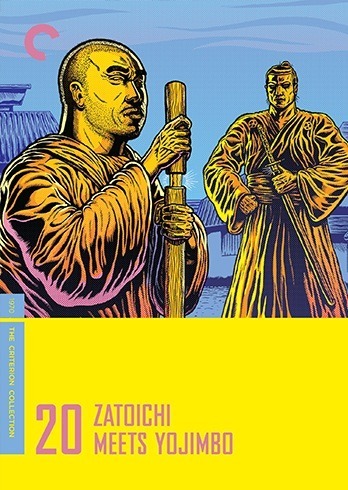
Zatoichi Meets Yojimbo (1970)


The American remake of Zatoichi is a decade-spanning series about a blind gunman. His cane hides a gun of some kind, maybe a rifle or a shotgun. Probably a shotgun (maybe a sawed off one, this is close range after all).

Remakes of other samurai films might lead one to believe that this is a Western of some sort, but there are plenty of those already. I think it should be in the modern day, or maybe even in the near future.

Or maybe it would just be a Daredevil reboot.

While we’re thinking about near future, let’s look ahead to May 6, 2016. Around that day, I am going to be seated in a crowded movie theater, likely an IMAX theater. On the screen will be Batman vs. Superman, the big match up between two of the biggest named in superheroes. And as I sit in that theater watching Ben Affleck beat up Henry Caville or whatever it is that Zack Snyder’s got cooking up, I’m going to think back to today, February 22, 2014.

But then I’m going to think back even further, back to 1970, when Japanese movie goers were given the chance to see Zatoichi, gone for two years after a constant string of 19 films over 7. The masses must have craved the blind swordsman’s return. And when it came, he wasn’t alone. Beside him was Toshiro Mifune as the Yojimbo! Whoa. Imagine the hype that must have surrounded that release. Batman and Superman are cool or whatever, but Zatoichi, man. AND YOJIMBO! DUDE!

That’s where it’s at.

And that’s where I’ll be while Zack Snyder recreates 9/11 again in front of me.

It was sort of off-putting to see the Yojimbo in color. I’m so used to his black and white incarnation that I didn’t even recognize him at first. It just didn’t look right. But it was him, being a drunk. And it made me realize that it has been far too long since I’ve watched a Kurosawa film. In fact, I don’t think I’ve seen one since I began writing for the internet. How ridiculous is that?

(Very.)

But the thing that’s strangest about Zatoichi Meets Yojimbo is just how far everything seems to have come in the in the last 5 years. As you may recall, this completes my personal trilogy: Revenge, Vengeance, Yojimbo. And in the time between Vengeance and Yojimbo, a whole lot has happened. Technically, both of the early Zatoichi movies were fine. Never super interesting, but competently made.
Yojimbo is interesting. It begins in the rain and blood flows freely (something oddly lacking from two films about getting even through swordplay). And Ichi wants to get out. He’s done. It’s been two years, and he wants to rest.

And I wondered again if I was missing something. He constantly talks about events from three years prior, last time he was at his hometown. In my personal trilogy, none of these events happen onscreen, and I can only guess that those who followed along from the start might know what he’s blabbering on about. But maybe they don’t.

But the events of three years prior don’t matter; what matters is the time in between. His hometown has been taken over by the yakuza, and also some other things happened. Then there’s mystery, murder, and intrigue, as talk of gold bars held secretly by one man drives everyone on all sides of the fight to search for the treasure.

(So it’s really Zatoichi Goes Looking for Gold, and maybe the American remake would actually be set in the Pirate era and star Johnny Depp.)

But without revenge to back him up, it was hard to follow Ichi’s motivations. He does things that seem contradictory, and while maybe it was all for the gold, there seems to be something beneath that. But I couldn’t for the life of me figure out what. A discussion at the end of the film says that Zatoichi isn’t greedy. He’s not in it for the money; juxtaposed against Ichi’s attempt to take the found gold. But does that make him greedy? Not necessarily. Was the gold the driving force the whole time? It couldn’t have been, because if it were he would have just taken the gold and run. There was more to it. Perhaps it something from his childhood that no one could really understand.

(Maybe the remake takes place at Xanadu, and Charles Foster Kane was actually a blind gunman instead of a media mogul.)

With Yojimbo, Zatoichi’s series turns 20. It’s a crazy milestone, if you think about it: One character with twenty adventures (and he’s still not done). That’s television-length levels of commitment, but it’s not like a TV show. Each film is its own narrative, and there is no broader story. In none of the three films does Zatoichi actually have a final goal. He does a thing and then he’s just off to the next thing. I don’t see the endgame, and I don’t know that there is one. I tend to doubt that the last Zatoichi movie really finalizes the character in any meaningful way, because the films aren’t building to something. There’s no specter at the end of the line that haunts him.

So Zatoichi films could exist indefinitely.

He’s the James Bond of Japanese cinema. His stories continue until the people behind them get sick of working on him. But it’s 1970, and despite the hiatus, the character is alive and kicking. Kind of like James Bond. And with this most recent film, it’s as good as Zatoichi has ever looked. Just like James Bond.

So let’s imagine it: James Bond Meets Yojimbo.

That would be amazing.

Monday, February 17, 2014

Zatoichi's Cane Sword (1967)

Heroes become attached to their weapons. You can't think of Luke Skywalker without his lightsaber or James Bond without a Walther. There's also a strange fetishization of weapons that comes through the act of naming. In the case of The Hobbit and The Lord of the Rings, there's Sting wielded by Bilbo and later Frodo, or Glamdring wielded by Gandalf; and this is all part of a tradition that Tolkien knew well, going back to Arthur and Excalibur, Thor and Mjolnir, Beowulf and Hrunting, and to the blades Gram and Balmung of Siegfried. A sort of iconographic magic is imbued upon the arms of cinematic heroes and comic book heroes: Indiana Jones and his whip, Captain America and his vibranium shield, Batman and his batarangs. In Zatoichi's Cane Sword, the fifteenth film in the series and definitely one of my favorites, we get to learn a little bit of the fascinating lineage of Zatoichi's iconic weapon. The cane sword even provides a larger symbol for his recurring mental state as well as the moral imperative that is at the heart of many Zatoichi films.

In Cane Sword, our hero meets an aged blacksmith whose mentor crafted Zatoichi's own blade. The old man tells Zatoichi that there's a small crack near the hilt of the sword, and that using it will cause the blade to break. Zatoichi takes this as a sign that he should give up his ways and attempt (yet again) to settle down and lead a normal life. If you've watched at least five of the Zatoichi films before this one, you can probably figure out that this doesn't go as planned, especially since there are so many baddies in town.

There were some continuity issues I noticed between The Tale of Zatoichi and The Tale of Zatoichi Continues regarding the blade. At the end of the first film, he seems to give up his own sword, but he's got it back at the beginning of the second film. A bigger issue to consider is what happens to the blade at the end of Zatoichi the Fugitive. While that would be an ideal explanation for the sword's current state, Wikipedia suggests that the cane sword in this film is supposed to be Zatoichi's third blade. A convenient retcon to be sure, and yet it makes no actual sense in the continuity of the film series. I don't even see how it works in the fictional histories of Zatoichi or the blacksmith. It may be best to not think about it. This was not a cohesive, fully-planned-from-beginning-to-end film series, so these muck-ups are bound to happen.


Shintaro Katsu continues to be solid as our main man, once again torn between a desire for a trouble-free life and the inability to escape trouble. Special kudos ought to go to director Kimiyoshi Yasuda, particularly for the memorable finale, and also to screenwriter Ryozo Kasahara for his strong thematic material. Yasuda also directed Zatoichi on the Road and Adventures of Zatoichi, and he has further films in the series coming up; Kashahara also has another Zatochi film he penned in the near future (Zatoichi Challenged) and apparently wrote an early draft of the Zatoichi update/pseudo-remake Blind Fury.

But I want to come back to the sword since it is the focus of the film. Weapons are extensions of our heroes, and the cane sword has always been a fitting symbol for the Zatoichi character: like the sword, the man seems like something else on the surface (i.e., a blind masseur), but when unsheathed, his true nature is revealed (i.e., a killer). I've mentioned Wolverine before in a review or two of these films, and I can't help but feel some connection between Logan's retractable adamantium claws and Zatoichi's cane sword. Logan's claws were something he was born with, and I think even if Zatoichi tries to deny it, his killer instinct is innate. He cannot deny his true nature in the same way that a blade, if it could express itself without human hands, would have to cut in order to do so.

And so there's the matter of the crack near the hilt and only one more kill with the cane sword. That's most Zatoichi movies in a nutshell. He tries to settle down because he'd rather preserve his own life, as if something within him would break if he kills again. And yet the world Zatoichi lives in is full of evil, and the good people are all too weak to defend themselves, and even though Zatoichi is a killer, there's good in him as well. For the downtrodden, Zatoichi risks breaking and continues on, wandering and drawing. Makers can imbue their materials and works with skill, and the wielders of such works can come to resemble the work and its material. By the end of the film, Zatoichi is not defined by the sword per se, but it's the inner stuff of Zatoichi, that drive in his nature, that manifests in the blade in his hand.

Saturday, February 15, 2014

Zatoichi's Vengeance (1966)


I live in a world with only two Zatoichi films. The first film, Revenge, makes all kinds of allusions to the character's past life and past world. I mean, it’s centered on the death of a master whose role is only vaguely hinted at, and he is surrounded by people who knew him back in the day (or have at least heard of him).

Vengeance, on the other hand, is self-contained. Nobody knows who Zatoichi is, and the film doesn’t even assume that you do. If you know the film is about a blind swordsman, you’re golden. So, Zatoichi’s Vengeance serves as a better introduction to the character of Zatoichi than Zatoichi’s Revenge does.

Even so, I’m glad I saw Zatoichi’s Vengeance second.

In my two-film world, Zatoichi’s Vengeance is The Dark Knight to Revenge’s Batman Begins. (It’s an imperfect analogy, but stick with me.) Revenge is the origin story. Here is a man who returns to his old stomping ground to find out that his master has been killed and his master’s daughter has been pulled into prostitution and treated horrendously. Even without any real context, these are pretty good reasons to follow a man as he exacts his revenge upon the people who have wronged him, his master, and his town.

Also, he’s blind, like a bat. (Except bats aren’t blind, but whatever. Not the point.)

For whatever reason, the word “vengeance” feels darker than “revenge.” They technically mean the same thing, but VENGEANCE is an excessive, horrible thing, whereas revenge is honorable, logical, and acceptable.

And so, Zatoichi’s Vengeance is a much darker film than Revenge. Though Zatoichi defeats evil in the end (there are literally a dozen films left to go), it’s bittersweet rather than triumphant. ­Vengeance, you see, is about Zatoichi’s weaknesses, his imperfections. Here is a blind man masquerading as an ultra-heroic swordsman. Without his bladed cane, he is nothing more than a bumbling fool. But even with the cane in hand, he's still human.

Zatoichi happens upon another blind man, a Biwa-playing priest who has been blind since birth (unlike Zatoichi, who apparently developed the condition as a child). The priest’s senses are even better than Zatoichi’s (he sensed Zatoichi from a hundred yards away, whereas Zatoichi didn’t notice him until they were mere feet apart), and he speaks cryptically about Zatoichi’s outsider status. He can’t fit in with blind men or with sighted ones. To them, he is just a freak.

Like the Joker. (I’m going to run this metaphor into the ground. Don’t you worry.)

After following the priest’s advice and heading to an apparently-quiet town, he finds that this place has been overrun by a gang boss who is making everyone pay him lots of money to keep their businesses open.

Zatoichi enters on this, and eventually it becomes his mission to help these people. But he is ambivalent. He is as capable a fighter as they come (as much was proven in Revenge), but the priest appears again and seeds doubt into his mind. He had shown off his skills in front a young boy, one who now had the thirst for power. (Not in the megalomaniacal way, although if he showed up later in Sympathy for Lady Zatoichi like that guy from The Incredibles, I would totally not be surprised.) But he doesn’t want to be the corrupting power, and so he must do that thing that Batman must do (although in a totally different way):

“Endure.”

And so we are subjected to Zatoichi being savagely beaten and nearly drowned in front of the small boy. Despite the weapon of choice and the body count, neither Zatoichi film is particularly blood-soaked, but Zatoichi’s face after that beating is drenched. It’s tough to watch, but it is undoubtedly the most compelling scene in either of the films. This is a man trying to do right by a young boy who he feels responsible for, a boy he really doesn’t know at all, and he must suffer in the process.

Fascinating.

Seriously. It’s fascinating. And it’s made all the more fascinating by having seen Revenge (and presumably the other early films). The moment where he admits to being afraid is powerful no matter what, and would work even in this self-contained story, but with greater context comes greater responsibility, and it’s all the more heartbreaking to see his fall from glory. As he walks off into the sunset at the film's end, the people he tried his hardest to help are distraught. Death has consequences, something that Revenge never really acknowledged. Vengeance does, and is far more powerful because of it.