Showing posts with label zatoichi. Show all posts

Wednesday, April 18, 2018

Zatoichi and The Chest of Gold (1964) Kazuo Miyagawa: Japan’s Greatest Cinematographer

With ZATOICHI AND THE CHEST OF GOLD running as part of the Kazuo Miyagawa: Japan’s Greatest Cinematographer at both The Japan Society and MOMA I'm reposting the review from when we did a month of Zatoichi films

Against a black background the sixth film in the series opens with a kick ass title sequence that has the blind Ichi taking on a series of rogues who attack him. It sets the mood and draws us into the story.

This time out Zatoichi has returned to a town for the first time in two years. He's returned to the village in order to pay respects at the grave of a man he killed on his last visit. Arriving during a celebration to mark the end of a drought he is at first welcomed and then is severely beaten by the people in the town who think he's stolen their tax payment. Deciding to do the right thing he sets off to try and track down the real culprits.

A twisty turny film that plays closer to some of the earlier films in the series with good guys and bad guys not so clearly defined. The film is also much darker and somber than the last few titles with the treachery and mechaniations of the bad guys taking a heavy cost. The film has a kind of noirish feel but with Zatoichi and sword play in the mix.

While the plot keeps things interesting it's the series of wonderful set pieces that really hold our attention. As I said at the top the film begins with a great title sequence, this is followed by a an extended night time battle in the middle of the film, one that has Zatoichi fighting with a man on his back,; the gambling sequences where Ichi wagers whether he can cut a coin in half, and there is the final confrontation that actually has the normally invincible Zatoichi ending up bloodied. Perhaps he's mortal after all.

A very solid entry in the series

ZATOICHI AND THE CHEST OF GOLD is screening as part of Kazuo Miyagawa: Japan’s Greatest Cinematographer which is being co-presented by The Japan Society and The Museum of Modern Art. Click on the links in names of each location for show times, tickets and more information

Wednesday, January 10, 2018

The second Have Sword Will Travel happens at the Quad Sun January 28, 7.15pm

Here is the Quad's press release on the next installment of HAVE SWORD WILL TRAVEL

For our second installment of this new monthly series exploring the multifaceted figure of the knight errant in East Asian films, we're proud to present this double bill of Zatoichi on the Road (on 35mm!) and Lone Wolf and Cub: Sword of Vengeance. Co-presented and programmed by Subway Cinema and the Quad

Zatoichi on the Road
(aka Zatoichi and the Scoundrels)
Kimiyoshi Yasuda, 1963, Japan, 87m, 35mm
To honor the will of a dying man, Zatoichi, a blind masseur, agrees to escort a distressed maiden back to her family. But his oath finds him caught on the warpath between rival yakuza clans. His hand forced, Zatoichi shocks the ruffians with the fury of a blind man’s blade.

In Japanese with English subtitles

Followed by...

Lone Wolf and Cub: Sword of Vengeance
Kenji Misumi, 1972 , Japan, 83m, DCP
The Yagyu ninja clan has fomented the mother of all conspiracies to take over samurai Itto Ogami’s prized position as shogun’s executioner. With his infant son in tow, the disgraced assassin roams the land, slowly hatching a master plan of bloody revenge against the evil schemers.

In Japanese with English subtitles

Monday, March 3, 2014

Zatoichi The Last (2010)

Latest stab at reinventing  the Zatoichi story is a good looking film that kind of misses the point of it all.  Add it the long list of recent films that in rethinking a classic character completely missed what made it work. Of all the Zatoichi inspired films this is the one that I would be happy never to see again and forget ever existed,

The plot of the film has Ichi returning home heart broken after his wife was killed by the son of a yakuza. Hoping to put all the violence behind him and lead a normal life Ichi tries his hand as a fisherman. However the local yakuza is looking to squeeze the peasants so it's up to Ichi to once more take up the cane sword to protect them.

A good looking film, with some great music and some good fights, the film is missing the point when it comes to everything else. I could go on about the dullness of the plot (its a variation on several Zatoichi films and lifts bits from Shintaro Katsu's final film) and the pacing which pushes the film to an unwieldy and stupefying 130 minutes. Instead I'd just like to go on about how wrong they got the character of Ichi.

 Ichi is pretty much a broken man when the film begins and by the time his wife is killed a couple minutes into the film he completely unravels. Why was he so broken to begin with? We don't know. While Shingo Katori gets some of the twichiness of what we think a blind man should have right, the problem is it's radically different than a man we think should be a swordsman. How could he fight so when the whole world makes him wince. He almost seems incapable of getting around.

Feared swordsman? I think not.

Actually the real question is with all the damage he takes in this film, how the hell did he not end up dead sooner? Seriously? He's cut and shot and stabbed and beaten so many times that he shouldn't be a feared swordsman he should be dead.

All humor has been drained out of the character. Yea I know the film isn't about happy stuff, but before this there was always a humor and a humanity under lying everything. The humor is gone, the humanity has been twisted to provoke sadness. This Ichi is so different as to almost be an abomination to connect it to every film that went before.

Actually what this reminds me of is all of those embarrassing restarts that fill modern popular culture. You know things like the Roland Emmerich remake of Godzilla, Sylvester Stallone's Judge Dredd , orJonah Hex. This is one of those films that needs to be forgotten and dumped into the dust bin of time.

I hate this film, and while I would be happy that the end of the film assures that there can't be a direct sequel, I hate that the film may have put the kibosh on the character reappearing any time soon.

The worst Zatoichi film ever.

Friday, February 28, 2014

Zatoichi (1989) (aka Zatoichi Darkness is his Ally)

It begins with an older , greying Zatoichi who is in prison being abused by having his food stolen and soup dumped on the floor. Ichi kneels down and sucks the soup off the ground. He then goes to eat and finds his rice has been stolen. Another poor man gives him some of his rice. The man  tells Ichi that he is being persecuted for trying to make things better.  This leads into a fight between the blind man and another prisoner in which the other man is literally broken apart- this is no longer you're fathers Zatoichi films and for Ichi perhaps the world has gotten a bit worse...

Coming 16 years after the film series ended and 10 years after the TV series the film feels very different than  what had gone before, despite hitting many familiar plot points.  This is very much the work of an older more mature filmmaker. While I don't know how the film relates to the TV series (I know it ignores the end of the series) you can feel how the production of the TV series influenced it with an economy of style and an intimacy that isn't always evident in the earlier films.

The plot of the film runs together several familiar plot threads with Ichi in trouble with gamblers for being too good, rival gangs battling it out,a noble ronin who befriends the blind man,  a man looking to change the world and of course revenge. Please forgive me for not going into detail but frankly in the time it took me to move from TV to computer the details of the plot were gone. What sticks with me is the small human moments the exchanges between Ichi and his friends, the young girl who says she looks like Ichi's mother, the little kids writing around the blind man resulting in flying ink...

And of course the violence. There  are severed limbs and heads not to mention gallons of blood. Ichi is constantly fighting roving gangs sent to kill him. A small army dies by his hand. Its kind of exciting but at the same time there is a sadness to it all. Why can't anyone just learn to leave the poor guy alone?

Shintaro Katsu's portrayal is stunning. Its clear he and the role are one. Every move, every gesture is organic. If you've seen other films in the series you can see just by body language that time has not been kind to Ichi. his movements have moved in on themselves as if he's afraid to move lest he get banged up.This is an older and sadder man.

I'm not sure what the story of the making of the film, but I know that this was one of the last films that Katsu made. It was the last that he directed and while I was watching it I was of the opinion that had the script been less all over the place this would have and could have been the best of the series. The moments, the small character moments are truly amazing and the film's tone and feel haunt me. In a weird way the film on an emotional level is one of the most powerful in the series, and possibly of any film I've seen with Katsu in .

In reading some reviews of the film several people said that when the film was done they were left wanting one more film. It felt to them, as it felt to me, like Katsu was trying to finish with the character and almost did it. This isn't to say that it's a bad film, oh hell no, only that it's almost a great film that seems to have been compromised by he need to give fans a little of everything.

However you feel about the film, if you like the character it behooves you to track down the film and see the final appearance of a screen legend.

Thursday, February 27, 2014

Zatoichi's Conspiracy (1973)

Final film in the original series is a return, largely, to the way the series was before the previous two entries with their trippy visuals and slightly disjointed story telling.While the film is a return to what made the series so good, it's also clear the series had lost it's way.

The plot has Ichi returning to his home town. While on the road he is escorted to an inn semi-forcibly. It seems a rich man has taken pity on him and paid for his stay at the inn. What the man doesn't know is that he knows the blind man from childhood, a fact he refuses to believe since it will complicate matters- he's trying to manipulate control of a local quarry. Not standing for the corruption Ichi stands against his old friend, and his yakuza swordsmen.

A solid entry in the series the film is a kind of coda to the series, though that really is the final film which was made some 16 years after this one (and echoes this one). Zatoichi goes home, and in someways so do we in the audience. As I said at the top this is a return to the top this is move back to straight forward filmmaking and away from the experimentation and a return to Zatoichi fighting corruption. He is not, for the first time in many entries a fugitive from the law hiding out.

However just as Zatoichi finds that all is not well at home, his "mother" has passed on, his friend is now corrupt, things are not as he remembered them, we in the audience have a similar reaction. there is a rote-ness to the story (we have been here before) and the tale has been tailored to fit "modern", ie 1973 audience tastes thanks to the introduction of some rebel rousing kids. While I could have forgiven the plot lines familiar story, the kids' story is intrusive (though I think largely to their dress and manner seeming out of place)

This is not to infer in any way that it's a bad film, it's not, it has some really good sequences including Ichi having to escape the mud that he was dumped in. this leads into his reappearance in the home of his enemy looking like a mummy of old. Truthfully the sense of dread and horror in some scenes and emotion in others is some of the best in in the whole series.

I would have loved to have see what the next film in the series would have been...but of course what followed this was the TV series.

Definitely worth tracking down.

Wednesday, February 26, 2014

Blindman (1971) or Zatoichi in the old spaghetti west

On Saturday Alec was talking about the idea of Zatoichi being a gunfighter. The thing is that back in 1971 Tony Anthony, a man probably best known in the US for starting the 3D craze of the 1980's (His western Comin At Ya was the first film of the cycle), starred in a full bore spaghetti western that was a riff on Zatoichi.

Anthony's blind man is a gunslinger who travels with the help of his horse.His rifle has a bayonet on the end so it's a direct connection to Ichi's cane sword. He is calm fellow who is suffers injustice only long enough to turn the tables. Where Ichi has a reluctance to kill Anthony will just kill you to get what he wants.

The plot of the film has the blind man getting screwed over by a guy named Skunk. Skunk was suppose to help get 50 women to a bunch of miners in Texas, but instead sent them to some bad guys in Mexico. After getting the location from Skunk he blows up the building he and his friends are in and heads off to get the women back, leaving a trail of dead in his wake.

Now to be honest I'm not going to do a real review of the film. the version of the film I saw, an 85 minute one of You Tube, is a tad choppy. IMDB says the film is suppose to run 105 minutes and based on what I've seen I can believe it. I will say that the film is pretty good and very violent with no one really having any qualm about killing someone dead.

Anthony's take on the character seems perfectly in keeping with the Spaghetti Western ideal of gritty violence. He's a weird melding of say Sabata or Sartana and Zatoichi. If you can imagine one of the legendary smart ass western heroes being blind, then you have Anthony's blind man. While he's more gunslinger than blind samurai, I think h's a valid take on the character simply because to be like Ichi in a gun society would result in him dying pretty damn quick.

Those looking for another reason to track this film down should consider that one of the stars is RIngo Starr as a  bandit named Candy. Its a much meatier role than he normally got, with only his role in That'll Be the Day coming close.

Definitely worth tracking down.

Zatoichi in Desperation (1972)

It begins with Zatoichi meeting an old woman on a bridge. When the woman falls through a hole in the bridge Ichi feels obligated to bring the woman's shamisen to her daughter. Arriving in town she finds the woman works in a brothel

One of only two Zatoichi films directed by star Shintaro Katsu, this is a trippy bleak film filled with psychedelic imagery and sound manipulation, amped up colors and realistic violence. While similar  in many ways to the previous entry in the series (Zatoichi at Large) with some of the camera work and images taking precidence over story, this film works better in that its clear from the start that we are not in typical Zatoichi territory. This is a Zatoichi of the mind or of legend- watch the gambling scenes about a third of the way in and you'll see a film that's playing with the tropes of the series and telling a good story. In its way it's more a psychological riff, with director Katsu aiming more to create a mood. Its a kind of Euro-art house samurai movie.

Does it work? Largely it does. Granted it doesn't have a perfect story, but the film does have mood to burn. The film also has some wicked violence including several nasty turns by the villains who, among other things drive a pike through Ichi's hands so he can't hold a sword (Don't worry that doesn't stop him)

For me the real problem with this film, like several of these final films, is that there was some point where Ichi  became a kind of caricature of himself. For some reason he's become an outlaw always on the run. His abilities also became even more super human.I'm guessing that this was the result of the character becoming so hot that you had the Yojimbo and One Armed Swordsman cross overs. While not a bad film I completely understand why the series only lasted one more entry before shifting gears and ending up on television.

How would I rate it? Middle of the pack. While the story is just okay the flourishes that Katsu brings to the film make it worth seeing.

Tuesday, February 25, 2014

Zaotichi at Large (1972)

Possibly my least favorite of the whole Zatoichi series, the film is set in motion at the start when Zatoichi delivers a woman's baby in a field of wheat. She dies in childbirth so Ichi takes the baby and tries to find the baby's relatives. When he finds them he discovers that the family has problems of it's own (the baby's aunt is going to be forced into prostitution) Ichi of course gets involved.

For me the film doesn't really work on most levels. Yes the has some great performances but the direction and the craft of the filmmaking doesn't hold up.

The trouble starts at the top with a child birthing scene that should be frightening and instead plays like a raucous  comedy. There is something about Katsu waiving the baby doll around that is much too funny.

Thinks aren't helped by the score which seems to be the sort of serious Montavani or a less funky version of some of the sounds that came out of Philadelphia. While not truly bad the music sounds dated as if it was lifted from your parents record collection. Granted the opening Ballad of Zatoichi which mixes a classical recitation with the funky score is interesting but nothing I'd want to hear again.

The pacing of the film and the story progression doesn't work. While running a brief 88 minutes the film feels several times longer. Scenes seem to drag and the plot seems to flounder around in a way that most of the other Katsu produced films don't.

The real sin of the film is that so much of the film is in close up. We don't see scenes or locations but faces. We see parts of the action not the whole thing. While in 1972 this may have been daring and unique now it plays badly and seems dated. I hate the look of the film. Additionally several sequences seem to have been arranged with too much of an eye to looking good rather than telling the story- the fight that concludes the film for example is more silly than anything else.

Give the film points for trying something new but if you have to skip one Zatoichi film, this is the one to skip

Monday, February 24, 2014

Zatoichi Meets the One Armed Swordsman (1971)

Steve here- this is a tag team post. Its taken a large number of us here at Unseen to get this post done. It went through several hands before Hubert started to put it together,but circumstance required that I finish it. Actually the final draft is all mine, largely because I can't write to Hubert's level and i couldn't blend the words seamlessly.

A Hong Kong Japanese co production this film brings together Shintaro Katsu's Zatoichi with a variation of Jimmy Wang Yu's  One Armed Swordsman. The One Armed Swordsman was a character that Wang Yu would play in one form or another for much of his career. The original character appeared in a two or three Shaw Brothers films before Wang Yu took it on the road. The character was in many ways similar to Zatoichi in popularity.

The collision of the two characters is set in motion when Wang Kang (Yu) meets a Chinese couple and their son. They offer to take Kang where he wants to go because they know the way and I assume speak Japanese which he doesn't. While on the road the group is forced to step off the road for a tribute train going by. When the boy gets up to chase his kite one of the swordsman in the front attempts to kill the boy, however his mother takes the blow. All hell breaks loose and Kang steps in to fight the samurai. Kang escapes and the remaining samurai kill all (most) of the witnesses.  Zatoichi finds the son mourning his father and takes him away.

What follows is a dance as Zatoichi and Wang Kang crisscross paths repeatedly with Wang on the run with the boy and Ichi trying to sort it all out- and ending up with a price on his head for his efforts.

The notes in the Criterion box set mention that until the film never received an official home video release anywhere in the world until after 2000. I'm guessing this is the reason that the film has so many legends and stories told about it. The best known tale is that there were two versions of the film one for Hong Kong and one for Japan. The notes say that the only version that exists is the one in the set, and I'm guessing that's probably true. Alternate versions of popular films such as this tend to show up somewhere like home video. I've never run across anyone who has ever said that they've actually seen it, which leads me to believe that IMDB and the stories about it are wrong about an alternate cut - I mean where would you put a second fight between Kang and the priest?. (If you've seen it let me know, more importantly if you know where I can get a copy let me know)

The talk of an alternate version reminds me of the talk that there was an alternate cut of King Kong vs Godzilla where Godzilla wins. While the ending is essentially the same in both versions, there are differences (beyond the American actors) with the order of events different, more time on  Kong island and a few other changes. I'm guessing that no one has undertaken a release of the Japanese version in the US is that the brown face portrayal of the native on Kong Island is kind of offensive in today's world.

For me the film is a mixed affair. While it's a solid entry in the series with lots of the Zatoichi riffs at work from an uneasy alliance that goes side ways, bad guys out to cover their asses causing more trouble, a child in need and of course a person one would think being above reproach turning out to be the bad guy. I like that a running line through the film is about the lack of communication between the two heroes who end up fighting each other needlessly because  they simply can't talk to each other.

The film gets into trouble when Japanese and Hong action styles collide. The trouble is that the wu xia wire work of Wang Kang feels completely out of place in the realistic world of Zatoichi. The leaping seems silly, or at least in the context of Zatoichi's world. He does these great leaps up and over people and it all feels wrong. Also seeming kind of wrong is the short sword he fights which kind of makes you feel that he should be getting his butt kicked.

What I do like is the final confrontation between the two stars. Its a neatly filmed little spaghetti western style shoot out done with swords instead of guns. (Which reminds me in the same  year as this film was made, over in Italy actor director producer Tony Anthony turned out his western riff on the character BLIND MAN-a review will run Wednesday)

As films go this is a solid but not particularly taxing entry in the series. Definitely worth seeing, especially if you don't mind the mashing up of film styles.

Sunday, February 23, 2014

Zatoichi Goes to the Fire Festival (1970)

There's madness and manic energy all over Zatoichi Goes to the Fire Festival, the 21st film in the series. There's blood, there's slapstick, there's pathos, there's partial female nudity and lots of male butts, and when the violence occurs, it's a frenzy. There's so much going, so much to consider; I enjoyed the movie immensely, but admittedly I may have to watch it again to think about where I'd rank it in this whole series. So much of the time watching Fire Festival, I laughed in joyous disbelief at how badass and how strange things got as the film progressed.

Fire Festival is packed with enough ideas for maybe three separate films, though they're jammed together into this single movie, with the three strands linked by a loose consideration of masculinity, whether through notions of moral duty or assertions of strength. Part of the plot involves Zatoichi dealing with a jealous husband who believes that our blind hero slept with his wife (played by the gorgeous Reiko Ohara). This nameless ronin who ominously wanders the shadows like some analog for Robert Mitchum is played by the great Tatsuya Nakadai, who you may recognize from Yojimbo, Harakiri, Ran, The Human Condition, and many other great Japanese films. His sword work is spectacular, with confident, forceful, arcing strikes, often with his katana glinting through bodies in the dark. And yet Fire Festival is not just a tale of misplaced jealousy, but also one of men treating women like chattel. Zatoichi saves the ronin's wife from a mistress auction. It's a particularly memorable scene in which a crowd of dirty old men pay good money to buy a woman and use her as they will. It's as seedy as it sounds, and of course Zatoichi, who's good at heart, saves the day (but apparently only for the fairest of them all).

There's also the matter of Umeji, an effeminate pimp and would-be gangster played by the androgynous Pîtâ aka Peter, who also appeared in Ran and (frighteningly) the sixth Guinea Pig film. The gender play and odd sexuality of Pîtâ was something I didn't really expect from a Zatoichi movie. It makes for a comic and surreal scene between Shintaro Katsu and Pîtâ later in the film, one that makes me wonder how it played in Japan in 1970. Watching the scenes with Umeji, I began to ponder various expectations of masculinity and how they're being subverted, especially in chambara films and especially given the context of would-be yakuza. There's a way of being classically masculine in this cinematic world (i.e., Katsu characters, Nakadai characters, Toshiro Mifune characters), but Pîtâ upends this idea, even just at the surface level: he's a pimp, but he looks as pretty as the women he's pimping.


There's also Lord Yamikubo to deal with, a cruel blind crime boss who serves as a kind of anti-Zatoichi. He's played by Masayuki Mori in semi-cataract contact lenses, though his blindness doesn't seem as debilitating or complete as Zatoichi's. (Mori's also appeared in Rashomon, Ugetsu, and The Bad Sleep Well.) Yamikubo's a good foil for Zatoichi, and more a mover of pieces than a fighter himself. He understands the longings in Zatoichi's soul, and he seduces Zatoichi with this sense of mutual understanding. He even suggests directly to our hero that Zatoichi's existential plight is his own. Of course, he's a hypocrite and a mirror opposite who seeks to negate Zatoichi by whatever means possible.

Fire Festival is the last of these films directed by Kenji Misumi, who has five others in franchise to his credit (The Tale of Zatoichi, Fight Zatoichi Fight, Zatoichi and the Chess Expert, Zatoichi Challenged, and Samaritan Zatoichi). There are flashes of artifice, impressionism, and expressionism in this film that seem new to Misumi's bag of tricks, and which help pave the way for some of the bits in his Lone Wolf and Cub films. Each of Misumi's contributions to the series have seemed like essential viewing for the gestalt experience of Zatoichi as a character. (Overall, this is a series with no awful films, just some that are not as good as the others.)

While the penultimate battle of Fire Festival is inspired, the most memorable set piece in the entire movie, and one of the standouts of the Zatoichi series, has to be the battle in the bath house. What begins as a chance to unwind becomes an explosion of madness. Throngs of tattooed yakuza come at Zatoichi, with everyone fighting bare-ass naked. Think that fight scene in David Cronenberg's Eastern Promises but multiply it by 10. The fighting itself would be remarkable since Katsu always moves well with a sword and the action is always staged with great in-frame movement, but what really makes the scene is Isao Tomita's score. Sheer god damn anarchy. It's like someone took the Batman '66 fight theme and married it to sneering guitar psychedelia and the most blaring work of Steroid Maximus. It's zany, it's dangerous, it's impossible to pin down, and it shouldn't work since the pieces are so tenuously joined and threaten to undo the whole, but it holds together precisely because audacity is a special kind of adhesive. So too is the state of this film.

Saturday, February 22, 2014

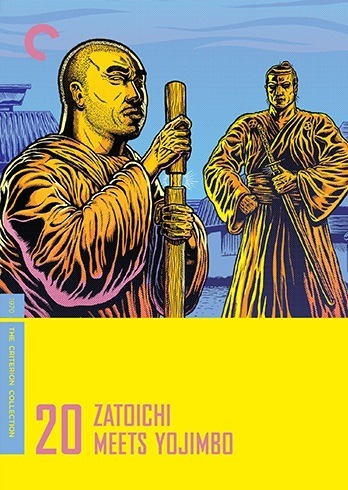
Zatoichi Meets Yojimbo (1970)


The American remake of Zatoichi is a decade-spanning series about a blind gunman. His cane hides a gun of some kind, maybe a rifle or a shotgun. Probably a shotgun (maybe a sawed off one, this is close range after all).

Remakes of other samurai films might lead one to believe that this is a Western of some sort, but there are plenty of those already. I think it should be in the modern day, or maybe even in the near future.

Or maybe it would just be a Daredevil reboot.

While we’re thinking about near future, let’s look ahead to May 6, 2016. Around that day, I am going to be seated in a crowded movie theater, likely an IMAX theater. On the screen will be Batman vs. Superman, the big match up between two of the biggest named in superheroes. And as I sit in that theater watching Ben Affleck beat up Henry Caville or whatever it is that Zack Snyder’s got cooking up, I’m going to think back to today, February 22, 2014.

But then I’m going to think back even further, back to 1970, when Japanese movie goers were given the chance to see Zatoichi, gone for two years after a constant string of 19 films over 7. The masses must have craved the blind swordsman’s return. And when it came, he wasn’t alone. Beside him was Toshiro Mifune as the Yojimbo! Whoa. Imagine the hype that must have surrounded that release. Batman and Superman are cool or whatever, but Zatoichi, man. AND YOJIMBO! DUDE!

That’s where it’s at.

And that’s where I’ll be while Zack Snyder recreates 9/11 again in front of me.

It was sort of off-putting to see the Yojimbo in color. I’m so used to his black and white incarnation that I didn’t even recognize him at first. It just didn’t look right. But it was him, being a drunk. And it made me realize that it has been far too long since I’ve watched a Kurosawa film. In fact, I don’t think I’ve seen one since I began writing for the internet. How ridiculous is that?

(Very.)

But the thing that’s strangest about Zatoichi Meets Yojimbo is just how far everything seems to have come in the in the last 5 years. As you may recall, this completes my personal trilogy: Revenge, Vengeance, Yojimbo. And in the time between Vengeance and Yojimbo, a whole lot has happened. Technically, both of the early Zatoichi movies were fine. Never super interesting, but competently made.
Yojimbo is interesting. It begins in the rain and blood flows freely (something oddly lacking from two films about getting even through swordplay). And Ichi wants to get out. He’s done. It’s been two years, and he wants to rest.

And I wondered again if I was missing something. He constantly talks about events from three years prior, last time he was at his hometown. In my personal trilogy, none of these events happen onscreen, and I can only guess that those who followed along from the start might know what he’s blabbering on about. But maybe they don’t.

But the events of three years prior don’t matter; what matters is the time in between. His hometown has been taken over by the yakuza, and also some other things happened. Then there’s mystery, murder, and intrigue, as talk of gold bars held secretly by one man drives everyone on all sides of the fight to search for the treasure.

(So it’s really Zatoichi Goes Looking for Gold, and maybe the American remake would actually be set in the Pirate era and star Johnny Depp.)

But without revenge to back him up, it was hard to follow Ichi’s motivations. He does things that seem contradictory, and while maybe it was all for the gold, there seems to be something beneath that. But I couldn’t for the life of me figure out what. A discussion at the end of the film says that Zatoichi isn’t greedy. He’s not in it for the money; juxtaposed against Ichi’s attempt to take the found gold. But does that make him greedy? Not necessarily. Was the gold the driving force the whole time? It couldn’t have been, because if it were he would have just taken the gold and run. There was more to it. Perhaps it something from his childhood that no one could really understand.

(Maybe the remake takes place at Xanadu, and Charles Foster Kane was actually a blind gunman instead of a media mogul.)

With Yojimbo, Zatoichi’s series turns 20. It’s a crazy milestone, if you think about it: One character with twenty adventures (and he’s still not done). That’s television-length levels of commitment, but it’s not like a TV show. Each film is its own narrative, and there is no broader story. In none of the three films does Zatoichi actually have a final goal. He does a thing and then he’s just off to the next thing. I don’t see the endgame, and I don’t know that there is one. I tend to doubt that the last Zatoichi movie really finalizes the character in any meaningful way, because the films aren’t building to something. There’s no specter at the end of the line that haunts him.

So Zatoichi films could exist indefinitely.

He’s the James Bond of Japanese cinema. His stories continue until the people behind them get sick of working on him. But it’s 1970, and despite the hiatus, the character is alive and kicking. Kind of like James Bond. And with this most recent film, it’s as good as Zatoichi has ever looked. Just like James Bond.

So let’s imagine it: James Bond Meets Yojimbo.

That would be amazing.

Friday, February 21, 2014

Samaritan Zatoichi (1968)

One of the best films in the series is a return to the  humanity that was lost in the previous film Zatoichi and the Fugitives. Sure there is darkness but it's not all encompassing.

The plot of the film has Ichi and his friend Sanuske becoming involved in a plot to kill a man who owes the yakuza money. Because the man is hiding in a dark house Ichi is the one to kill the man, but it was all a set up. The yakuza boss wanted the man dead so he could get his hands on the man's sister. Ichi then turns to protecting the woman until she can get to her aunts house.

Simple story complex issues.

Besides just being a damn good story, this is a meaty film, one that feels way meatier than you'd expect from an 82 minute film. Rolling around in the film are all sorts of notions relating to honor, obligation, forgiveness and making up for past wrongs. Never preachy the film simply tells you a good story while letting the audience think about what i right and what is wrong.

The film has several wonderful set pieces, all of the action is of course first rate, also first rate are sequences as the one early on when Ichi is eating in an inn and his friend tries to steal his meager fish. Another is a gambling scene that puts a spin on the typical dice game, and reveals Ichi isn't as honest as he usually seems.  The arcade sequence is another stand out, and is wonderfully touching.

I love the use of wide screen in this film. Every shot is beautifully composed and it amps up the emotion of the film frequently by bisecting or compartmentalizing the image in ways that says so much more than the dialog does (Watch the first scene when Ichi goes into the room at the inn with the woman he will soon be protecting.)

This is a great film by any standard and especially by the very high standard that is the Zatoichi series. A must see.

Thursday, February 20, 2014

Blind Fury (1989)

A remake/re-imagining of the Zatoichi character, Blind Fury uproots the blind swordsman from feudal Japan and plants him in the United States in the 1980s. Or at least it's an oddball riff on the character, now played by Rutger Hauer, in a comparably oddball version of the United States in the 1980s.

I say a version of the United States because most of the schlocky (but lovable) action films of that decade don't really take place in a familiar world but an exaggerated version of the world at that time, one in which rugged, ornery American values are the measure of all things. This goes for Commando, Death Wish 3, Cobra, American Ninja, Remo Williams: The Adventure Begins, the first two Rambo sequels, etc.; those jingoistic nationwide counterattack flicks like Red Dawn and Invasion USA; and the videogame Bad Dudes, perhaps the finest artifact of this imagined world, a game in which two meatheads in black tank tops and fingerless gloves have to save Ronald Reagan from a terrorist organization comprised of ninjas. This is one GI Joe nation, under a Christian God (and God is an American), with liberty, and justice, and unlimited ammo for all red-blooded cowboy rootin-tooters.

Welcome, Zatoichi, to The United States of the Eighties. Your new name is Nick Parker.


And yes, I love Blind Fury. Unironically.

It's such a bizarre take on Zatoichi. For one, our hero isn't a masseur/reformed gangster who's constantly attempting to live down the sins of his past. Nick is a Vietnam vet who lost his vision during the war. He's nursed back to health by kind villagers, one of whom teaches him how to use a sword not unlike a katana. How does a random villager in Vietnam know how to do reverse-handle slashes like a seasoned Japanese practitioner of iaido or kenjutsu? Don't ask, and enjoy your stay on Planet Eighties, where all of Asia is sort of like the five boroughs in New York.

Blind Fury spins a story with similar beats to Zatoichi Challenged, with some nods to Fight, Zatoichi, Fight as well. (That makes sense since Zatoichi Challenged is like a thematic continuation of a story started in Fight, Zatoichi, Fight and also referenced in Zatoichi and the Chess Expert.) Nick visits America to reconnect with an old war buddy (Terry O'Quinn), but it turns out he's in Reno forced to make some sort of synthetic drug. After the death of his war buddy's ex-wife (Meg Foster) in Miami, Nick vows to take his war buddy's son to Reno to reunite him with his dad. Hacking, slashing, and riffing on recurring tropes of the Zatoichi series (e.g., thugs picking on blind men, gambling) ensues.

Since Blind Fury is a standalone movie, there's no sense of cyclical hope and disappointment in Nick's life as there is in Zatoichi's. Much of this is due to Nick's lack of regret. The screennplay by Charles Robert Carner (who also wrote the gloriously schlocky Gymkata) and Hauer's performance paint Nick a someone who's pretty easygoing. He isn't trying to go straight or atone. Instead, he's just a vagabond with a cane sword who seems to be having a good time.


If Shintaro Katsu was playing Zatoichi, Rutger Hauer is playing the heroic Rutger Hauer; if Zatoichi's mission was to protect the downtrodden because there's too much evil and corruption in feudal Japan, Nick's mission is to kick ass and help people out because he's Rutger Hauer and this is The Goddamn United States of the Eighties.

Blind Fury heaps additional absurdity onto the blind swordsman idea in that almost everyone Nick fights is wielding a gun rather than a sword. Yeah, the blind guy brought a knife to a gunfight. That means the fights in Blind Fury are less about counterpunching as in the Zatoichi films and more about exemplifying the tenants of eighties badassery; it's still a case of "you try to hit me, I dodge, you get hit back," but Nick seems to smile coolly about the whole ordeal like it ain't nothing. Sho Kosugi, everyone's favorite 80s ninja, makes a guest appearance at the end for the requisite sword duel. The fights here are fine, but they don't have the same wow- or dazzle-factor as any of the Zatoichi films. As much as I like Hauer, no one movies like Katsu in those long takes. Really, Nick is a caricature who belongs with the proud pantheon of 80s action caricatures; Zatoichi is a  character, realized from the inside out (series continuity be damned).

Part of me wonders where they would have gone with Nick Parker if the Blind Fury series caught on. I want to believe that he'd have teamed up with other proud citizens of The United States of the Eighties--Remo Williams, John Matrix, the A-Team--and that he continued to save lives across this imagined land where spent bullet casings are as plentiful as pennies.

I want to believe.

Zatoichi and the Fugitives (1968)

Blind bastard doesn't know who he's dealing with.

Mean, cruel and nasty this is one of the darkest films in the Zatoichi series. Its a film who's darkness I found disturbing.

After getting caught in a rain storm Ichi takes refuge in an abandoned house. Ichi is aware that there is some one there but acts as if the girl hiding there isn't there. When the rain passes he heads off on the road where two surly guys try to torment and rob the blind man...its the last thing they ever do. The killings are witnessed by the girl. It transpires that she is traveling with a group of fugitives with a nasty reputation.  They are heading to town where a local yakuza leader is now a man of the law. The fugitives need a place to hide and the boss needs muscle...Ichi of course gets involved.

Darkness doesn't make a difference to a blind man

What makes the film so disturbing is that the bad guys in this film really are bad guys. They torment Ichi at every turn, by throwing dirt in his food, pricking his face with their swords and knives, trying to get him to step on blades and attacking him frequently. Ichi even comes up on the short end of a battle. Normally the villains in the series have some attempt at being good people,but not here. The bad guys are really really bad. These guys are some of the nastiest I've seen on screen.

Interestingly as if to balance the villainy of the fugitives, most of the people are solidly good, there is no grey in this film only black and white.

The bloodiest of the series to this point, this is also a film where Ichi gets severely wounded. Abused by the fugitives at one point, he spends the rest of the film dealing with his wounds, even as he's fighting for his life. We've never really been this afraid for Zatoichi, and while I know there are 8 more films and a TV series to go, I still was afraid he was going to expire before the film ended.

While most definitely a solid entry in the series (it may very well be one of the key films) I'm not sure what I think of it. There is something about the overly gritty, realistically violent film that doesn't sit well with me. While I like many of the sequences and love that I can root for Ichi to kill everyone, I'm  bothered by the toll that Ichi is forced to pay. Is it too much?

My skittishness aside this is an import film in the series and a must see.

Wednesday, February 19, 2014

Zatoichi Challenged (1967)

While staying at an inn the mother of a little boy dies. Zaotichi agrees to take the boy to his far away father. A long the way they meet up with a band of travelers who allow them to ride along part of the way. When Ichi and the boy reach his father they find he has been working for the yakuza making high priced pornography. Unfortunately the government wants the porn destroyed and everyone connected with it killed, Ichi however refuses to let that happen.

Speed bump in the Zatoichi film has a great opening third, a great last third and a deadly dull middle third. While good over all, and damn amazingly great in parts this is one of my least favorite of the entire series. The problem is that middle is way too talky and static.

I don't want to deal with the bad instead I'd like to highlight some of the good, beginning with some of the musical score. The opening guitar riffs make this feel like its going to be a kin to a spaghetti western and there are times when the film riffs on westerns, from its frontier town setting to the Shane echos at the ends.

While there really isn't any gambling in the film, there is a nice sequence where Ichi has to guess which hand a coin is in.

Actually to be honest the film's strong points is in the sequences, Ichi and the boy bonding, the opening fight on the road, the massive attack late in the game and the near perfect final confrontation in the snow between Ichi and the samurai who has become his friend. These are marvelous pieces which stick in my head way more than the film as a whole.

IS this a bad film? Most certainly not, but when you compare it to some of the highs in the Zatoichi series it seems not as good.

Definitely worth seeing, just don't expect one of the highs of the series.

Tuesday, February 18, 2014

Ichi (2008)

This is a repost of my IMDB review of ICHI from when the film came out. I figured since we're doing the month of Zatoichi I might as well include it.

Rethink, and perhaps continuation of the story of Zatoichi, the blind swordsman. here the blind masseuse and gambler has been replaced by a blind woman who is a trained musician. As the film begins she is looking for a certain man. One can pretty much assume that she wants to kill him. While staying with a blind woman some toughs decide to rough up her host when they won't pay for her services. A wandering samurai named Toma tries to help, but its Ichi who kills the men. Following Ichi Toma ends up hired as the protector of a village. They think Toma killed some of the gang that had been running rough shod over them, but it was actually Ichi. As the gang moves to take revenge, Toma and Ichi grow close. How it all plays out is the movie.

Some people really don't like this movie. I've seen some things that have blasted the film for not being a real Zatoichi film. Some people have taken it to task for having poor performances, especially in the lead. I really liked the film. I had no problems with Haruka Ayase as Ichi. I found her fine for what the part is. This is not a real restart of Zatoichi, its more a continuation with flashback sequences implying that the elder Ichi was this girl's father. Its a film that is going in a different direction.

I have no trouble with the film being anything other than its own thing. You can't really compare it to the best of the Zatoichi series since its not really fair since those films had a couple of chances to hit their stride before they got it right. Its certainly better than the weakest of the series. If I were to pin point the film's flaws it would be the over length, I don't know if the film really needs to be two hours. Certainly it felt longer while watching it than when it was over. The other flaw is that the films budget at times makes it seem almost like a TV movie, especially with the use of computer generated blood.

I like the film a great deal and would recommend it, especially if you let the film do what it wants to do and not take for what its not, say a continuation of Beat Takashi's take on the characters. Worth a rental or an evening at the movies.

Zatoichi The Outlaw (1967)

The title sequence of this film is a killer. It  has Ztoichi at a shooting gallery (they use bow and arrows). While eating he listens as a man misses his shots. As an ominous chord is struck the title The first feature by Katsu Productions appears. Then the shooter, annoyed by Ichi's kibitzing pulls him into the arcade and forces him to take some shots. Ichi begrudging agrees, but does so at the small targets. as everyone gets a good laugh Ichi takes a shot...A bullseye - a gong is rung and the title Zatoichi The Outlaw is splashed across the screen


This time out Ichi is sucked once more into the battle between rival gangs. One gang is kidnapping the farmers who can’t pay at their gambling den. Their opposite number draws the swordsman into the battle claiming to be for the people. Of course they are just trying to take total control of the situation. Add to the mix a swordless samurai who won’t fight, peasant uprisings, severed limbs and dash of politics and you have a heady mix.

With Katsu taking control of production the series seems to be shifting gears in any number of areas.

First this is the first of the films that seem to have been filmed entirely on location. I’m sure that the interiors were done on a sound stage, but at the same time they feel as though they were real houses. More importantly all of the exteriors feel real. In going through most of the films for this look at all of the films in the series you realize that in many of the earlier films the exteriors were shot on sound stages (especially the night sequences), that’s not the case here and it’s wonderful. What I love is that the real location filming allows for some stunning sequences, especially toward the end of the film where we get several battles in the rain and another where the wounded Ichi is carried on a board in order to rescue one the samurai who is being hauled off for execution. This is the film where you really get a sense that the story is taking place in the real world with real weather.

The action in the films seems to have been taken up a notch. Blood flows freely, arms and heads are severed. Even the normally seemingly indestructible Ichi is badly wounded and bloodied (notice how blood flows down his forehead during one of the rain battles). The blood actually adds weight to the proceedings. In this film the fighting has a terrible cost- and reinforces the repeated line about blood spoiling the ground.

The film is also very politically charged. The lines between the gangs, the government and the people is very much in play. The struggle for control is in the fore front and where in other films you get hints of it , in Zatoichi the Outlaw its very pronounced. The abuse faced by the peasants is very much on the films mind and it goes to great lengths to put Ichi on the side of the down trodden with him talking about how he has no use for anyone who doesn’t do anything for society and the people.

What is also really cool with this film are the small details. Watch all the small background details all through the film from the street traffic in the opening arcade sequence to the collateral damge in the fight scenes, swords go through walls, top knots are cut, and damage is inflicted by careless swings of the sword. The battles between Ichi and his opponents take on a desperation, gone are the carefully choreographed fights, people squirm in the mud, people don’t die instantly. It may not sound like much but it adds a weight that I for one greatly appreciated.

I like this film a great deal, and if the film won’t remain at the forefront of my brain as a favorite Zatoichi film, it’s only because there are 26 great films and they all can’t be first and foremost.

Monday, February 17, 2014

Zatoichi's Cane Sword (1967)

Heroes become attached to their weapons. You can't think of Luke Skywalker without his lightsaber or James Bond without a Walther. There's also a strange fetishization of weapons that comes through the act of naming. In the case of The Hobbit and The Lord of the Rings, there's Sting wielded by Bilbo and later Frodo, or Glamdring wielded by Gandalf; and this is all part of a tradition that Tolkien knew well, going back to Arthur and Excalibur, Thor and Mjolnir, Beowulf and Hrunting, and to the blades Gram and Balmung of Siegfried. A sort of iconographic magic is imbued upon the arms of cinematic heroes and comic book heroes: Indiana Jones and his whip, Captain America and his vibranium shield, Batman and his batarangs. In Zatoichi's Cane Sword, the fifteenth film in the series and definitely one of my favorites, we get to learn a little bit of the fascinating lineage of Zatoichi's iconic weapon. The cane sword even provides a larger symbol for his recurring mental state as well as the moral imperative that is at the heart of many Zatoichi films.

In Cane Sword, our hero meets an aged blacksmith whose mentor crafted Zatoichi's own blade. The old man tells Zatoichi that there's a small crack near the hilt of the sword, and that using it will cause the blade to break. Zatoichi takes this as a sign that he should give up his ways and attempt (yet again) to settle down and lead a normal life. If you've watched at least five of the Zatoichi films before this one, you can probably figure out that this doesn't go as planned, especially since there are so many baddies in town.

There were some continuity issues I noticed between The Tale of Zatoichi and The Tale of Zatoichi Continues regarding the blade. At the end of the first film, he seems to give up his own sword, but he's got it back at the beginning of the second film. A bigger issue to consider is what happens to the blade at the end of Zatoichi the Fugitive. While that would be an ideal explanation for the sword's current state, Wikipedia suggests that the cane sword in this film is supposed to be Zatoichi's third blade. A convenient retcon to be sure, and yet it makes no actual sense in the continuity of the film series. I don't even see how it works in the fictional histories of Zatoichi or the blacksmith. It may be best to not think about it. This was not a cohesive, fully-planned-from-beginning-to-end film series, so these muck-ups are bound to happen.


Shintaro Katsu continues to be solid as our main man, once again torn between a desire for a trouble-free life and the inability to escape trouble. Special kudos ought to go to director Kimiyoshi Yasuda, particularly for the memorable finale, and also to screenwriter Ryozo Kasahara for his strong thematic material. Yasuda also directed Zatoichi on the Road and Adventures of Zatoichi, and he has further films in the series coming up; Kashahara also has another Zatochi film he penned in the near future (Zatoichi Challenged) and apparently wrote an early draft of the Zatoichi update/pseudo-remake Blind Fury.

But I want to come back to the sword since it is the focus of the film. Weapons are extensions of our heroes, and the cane sword has always been a fitting symbol for the Zatoichi character: like the sword, the man seems like something else on the surface (i.e., a blind masseur), but when unsheathed, his true nature is revealed (i.e., a killer). I've mentioned Wolverine before in a review or two of these films, and I can't help but feel some connection between Logan's retractable adamantium claws and Zatoichi's cane sword. Logan's claws were something he was born with, and I think even if Zatoichi tries to deny it, his killer instinct is innate. He cannot deny his true nature in the same way that a blade, if it could express itself without human hands, would have to cut in order to do so.

And so there's the matter of the crack near the hilt and only one more kill with the cane sword. That's most Zatoichi movies in a nutshell. He tries to settle down because he'd rather preserve his own life, as if something within him would break if he kills again. And yet the world Zatoichi lives in is full of evil, and the good people are all too weak to defend themselves, and even though Zatoichi is a killer, there's good in him as well. For the downtrodden, Zatoichi risks breaking and continues on, wandering and drawing. Makers can imbue their materials and works with skill, and the wielders of such works can come to resemble the work and its material. By the end of the film, Zatoichi is not defined by the sword per se, but it's the inner stuff of Zatoichi, that drive in his nature, that manifests in the blade in his hand.

Sunday, February 16, 2014

Zatoichi's Pilgrimage (1966)

I don't want to give up my faith in people... - Zatoichi

When the Zatoichi films were all released on DVD in the US for the first time about 10 years ago there was one film not included in the release. My investigation back in the day had the film turned up a comment saying that the film was intentionally held back from release for two reasons, the wishes of the family of star Shintaro Katsu as well as the film not being like the other films in the series and  being less action packed. I don't know how true the story of the reasons is, but I do know that the only way I ever found to get the film until the Criterion release was as an unsubtitled DVD from Japan/Yes Asia.

Having owned all of the Zatoichi films on DVD there was no reason to upgrade to the Criterion Box except to get this film, however since I really wanted to see Zatoichi's Pilgrimage and it meant getting all the films on Bluray in a kick ass box set I decided to splurge and get the collection.

Lantern for a blind man? You have a wry sense of humor...

Easily one of my favorite Zatoichi films, this change of pace truly is something wonderful.

The plot of the film is set in motion with Zatoichi setting off on a pilgrimage of 88 temples to do penance for all the people he's killed. However from the outset things go wrong and his prayer not to have kill anyone is broken almost instantly. Attacked by a lone man Ichi must kill him to survive.  Heart heavy he once more sets off on the road followed by the man's horse who directs him to the dead man's sister who tries kill him. Ichi doesn't move and is wounded. Feeling remorse she tends to Ichi and takes him in.

It transpires that the girl's brother was hired by a local gang leader to kill Ichi, the hope was to get the brother out of the way so he could take over the village and surrounding land. The villagers are aware of the plan but hope Ichi will take on their enemy and leave their hands clean.

This is in a weird way it's an interesting riff on the Seven Samurai with the role of the farmers much less noble. They are in their own ways just as bad as the gangsters. They won't even help the one protecting them. As Ichi remarks earlier in the film the good people are rarely as good as they pretend to be.

What I love about the film is it really is operating on a level beyond the action. Notions of regret, redemption and forgiveness run all the way through it. Ichi's journey, and this is a journey, is marvelously emphasized by the long shots of him on the road or at the bottom of long staircases. We know the path he is traveling because of the long distances we see him travel.

Over the course of the film we are forced to ponder if violence necessary? More importantly is if we choose to do nothing what does that mean for others? I may choose the path of non-violence but that may mean someone else has to choose violence. This is a very heady film, probably the most heady of the entire series and it's a shame that it hasn't readily been available before since it colors the character and the series in a very interesting light.

Of course if you're not like me and prone to love philosophy there is the story and the set pieces, from the opening stair climb, to the battle on the bridge, to the feast and finally the final battle that will get your blood pumping.

This is a great film even by the high standards of the Zatoichi series and a must see.

Saturday, February 15, 2014

Zatoichi's Vengeance (1966)


I live in a world with only two Zatoichi films. The first film, Revenge, makes all kinds of allusions to the character's past life and past world. I mean, it’s centered on the death of a master whose role is only vaguely hinted at, and he is surrounded by people who knew him back in the day (or have at least heard of him).

Vengeance, on the other hand, is self-contained. Nobody knows who Zatoichi is, and the film doesn’t even assume that you do. If you know the film is about a blind swordsman, you’re golden. So, Zatoichi’s Vengeance serves as a better introduction to the character of Zatoichi than Zatoichi’s Revenge does.

Even so, I’m glad I saw Zatoichi’s Vengeance second.

In my two-film world, Zatoichi’s Vengeance is The Dark Knight to Revenge’s Batman Begins. (It’s an imperfect analogy, but stick with me.) Revenge is the origin story. Here is a man who returns to his old stomping ground to find out that his master has been killed and his master’s daughter has been pulled into prostitution and treated horrendously. Even without any real context, these are pretty good reasons to follow a man as he exacts his revenge upon the people who have wronged him, his master, and his town.

Also, he’s blind, like a bat. (Except bats aren’t blind, but whatever. Not the point.)

For whatever reason, the word “vengeance” feels darker than “revenge.” They technically mean the same thing, but VENGEANCE is an excessive, horrible thing, whereas revenge is honorable, logical, and acceptable.

And so, Zatoichi’s Vengeance is a much darker film than Revenge. Though Zatoichi defeats evil in the end (there are literally a dozen films left to go), it’s bittersweet rather than triumphant. ­Vengeance, you see, is about Zatoichi’s weaknesses, his imperfections. Here is a blind man masquerading as an ultra-heroic swordsman. Without his bladed cane, he is nothing more than a bumbling fool. But even with the cane in hand, he's still human.

Zatoichi happens upon another blind man, a Biwa-playing priest who has been blind since birth (unlike Zatoichi, who apparently developed the condition as a child). The priest’s senses are even better than Zatoichi’s (he sensed Zatoichi from a hundred yards away, whereas Zatoichi didn’t notice him until they were mere feet apart), and he speaks cryptically about Zatoichi’s outsider status. He can’t fit in with blind men or with sighted ones. To them, he is just a freak.

Like the Joker. (I’m going to run this metaphor into the ground. Don’t you worry.)

After following the priest’s advice and heading to an apparently-quiet town, he finds that this place has been overrun by a gang boss who is making everyone pay him lots of money to keep their businesses open.

Zatoichi enters on this, and eventually it becomes his mission to help these people. But he is ambivalent. He is as capable a fighter as they come (as much was proven in Revenge), but the priest appears again and seeds doubt into his mind. He had shown off his skills in front a young boy, one who now had the thirst for power. (Not in the megalomaniacal way, although if he showed up later in Sympathy for Lady Zatoichi like that guy from The Incredibles, I would totally not be surprised.) But he doesn’t want to be the corrupting power, and so he must do that thing that Batman must do (although in a totally different way):

“Endure.”

And so we are subjected to Zatoichi being savagely beaten and nearly drowned in front of the small boy. Despite the weapon of choice and the body count, neither Zatoichi film is particularly blood-soaked, but Zatoichi’s face after that beating is drenched. It’s tough to watch, but it is undoubtedly the most compelling scene in either of the films. This is a man trying to do right by a young boy who he feels responsible for, a boy he really doesn’t know at all, and he must suffer in the process.

Fascinating.

Seriously. It’s fascinating. And it’s made all the more fascinating by having seen Revenge (and presumably the other early films). The moment where he admits to being afraid is powerful no matter what, and would work even in this self-contained story, but with greater context comes greater responsibility, and it’s all the more heartbreaking to see his fall from glory. As he walks off into the sunset at the film's end, the people he tried his hardest to help are distraught. Death has consequences, something that Revenge never really acknowledged. Vengeance does, and is far more powerful because of it.