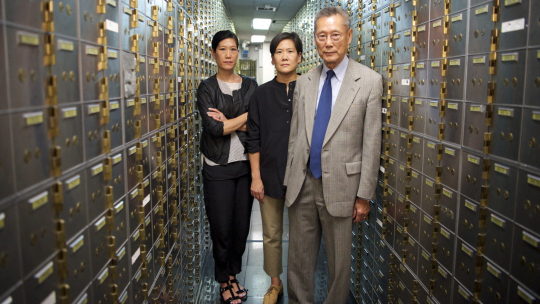
I know Nate Hood reviewed this back during the NYFF, but I had a review done and I don't want it to go to waste so now that the film hits theaters Friday here my thoughts.
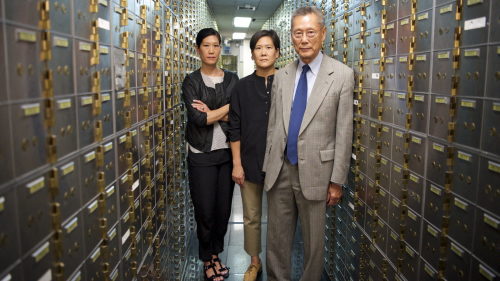
As a former frequent traveler through New York’s Chinatown I was well aware of the Abacus bank. It seemed like it was on every corner. That’s not the case, but it does make clear that the bank is clearly part of the life of that New York community. However when the Manhattan DA decided to go after the bank for bad loans it came as kind of shock. The bank was never like the other guys, it was and is family for many people.
And so it was that in an age of too big to fail the Manhattan DA decided to go after someone he thought he could take down and look like he was keeping everyone safe. Never mind that he couldn’t prove that the “corruption” was more than a couple of bad guys, particularly the prosecution’s lead witness who couldn’t stop telling lies, even on the witness stand, he was going to go for the kill.
Coming in as the case was heading to trial, legendary filmmaker Steve James waded into to fray and documented everything. Talking to everyone involved with the case, except the prosecution witnesses who lied under oath, James lays out the case beautifully, to the point where you wonder why the DA pursued the case when it was clear that the bank itself wasn’t to blame.
James film is a solid piece of reporting. It plays like, what it is, a solid FRONTLINE documentary. It’s a great piece about an injustice that in retrospect seems obvious. Of course when people believe what people have their own agenda or want to stay out of jail bad things happen. (Iraq war anyone).
While the film is excellent, the film is probably the least film that Steve James has done. As a man who has given us banquet movies such as HOOP DREAMS, ABACUS is a tasty after dinner snack. It may be perfectly prepared but compared to the filmmakers other delights it seems a little light. That doesn’t mean that the film is bad (absolutely not) it’s just not as detailed as I would have liked (say some sign of the women’s families other than the odd reference).
Definitely worth a look.
A collection of reviews of films from off the beaten path; a travel guide for those who love the cinematic world and want more than the mainstream releases.
Showing posts with label NYFF 2016. Show all posts
Tuesday, May 16, 2017
Thursday, October 20, 2016
13th (2016) New York Film Festival 2016
Ava DuVernay long angry scream of a film was the opening night film of this year’s New York Film Festival. It is a visceral gut punch that is taking no prisoners. Not so much a documentary as call for a complete change of how we view the issue of race as well as criminality. DuVernay has made a film that is vital and alive and important piece of cinema.
Beginning with the notion that the 13th Amendment of the US Constitution started institutional racism, DuVernay charts the story of how African Americans were put at the center of the rise of what has become our prison state where an ungodly number of men, mostly Black and other minorities are locked up. She explains how an artificial criminality was used to justify racial inequality. Because laws were used to arrest Blacks and get them out of the way, the statistics could then be used to shore up notions that they were not to be trusted. You could then write more laws to continue keeping the "bad people" under control and justify whatever evil you wanted to justify. The problem is that not only did they poison the minds of whites but the minorities themselves It is so wrong on the most basic level, and gotten so far out of hand that it’s threatening to lay waste to more than just the “criminals” it is supposed to control.
It’s a complex issue which DuVerny explains in such a way that there really is no way to argue with her.
As a call to arms the film is an absolute must see. It’s a well-made and well-reasoned explanation as to why minorities of all sorts are pissed off with America. It’s a stunning portrait of racism, both intentional and unintentional, in the country. The weight of DuVerny’s argument is simply crushing. It leaves you exhausted and overwhelmed. It's a film that will move emotionally. It may even move you to get off the couch and have you join the movement to make change. This is a film that really should be seen so that the discussion of what to do can begin in earnest.
As a social document and a petition for change the film cannot be argued with.
However if one takes a step back and looks at 13TH as a film it is not quite as perfect.
Before anyone goes crazy and argues that the film shouldn’t be seen as a just as a film or art and reviewed a such, but as political act, one must remember two things , first this is a film website. It’s my job to look at it as a film. I’m not going to say it’s anything less than what it is- a moving experience, I’m simply going to note a few thing. The second thing is that as of the moment is right now, and fuel for the discussion of race and crime there is going to come a time when the film isn’t seen as a living document but as a film that may or may have had an effect. I don’t know how history will see the film but I can see how I view the film and I have to speak my mind. I can’t give it a bye because it is the hot button topic of the moment.
The first comment I want to make about the film is not so much with the film itself as with the promotion of it. Written up in many places as an exploration of how the 13th Amendment was written as if it were a grand conspiracy to keep the former slaves as slaves from the start, The film is being misrepresented since that really isn’t the case. No evidence presented to that effect in the film. And I'm pretty sure that it were it would be even remotely correct. The film instead states that 13th Amendment created a loophole through which all the racism and hatred the country could muster could be funneled, which is absolutely true. I wish that those talking up the film had chosen their words a bit more carefully because there really wasn't a conspiracy. I'm mentioning this because a couple of people at my day job asked me about the reality behind it since they had never heard it despite having studied law.
The other comment I want to make is that as moving as the film is it is very much a film one can admire more than like. I know this isn’t a film that one should like, it is after all a calculated position paper, but it’s not the sort of film that I think is going to result in many repeat screenings. My feeling is that I’ve seen it once, taken in what it has told me, and now I can take the info and do something with it. I don’t need to go back.
I mention this because in weighing the film and how I felt about it I realized that there are other equally troubling docs, such as the work of Joshua Oppenheimer, the recent ESPN OJ documentary and SHOAH which I will revisit because there seems to be more I could glean from them on a second, third or more pass by them. In looking at 13th I really don’t feel I need to go back. Yes there are sequences I would like to see again, but I don’t need to see it all again. In order to get it all down into a manageable length DuVerny has masterfully edited together so there are no pauses, no wasted moments because it’s all bullet points. This doesn’t mean it’s not a great film, it is, I’m just not sure I need to go back a second time.
I’m also curious how the film will be viewed in five years- will it be a nexus of change or will it be simply a film of a moment. Its too early to know or even speculate.
Regardless how I feel 13th is an important film and a must see.
13TH is currently available on Netflix and is playing in select theaters and is on the festival circuit
Wednesday, October 19, 2016
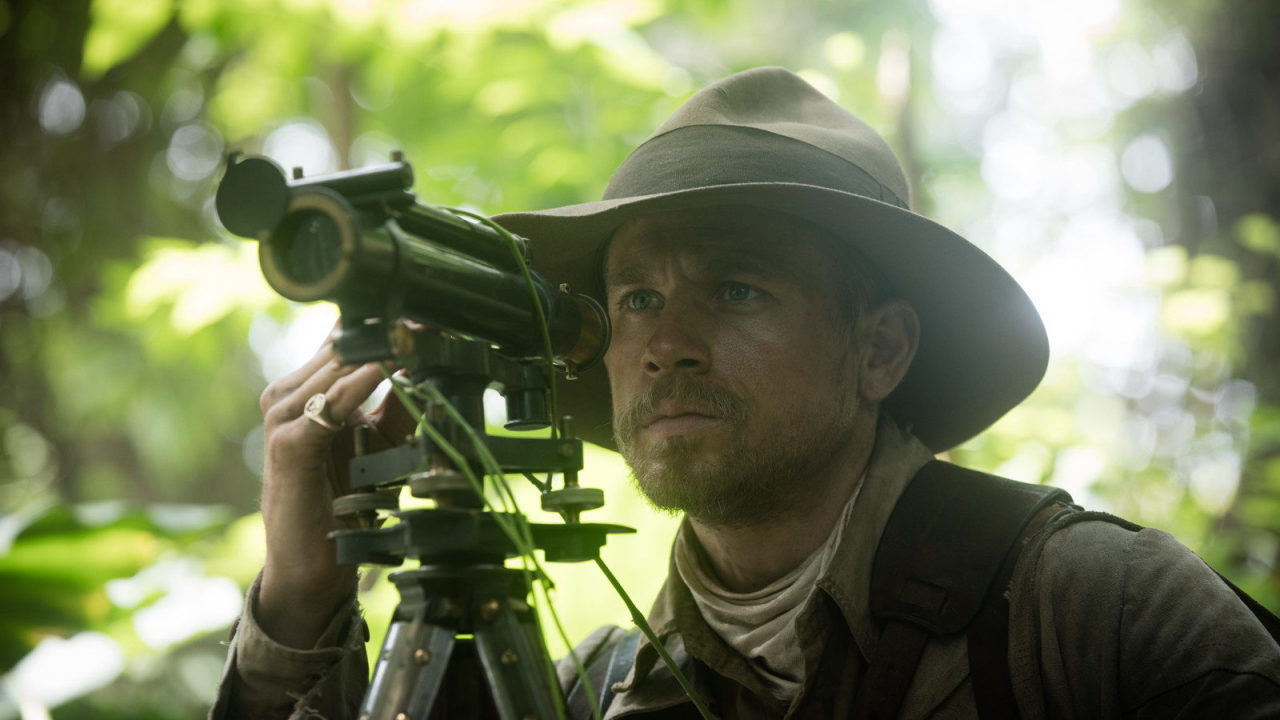
The Lost City of Z (2016) New York Film Festival 2016
James Gray's film of the LOST CITY OF Z is not the book. If you are looking for either author David Grann's journey to find the path taken by his subject Percy Fawcett or the absolute truth of what happened you are going to be disappointed. Gray has refashioned the story of Fawcett into a tale that is a weird mix of Werner Herzog, Joseph Conrad and Francis Ford Coppola, but with a twist all it's own.
The film is, more or less, the story of Col. Percy Fawcett a soldier in the British army. Sent to South America to map the border between Brazil and Bolivia because there is dispute that will effect the rubber trade and the two countries want an impartial outsider to do it. While traveling Fawcett hears the story of a lost city deep in the jungle. He thinks the tales are fiction until he himself finds evidence of civilization in the jungle. The possibility that the stories might be true hangs with him and over the next 20 years he makes several more trips to the jungle to try to track down the city.
Gray's film is a kind of conundrum in terms of modern cinema. More a throw back to grand old days of epic films that flourished in the 1930 until the 1980's than a modern one, the film presents a real life human spectacle that we don't see any more. Today epics are fantasy, science fiction or comic book in nature and aren't about real human endeavor. This is the real story of a real man filmed in a real jungle. It is not filled with explosions and epic action sequences or endless computer generated shots. What will modern audiences think?
What I love about the film is that it is deceptively simple. Nominally a straight forward tale of exploration Gray has crafted a film with a great deal going on. There are levels beyond the exploration, beyond the obsession. I need to see it again to get a better handle on all of the ideas I suspect are floating around.
In an age where every action is criticized if it's not from the right political view point Gray has fashioned a film that doesn't pretend to take a holier than thou position. We are not looking back at the world with more enlightened eyes, instead we are viewing Fawcett and his achievements from the stand point of the earliest part of the twentieth century. Gray is clearly amazed at what Fawcett did , and rightly so because regardless of what his motivations were it's hard not to see them as something amazing. He managed to map and record a large portion of an unknown territory and survive among populations that should have killed him as they did each other. His maps and writing would be the reference standard for decades after.
But the film is not about exploration. Instead it is about what happens when we latch onto something and chase it to the bitter end. This is the story of something consuming one man, his life and those around him. The film is not gospel history, Gray has slightly altered what happened in order to tell his story, which just sort of parallels Fawcett's. It's a story similar to the work of Herzog and Conrad but where those earlier works show how the madness destroys the man at the center, this film shows the human cost to everyone around him. Fawcett's wife is left to rely on the kindness of strangers and is broken by events, his children barely know him, reputations are ruined and people die just for being near him. There is a terrible cost, even beyond Fawcett's end. It is something that Fawcett's friend Costin recognizes before that final trip when he refuses to join the expedition. He has a wife and child he doesn't want to lose. Fawcett is too blind to it and it will cost him not only his life but also his son's.
The point at which the film truly parts ways with history to become it's own story is the final section. Here the question of whether obsession is worth the cost is pondered in the explorers final moments. Gray creates a mystical ending for the explorer and his son. Fawcett is accepting of the end, his son less so. Fawcett finally understands Costin's notion that what he has found may not be what he expected and is okay with that, his son isn't, and it's clear from the look in his eyes in those final moments he is only being brave for his father's sake (everything has always been for his father's sake). One has to applaud Gray for making an ending that is both truthful to history and to the story he is telling.
While not something you would know if you don't know the story or hadn't read the book, is the fact that Gray does a wonderful job of paring down the story. Where other filmmakers might have been tempted to open up or rewrite events, Gray sticks reasonably close to the facts. He pulls out the basic narrative and those facts that flesh out the tale he is telling but doesn't do the one's he leaving out any injustice. Where other people might have been tempted to have all sorts of scenes of life back home, Gray does so sparingly. We see enough to get the gist and he always does so in a manner that keeps us connected to Fawcett. We always remain focused on the man as if he is our own lost city. Its a gambit that pays off for while it reduces the screen time of characters such as his strong willed wife, it produces an emotional resonance at the end when we see her alone and clutching at straws that maybe, perhaps, her husband is still alive. It is the only time we see her without her husband and it breaks our heart.
In keeping things simple Gray never really explores what Fawcett was looking for other than the truth behind a tale. Where other filmmakers might have grafted some reasoning into the film, Gray doesn't. Fawcett is simply looking for a city. It could have been any sort of McGuffin. There is nothing beyond that and no implications of any sort. It is his obsession we don't need anything more than that. This straight forwardness to the story frees the film up from any sort of post modernist reconstruction or criticism of history or the film because there simply are no hand holds to do so. Gray is so straight forward that it is only some time after the film ends that we might be tempted to take a step back to ponder if we should be at least somewhat critical of the story beyond obsession. However there really is no way to, since it would require us to find things that aren't there and graft our prejudices on to the story, much like the real Fawcett who was so looking for a great stone city that he walked right by the very thing he was searching for.
This is a film that also manages to be nicely free of major problems with the treatment of the indigenous population as far as Fawcett is concerned. Fawcett's behavior in the film is clearly atypical in his world with his speaking out against slavery (and reporting it to British authorities), letting his guide go when the job as done and treating the people he meets with respect when "society", as represented by Mr Murray, belittles them and flees into the jungle. While not covered in the film, because it isn't germane to the tale being told, the real Fawcett survived for as long as he did because he treated the local people well, Though if one wants to ponder or question if he should have been doing what he was doing consider that in the end the very people he was traveling among ultimately made it clear he should never have been there.
From a technical stand point the film is first rate. I can't say enough good about the filmmaking on every level, which is a beautiful marriage of all that goes into making a film. You really must see this on the big screen because you will fall into it.
I also need to say that the cast is incredible and everyone disappears into their roles with Charlie Hunnam, Sienna Miller and especially Robert Pattinson completely disappearing into their parts. Pattinson is so good that when he showed up at the New York Film Festival press conference several writers around me had no idea who he was in the film.
This is an amazing film from top to bottom. It's a glorious return to classical style filmmaking but not classical story telling. It manages to be a wonderful mix of old school adventure and new era thoughtfulness. It is unlike any that's come out of Hollywood for decades and we are so much better for it. Highly recommended
THE LOST CITY OF Z premiered at The New York Film Festival, is due for a trip abound the festival circuit before getting released to theaters in the US April 21, 2017
The film is, more or less, the story of Col. Percy Fawcett a soldier in the British army. Sent to South America to map the border between Brazil and Bolivia because there is dispute that will effect the rubber trade and the two countries want an impartial outsider to do it. While traveling Fawcett hears the story of a lost city deep in the jungle. He thinks the tales are fiction until he himself finds evidence of civilization in the jungle. The possibility that the stories might be true hangs with him and over the next 20 years he makes several more trips to the jungle to try to track down the city.
Gray's film is a kind of conundrum in terms of modern cinema. More a throw back to grand old days of epic films that flourished in the 1930 until the 1980's than a modern one, the film presents a real life human spectacle that we don't see any more. Today epics are fantasy, science fiction or comic book in nature and aren't about real human endeavor. This is the real story of a real man filmed in a real jungle. It is not filled with explosions and epic action sequences or endless computer generated shots. What will modern audiences think?
What I love about the film is that it is deceptively simple. Nominally a straight forward tale of exploration Gray has crafted a film with a great deal going on. There are levels beyond the exploration, beyond the obsession. I need to see it again to get a better handle on all of the ideas I suspect are floating around.
In an age where every action is criticized if it's not from the right political view point Gray has fashioned a film that doesn't pretend to take a holier than thou position. We are not looking back at the world with more enlightened eyes, instead we are viewing Fawcett and his achievements from the stand point of the earliest part of the twentieth century. Gray is clearly amazed at what Fawcett did , and rightly so because regardless of what his motivations were it's hard not to see them as something amazing. He managed to map and record a large portion of an unknown territory and survive among populations that should have killed him as they did each other. His maps and writing would be the reference standard for decades after.
But the film is not about exploration. Instead it is about what happens when we latch onto something and chase it to the bitter end. This is the story of something consuming one man, his life and those around him. The film is not gospel history, Gray has slightly altered what happened in order to tell his story, which just sort of parallels Fawcett's. It's a story similar to the work of Herzog and Conrad but where those earlier works show how the madness destroys the man at the center, this film shows the human cost to everyone around him. Fawcett's wife is left to rely on the kindness of strangers and is broken by events, his children barely know him, reputations are ruined and people die just for being near him. There is a terrible cost, even beyond Fawcett's end. It is something that Fawcett's friend Costin recognizes before that final trip when he refuses to join the expedition. He has a wife and child he doesn't want to lose. Fawcett is too blind to it and it will cost him not only his life but also his son's.
The point at which the film truly parts ways with history to become it's own story is the final section. Here the question of whether obsession is worth the cost is pondered in the explorers final moments. Gray creates a mystical ending for the explorer and his son. Fawcett is accepting of the end, his son less so. Fawcett finally understands Costin's notion that what he has found may not be what he expected and is okay with that, his son isn't, and it's clear from the look in his eyes in those final moments he is only being brave for his father's sake (everything has always been for his father's sake). One has to applaud Gray for making an ending that is both truthful to history and to the story he is telling.
While not something you would know if you don't know the story or hadn't read the book, is the fact that Gray does a wonderful job of paring down the story. Where other filmmakers might have been tempted to open up or rewrite events, Gray sticks reasonably close to the facts. He pulls out the basic narrative and those facts that flesh out the tale he is telling but doesn't do the one's he leaving out any injustice. Where other people might have been tempted to have all sorts of scenes of life back home, Gray does so sparingly. We see enough to get the gist and he always does so in a manner that keeps us connected to Fawcett. We always remain focused on the man as if he is our own lost city. Its a gambit that pays off for while it reduces the screen time of characters such as his strong willed wife, it produces an emotional resonance at the end when we see her alone and clutching at straws that maybe, perhaps, her husband is still alive. It is the only time we see her without her husband and it breaks our heart.
In keeping things simple Gray never really explores what Fawcett was looking for other than the truth behind a tale. Where other filmmakers might have grafted some reasoning into the film, Gray doesn't. Fawcett is simply looking for a city. It could have been any sort of McGuffin. There is nothing beyond that and no implications of any sort. It is his obsession we don't need anything more than that. This straight forwardness to the story frees the film up from any sort of post modernist reconstruction or criticism of history or the film because there simply are no hand holds to do so. Gray is so straight forward that it is only some time after the film ends that we might be tempted to take a step back to ponder if we should be at least somewhat critical of the story beyond obsession. However there really is no way to, since it would require us to find things that aren't there and graft our prejudices on to the story, much like the real Fawcett who was so looking for a great stone city that he walked right by the very thing he was searching for.
This is a film that also manages to be nicely free of major problems with the treatment of the indigenous population as far as Fawcett is concerned. Fawcett's behavior in the film is clearly atypical in his world with his speaking out against slavery (and reporting it to British authorities), letting his guide go when the job as done and treating the people he meets with respect when "society", as represented by Mr Murray, belittles them and flees into the jungle. While not covered in the film, because it isn't germane to the tale being told, the real Fawcett survived for as long as he did because he treated the local people well, Though if one wants to ponder or question if he should have been doing what he was doing consider that in the end the very people he was traveling among ultimately made it clear he should never have been there.
From a technical stand point the film is first rate. I can't say enough good about the filmmaking on every level, which is a beautiful marriage of all that goes into making a film. You really must see this on the big screen because you will fall into it.
I also need to say that the cast is incredible and everyone disappears into their roles with Charlie Hunnam, Sienna Miller and especially Robert Pattinson completely disappearing into their parts. Pattinson is so good that when he showed up at the New York Film Festival press conference several writers around me had no idea who he was in the film.
This is an amazing film from top to bottom. It's a glorious return to classical style filmmaking but not classical story telling. It manages to be a wonderful mix of old school adventure and new era thoughtfulness. It is unlike any that's come out of Hollywood for decades and we are so much better for it. Highly recommended
THE LOST CITY OF Z premiered at The New York Film Festival, is due for a trip abound the festival circuit before getting released to theaters in the US April 21, 2017
![]() |
| The cast and director at the New York Film Festival press screening. |
Tuesday, October 18, 2016
Elle (2016) New York Film Festival 2016
![]() |
| Director Paul Verhoeven and his clues a long way away from the audience |
I don't think there is. Frankly I think whatever may have been in the source novel has gotten lost on the road to the screen.
The film concerns a woman who is raped, who may or may not have liked it, and who then tries to track down the man responsible. She also has the hots for her neighbor, is having an affair with her best friend's husband, is on the verge of becoming a grandmother and is the daughter of a mass murderer. To say there are a lot of plot threads is an understatement.
The film is often played for laughs, but is structured like a thriller. It is so ambiguous about it's motivations that when the film ends you're left wondering what the hell you just saw and why you bothered.
I would like to think that the film is some kind of a sick joke but again Isabelle Huppert is in the film so I have to wonder, at least a little, if there was supposed to be something more going on. Huppert has a career full of challenging, feminist and empowering films so if she saw something in the novel there has to be something in the story, right? Huppert, according the Verhoven, wanted to do a film adaption before he was ever aboard. The film rights went to the director who then tried to make it as an American film but failed so he went to France and made it with Huppert. Whatever happened all meaning seems to have been lost.
I've read a lot of reviews that said this is what happens when a male director makes a film about rape, but to be honest if a female director made the same film or even something close we'd still be scratching our heads. A bad film is a bad film. If a filmmmaker has bad perspective their gender isn't going to make it better or make it excusable.
![]() |
| Isabelle Huppert and her fuzzy director |
While there all sorts of bad plot twists ( and I've yet to run across a mass market video game with graphic tentacle sex) the whole plot and the whole film hinges on how you see Huppert's motivations. Is she looking for revenge? Is she looking for more rough sex? Is the ending a deus ex machina sort of good timing or was that her plan all along? What is she up to? Its not really clear. Its so not clear that you don't know what the film's point of view is other than all the women (more or less) are better off without the men in their lives. We know nothing about Huppert's character or her motivations except what we want to lay upon her when it's all said and done. Its so not on the screen that people can and have gotten into heated arguments about what everything means or is really going on.
I really don't know what to think or what to feel. Though to be honest I kind of feel nothing and was laughing at the film instead of with it. I literally threw up my hands at one point when I was thinking "I bet they'll have a car accident right here" and they did. Clearly Verhoeven is fucking with the audience because he can- which may very well be all he's doing.
Is the film offensive? Oh most probably for the vast majority of civilized people. (I say most people because two guys off to my left found the rape sequences very funny).
Is the film worth seeing? Other than seeing what all the yelling and screaming is about, no, not really. Personally I think no one should see the film so it makes no money and just disappears.
While I have to admire the New York Film Festival for putting a provocative film in the main slate, I really wish they had picked one that was better and worthy of even pondering.
Monday, October 17, 2016
Hamilton's America (2016) New York Film Festival 2016
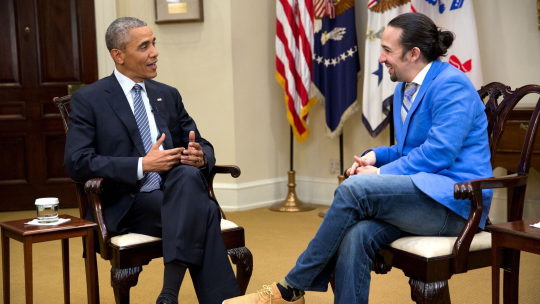
HAMILTON'S AMERICA is a long term record of the show, a filmed from two years before the first Opening Night until it's explosion on the Great White Way. Its a weird biographical mix of the Hamilton the man and Hamilton the show as well as a look at the creative process of show creator Lin-Manuel Miranda. It's a film that sells both history and the show to a new audience.
How you react to HAMILTON'S AMERICA is going to depend upon what you are looking to get out of it. Are you looking for a look at the Founding Father or are you looking for a making of the show with lots of clips? Both are here and for the most part both are very well done
As biography of Hamilton the man it is quite good and it makes the man and his achievements something truly alive especially for people living in today's digital age. Using Lin-Manuel Miranda's music the film brings all that this founding father did seem relevant to a world 200 plus years on. While not the story of everything that Hamilton did, it's more than enough to explain why he was so important to the very being of America. Its a great starting place for a discussion of the founding of the country.
The film is also loving portrait of what went into the making the musical that is going to be playing for decades to come. Since filming began when Miranda was only a couple of songs into the score the show gives us a general idea of how it was put together. We get to see how some choices were made and why the show is what it is, Its the perfect film for not only fans of the show but also for theater junkies who want to know how shows come together. One of to Broadway docs premiering at the New York Film Festival this year HAMILTON'S AMERICA is the better of the two film since here is a documentary that makes us care not only about the people involved but also the show itself.
As good a the film is at relating the stories of both Hamilton and the show to it's audience the film unfortunately has one big problem in that it is ultimately an 84 minute film for the show. While there is no doubt that the film was started with the idea of being a promotional tool for the show the film seems especially geared geared to putting more butts in the seats of the show. I'm not begrudging the producers and Miranda from making a film that will sell their work, I am bothered by the fact that when the film was done I didn't feel like I had seen something that taught me something, instead I wanted to jump on line to see what year the next block of tickets was available. I'm sorry, as good as this film is I don't think a documentary should make my over riding desire be to pay five or six hundred dollars for show tickets. Say what you will that is just wrong.
Crass commercialism aside, this is a very good documentary about a show, a founding father and my great (whatever) grandfather.
HAMILTON'S AMERICA premieres on PBS's Great Performances on Friday October 21st at 9pm
How you react to HAMILTON'S AMERICA is going to depend upon what you are looking to get out of it. Are you looking for a look at the Founding Father or are you looking for a making of the show with lots of clips? Both are here and for the most part both are very well done
As biography of Hamilton the man it is quite good and it makes the man and his achievements something truly alive especially for people living in today's digital age. Using Lin-Manuel Miranda's music the film brings all that this founding father did seem relevant to a world 200 plus years on. While not the story of everything that Hamilton did, it's more than enough to explain why he was so important to the very being of America. Its a great starting place for a discussion of the founding of the country.
The film is also loving portrait of what went into the making the musical that is going to be playing for decades to come. Since filming began when Miranda was only a couple of songs into the score the show gives us a general idea of how it was put together. We get to see how some choices were made and why the show is what it is, Its the perfect film for not only fans of the show but also for theater junkies who want to know how shows come together. One of to Broadway docs premiering at the New York Film Festival this year HAMILTON'S AMERICA is the better of the two film since here is a documentary that makes us care not only about the people involved but also the show itself.
As good a the film is at relating the stories of both Hamilton and the show to it's audience the film unfortunately has one big problem in that it is ultimately an 84 minute film for the show. While there is no doubt that the film was started with the idea of being a promotional tool for the show the film seems especially geared geared to putting more butts in the seats of the show. I'm not begrudging the producers and Miranda from making a film that will sell their work, I am bothered by the fact that when the film was done I didn't feel like I had seen something that taught me something, instead I wanted to jump on line to see what year the next block of tickets was available. I'm sorry, as good as this film is I don't think a documentary should make my over riding desire be to pay five or six hundred dollars for show tickets. Say what you will that is just wrong.
Crass commercialism aside, this is a very good documentary about a show, a founding father and my great (whatever) grandfather.
HAMILTON'S AMERICA premieres on PBS's Great Performances on Friday October 21st at 9pm
Sunday, October 16, 2016
Nate Hood picks his favorite films at the New York Film Festival
The was supposed to run as apart of an Unseen wrap up piece but Nate has exceeded expectations and I have to put his piece up on it's own.
I was generally unimpressed with this year’s selections. By and large, I found the films were either well-intentioned miscalculations or art-house detritus. I personally found it insulting that the curators seemed more interested in indulging obscure European titles like João Pedro Rodrigues’ The Ornithologist than the very best offerings of the Middle East, Africa, and Asia. Only five films in the main slate were from non-Western countries. Of those, only one—Sang-soo Hong’s Yourself and Yours—was from Asia. This is inexcusable. I cannot understand how the curators could defend including films like Dash Shaw’s My Entire High School Sinking into the Sea while ignoring recent offerings from Park Chan-wook, Hirokazu Koreeda, and Asghar Farhadi. The joke in recent years has been that the New York Film Festival has become Cannes 2.0. But if this is the case, how did award-winners like Andrea Arnold’s American Honey and Xavier Dolan’s It’s Only the End of the World get passed over for nonsense like Alain Guiraudie’s Staying Vertical?
Most of my favorite films of the festival were revivals, particularly the stunning 4K restoration of Gillo Pontecorvo’s masterpiece The Battle of Algiers (1966) and the Henry Hathaway retrospective. But I did end up enjoying some of the new releases. Here are my ten favorite picks.
10) Manchester by the Sea
I want to make it clear that even though I had issues with its bizarre get-the-nephew-laid side-plot, I can’t deny the film’s simple, exhaustive emotional power.
My review: https://unseenfilms.blogspot.com/2016/09/nathanael-hood-travels-to-manchester-by.html
9) Moonlight
Though it sometimes felt like the film could have benefitted from another screenplay draft—why exactly didn’t the film end with the protagonist and his boyfriend on the beach instead of staggering on for another 5 minutes?—Moonlight remains a stirring glimpse into a sorely under-represented minority community.
8) Abacus: Small Enough to Jail
My review: https://unseenfilms.blogspot.com/2016/10/nathanael-hood-on-abacus-small-enough.html
7) Bright Lights: Starring Carrie Fisher and Debbie Reynolds
I was afraid for a moment that Alexis Bloom and Fisher Stevens' new documentary would make the titular mother-daughter duo out to be a poisonous couple, constantly slinging abuse towards each other in-between tearful reconciliations. But here's the beauty of the film: both are generally at peace with each other and their relationship. The film is a look back, both at how foolish they were and how foolish they still are.
6) The Lost City of Z
Review at The Young Folks http://theyoungfolks.com/review/nyff-review-the-lost-city-of-z/89369
5) Personal Shopper
One of the scariest films I’ve seen all year—which is odd considering it isn’t too interested in being a horror film in the first place.
4) The Unknown Girl
My review: https://unseenfilms.blogspot.com/2016/10/nathanael-hood-investigates-unknown.html
3) The 13th
I'm not exaggerating when I say that Ava DuVernay's 13th might literally be the most important documentary of 2016. It might even be one of the most important documentaries of the decade. A stunning, stirring examination of the 13th Amendment and how it makes exceptions to slavery in cases that involve prisoners, it explores nothing less than the soul of America through its treatment of African-Americans in the post-Civil War era.
2) I, Daniel Blake
My review: https://unseenfilms.blogspot.com/2016/09/nathanael-hood-is-rocked-by-ken-loachs.html
1) Paterson
Jim Jarmusch's Paterson is a revelation, a heart-rending yet soul-uplifting story of a blue collar poet that reminds me why I love the cinema. I think the world had considered Jarmusch to be a director beyond his glory days, one of those old hat cinematic pioneers content to throw the odd project on the festival circuit every few years. But Paterson? Paterson is just as vibrant, vital, and stunning as anything Jarmusch has ever made. It might very well be my new favorite film of his.
I was generally unimpressed with this year’s selections. By and large, I found the films were either well-intentioned miscalculations or art-house detritus. I personally found it insulting that the curators seemed more interested in indulging obscure European titles like João Pedro Rodrigues’ The Ornithologist than the very best offerings of the Middle East, Africa, and Asia. Only five films in the main slate were from non-Western countries. Of those, only one—Sang-soo Hong’s Yourself and Yours—was from Asia. This is inexcusable. I cannot understand how the curators could defend including films like Dash Shaw’s My Entire High School Sinking into the Sea while ignoring recent offerings from Park Chan-wook, Hirokazu Koreeda, and Asghar Farhadi. The joke in recent years has been that the New York Film Festival has become Cannes 2.0. But if this is the case, how did award-winners like Andrea Arnold’s American Honey and Xavier Dolan’s It’s Only the End of the World get passed over for nonsense like Alain Guiraudie’s Staying Vertical?
Most of my favorite films of the festival were revivals, particularly the stunning 4K restoration of Gillo Pontecorvo’s masterpiece The Battle of Algiers (1966) and the Henry Hathaway retrospective. But I did end up enjoying some of the new releases. Here are my ten favorite picks.
10) Manchester by the Sea
I want to make it clear that even though I had issues with its bizarre get-the-nephew-laid side-plot, I can’t deny the film’s simple, exhaustive emotional power.
My review: https://unseenfilms.blogspot.com/2016/09/nathanael-hood-travels-to-manchester-by.html
9) Moonlight
Though it sometimes felt like the film could have benefitted from another screenplay draft—why exactly didn’t the film end with the protagonist and his boyfriend on the beach instead of staggering on for another 5 minutes?—Moonlight remains a stirring glimpse into a sorely under-represented minority community.
8) Abacus: Small Enough to Jail
My review: https://unseenfilms.blogspot.com/2016/10/nathanael-hood-on-abacus-small-enough.html
![]() |
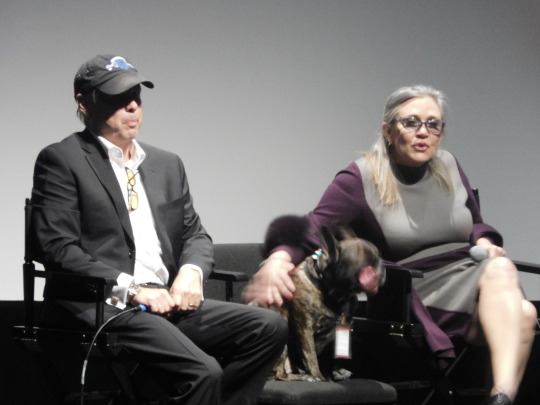
| Todd, Jerry and Carrie Fisher at the BRIGHT LIGHTS Q&A |
7) Bright Lights: Starring Carrie Fisher and Debbie Reynolds
I was afraid for a moment that Alexis Bloom and Fisher Stevens' new documentary would make the titular mother-daughter duo out to be a poisonous couple, constantly slinging abuse towards each other in-between tearful reconciliations. But here's the beauty of the film: both are generally at peace with each other and their relationship. The film is a look back, both at how foolish they were and how foolish they still are.
6) The Lost City of Z
Review at The Young Folks http://theyoungfolks.com/review/nyff-review-the-lost-city-of-z/89369
![]() |
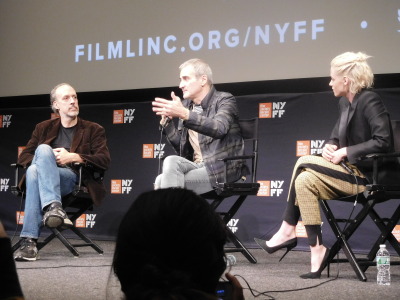
| Kent Jones talks to Olivier Assayas and Kristen Stewart about PERSONAL SHOPPER |
5) Personal Shopper
One of the scariest films I’ve seen all year—which is odd considering it isn’t too interested in being a horror film in the first place.
4) The Unknown Girl
My review: https://unseenfilms.blogspot.com/2016/10/nathanael-hood-investigates-unknown.html
3) The 13th
I'm not exaggerating when I say that Ava DuVernay's 13th might literally be the most important documentary of 2016. It might even be one of the most important documentaries of the decade. A stunning, stirring examination of the 13th Amendment and how it makes exceptions to slavery in cases that involve prisoners, it explores nothing less than the soul of America through its treatment of African-Americans in the post-Civil War era.
2) I, Daniel Blake
My review: https://unseenfilms.blogspot.com/2016/09/nathanael-hood-is-rocked-by-ken-loachs.html
1) Paterson
Jim Jarmusch's Paterson is a revelation, a heart-rending yet soul-uplifting story of a blue collar poet that reminds me why I love the cinema. I think the world had considered Jarmusch to be a director beyond his glory days, one of those old hat cinematic pioneers content to throw the odd project on the festival circuit every few years. But Paterson? Paterson is just as vibrant, vital, and stunning as anything Jarmusch has ever made. It might very well be my new favorite film of his.
Nightcap 10/16/16 NYFF is done, word on Billy Lynn, help fund TORMENTING THE HEN, and Randi's links
![]() |
| Everyone is gone and the last few people are straggling away from Alice Tully Hall |
As this posts the New York Film Festival is done and it’s time to relax and chill out. All of the mad dashing up to Lincoln Center is all over (for now).
I’m not going to do any sort of reflection on the festival. I just don’t have the words. I realized there was going to be a problem when I was talking to one of the Film Society patrons at the Personal Shopper press screening. He had been coming to the festival since it started and attended every year for the last 50 years. To him this year’s festival was the least exciting. There was of course some great films but there was no excitement because for the most part there wasn’t any big deal movies after 13TH screened.
I kind of agree with his assessment with even the public Q&A’s not generating any heat- though Debbie Reynolds call in for BRIGHT LIGHTS was of the highlights.
Actually the festival is probably going down as one with some really weird moments such as the most over hyped introduction ever with Dennis Lim's intro and the festival staff wildly over selling TONI ERDMANN (it seemed to liken it to seeing god) and the complete confusion as to what MY ENTIRE HIGH SCHOOL... was doing on the main slate (though many people I know will argue it shouldn't have been at the festival)
Despite the lack of excitement the festival did have some of the best films of the year. Here are my best of the fest films in no particular order
UNCLE HOWARD
CINEMA TRAVELERS
PATERSON
MOONLIGHT
HISSEIN HABRE
DAWSON CITY
JACKIE
and I'm including PERSONAL SHOPPER because while not perfect it is truly scary
I also have to mention Adriana Barraza in EVERYTHING ELSE because acting never gets better than that.
And of course there was the phone call by Debbie Reynolds which charmed everyone in attendance at the BRIGHT LIGHTS screenings- that's now on the list of truly great NYFF moments ever.
I am going to be posting Nate Hood's NYFF best of list separately. His wrap up piece is too good to be linked to my nonsense. I also want to thank Nate for helping out with reviews and with acting as my frequent wing man at NYFF screenings and events. As always it's been a pleasure my friend.
---
The other day a friend said she had just seen THE HOST for the first time. With the NYFF winding down I was reminded of the story of the film playing the New York Film Festival back in 2006. It was amusing as hell to see the film playing at Alice Tully Hall with an audience of upscale film lovers unfamiliar with Korean horror films. (remember this was before New York Asian changed the film landscape in New York) Watching the audience get more and more freaked out as the moster ate people was great fun. It was clear that many people didn’t expect the fear nor did they expect to be literally jumping out of their seats in mid-belly laugh. While there was no post film Q&A the post film talk among the audience was largely centered on what the hell was that and why hadn’t they seen anything like that before. It was for many a game changer
(perhaps it's time to shake up the programmers and get back to screening films that change the way New York and the world sees film)
---
A quick note or two on BILLY LYNN'S LONG HALF TIME WALK which world premiered at the New York Film Festival.
While as many of you know the word on the film is mixed, the real talk is about the high frame rate projection. The projection is supposed to render the images as if you are looking out a window. It is supposed to amazing and eerie.
I was talking to some people who are involved in the festival and was told a couple of things-
First there will only be two theaters to show it in the new format one in New York and One in LA. It will most certainly never be shown in that way ever again after the the theatrical run because the cost of the projectors are north of a million dollars. They are so costly that the theaters are only borrowing them for the screenings.
Next the technology is such that no other film is planning to shoot using it, which effectively means that in the current for them format is dead, or if not dead a prototype of a years in the future technology.
Lastly the frame rate isn't always 120 frames per second. The war scenes are at that rate. All the other scenes have different rates depending upon the mood that they want to create.
The people I spoke with said that if you're going to see the film and can see it in the high frame format do so. If not you need not rush out to see the film.
---
With the end of the NYFF Unseen (reviews will finish up Wednesday) is going back into cruising mode. As things stand now things are programmed into January. I’m going to go back and circle my wagons in my personal life and try to sort a few things out. There are things that have to be done and Unseen can take care of itself.
There is going to be lots of older films in the next few weeks. Any new films are going to be things I want to cover. I suspect that in the next few weeks I’ll be doing DOC NYC, SAIFF and a couple other film festivals that have peaked my interest.
Despite the preprogramming stay with us because who knows what is going to pop up.
---
Producer Ben Umstead has an Indegogo up for the post production on TORMENTING THE HEN. This is definitely a film you want to back. I've seen the films Ben has produced and they are awesome. Help get another one made.
The info can be found here
---
And now Randi's Links
A new Russian film propagates an old Soviet myth and reveals Putin's move to control history
The TAKEN speech
Syria's Banksy
Russian MST3K
KITT from Knightrider saves Christmas
HOLOGRAM FOR THE KING extended dream sequence
On Disney's Robin Hood or people with no joy should not review films
Broadway shows that shut down to revamp
![]() |
| So long until next year |
Saturday, October 15, 2016
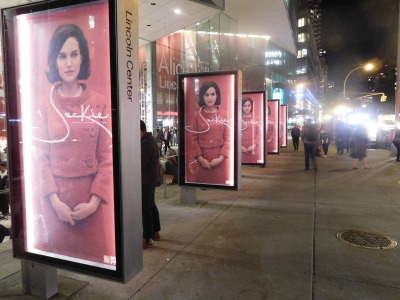
Jackie (2016) New York Film Festival 2016
To be perfectly honest I bought tickets to the surprise screening of JACKIE as a goof. I could do it so I did it, I didn't want to really see it, but I figured it would be a way of hanging out and talking movies. Worse came to worse I could sell them and be done with it.
I didn't sell them instead I did go, with my friend Nora. I'm not sure either of us had high expectations for the film, but we bought the ticket and took the ride... and when it was done we both were shocked at how good the film really is. I think it's easily one of the best films at the New York Film Festival, and probably one of the best of the year- as far as award bait films go and the whole year.
Set a week after the funeral of her husband JACKIE is a psychological portrait of Jackie Kennedy in the wake of the assassination. Based on an interview she gave to one of her friends the film delves into what she may have been thinking, feeling and doing. The events depicted are based on interviews, letters and recently released documents that put us into the head-space of the former First Lady.
All of the talk going into the film concerned Natalie Portman's performance as Jackie. The attention is being thrown her way because the film is all her. She is in almost every scene and every shot. She carries the film. I know that some people who have never heard Jackie speak are going to be bothered by her cadences but if you look at the TV White House that forms part of the film, you'll quickly realize how right on Portman is. While she gets the voice right she also gets the soul right- or seems to. Here is a woman in mourning, who has fallen from the top of the pyramid and is now trying to find her way. Under normal circumstances it would be tough but as she is simply trying to process she is being paraded out for the cameras, plan a funeral and be removed from her home because the next president wants to move in. Its a masterful performance and will get Portman her next Oscar nomination.
The rest of the cast is equally good with everyone disappearing into their roles pretty much completely. I particularly loved John Hurt as a priest Jackie talks to. I don't believe it's based on anyone in particular but he is as good spiritual figure as I've see on screen in a very long time.
While I was initially not in love with the film, somewhere about 15 minutes in the film clicked for me. I understood what it was doing and how it was doing it and I fell under it's spell. What I loved was that despite the obvious music cues and emotional manipulation it sucks you in and makes you feel what Jackie (or this version of her at least) is feeling. The film's tricks hook you and drag you along and make you go "yea this is what it must have been like". Its masterful filmmaking.
Another thing that I loved is that the film never gets into gossip territory. The film doesn't throw brickbats at the Kennedys or the Johnsons or anyone. The film remains steadfastly a portrait of a woman in mourning and how she shaped history.
Highly touted for Portman's performance if nothing else, JACKIE is exactly the sort of film that should be playing at the New York Film Festival. In a year where many of the highest praised films at the festival fizzled or disappointed JACKIE transcended the norm and was something truly special. Here is a film that has all the bells and whistles and uses them to pack an emotional wallop.
To be honest there is much to say about the film and it's explorations of public and private life, of it's look at the forging of history and of the very human story of mourning but I really don't feel like discussing them. Frankly what I want to do is just sit back and enjoy the fact that JACKIE hit it out of the park and then some. I'm sure that many people will be writing up the thematic elements and historical significance of the film. Let them. Me I'd rather just sit back and relax an ponder the film and occasionally mumble "Damn that's a good film" because sometimes that says it all.
Absolutely one of the best films at the New York Film Festival and a must see when the film opens December 2.
I didn't sell them instead I did go, with my friend Nora. I'm not sure either of us had high expectations for the film, but we bought the ticket and took the ride... and when it was done we both were shocked at how good the film really is. I think it's easily one of the best films at the New York Film Festival, and probably one of the best of the year- as far as award bait films go and the whole year.
Set a week after the funeral of her husband JACKIE is a psychological portrait of Jackie Kennedy in the wake of the assassination. Based on an interview she gave to one of her friends the film delves into what she may have been thinking, feeling and doing. The events depicted are based on interviews, letters and recently released documents that put us into the head-space of the former First Lady.
All of the talk going into the film concerned Natalie Portman's performance as Jackie. The attention is being thrown her way because the film is all her. She is in almost every scene and every shot. She carries the film. I know that some people who have never heard Jackie speak are going to be bothered by her cadences but if you look at the TV White House that forms part of the film, you'll quickly realize how right on Portman is. While she gets the voice right she also gets the soul right- or seems to. Here is a woman in mourning, who has fallen from the top of the pyramid and is now trying to find her way. Under normal circumstances it would be tough but as she is simply trying to process she is being paraded out for the cameras, plan a funeral and be removed from her home because the next president wants to move in. Its a masterful performance and will get Portman her next Oscar nomination.
The rest of the cast is equally good with everyone disappearing into their roles pretty much completely. I particularly loved John Hurt as a priest Jackie talks to. I don't believe it's based on anyone in particular but he is as good spiritual figure as I've see on screen in a very long time.
While I was initially not in love with the film, somewhere about 15 minutes in the film clicked for me. I understood what it was doing and how it was doing it and I fell under it's spell. What I loved was that despite the obvious music cues and emotional manipulation it sucks you in and makes you feel what Jackie (or this version of her at least) is feeling. The film's tricks hook you and drag you along and make you go "yea this is what it must have been like". Its masterful filmmaking.
Another thing that I loved is that the film never gets into gossip territory. The film doesn't throw brickbats at the Kennedys or the Johnsons or anyone. The film remains steadfastly a portrait of a woman in mourning and how she shaped history.
Highly touted for Portman's performance if nothing else, JACKIE is exactly the sort of film that should be playing at the New York Film Festival. In a year where many of the highest praised films at the festival fizzled or disappointed JACKIE transcended the norm and was something truly special. Here is a film that has all the bells and whistles and uses them to pack an emotional wallop.
To be honest there is much to say about the film and it's explorations of public and private life, of it's look at the forging of history and of the very human story of mourning but I really don't feel like discussing them. Frankly what I want to do is just sit back and enjoy the fact that JACKIE hit it out of the park and then some. I'm sure that many people will be writing up the thematic elements and historical significance of the film. Let them. Me I'd rather just sit back and relax an ponder the film and occasionally mumble "Damn that's a good film" because sometimes that says it all.
Absolutely one of the best films at the New York Film Festival and a must see when the film opens December 2.
Friday, October 14, 2016
A messy review about the very messy My Entire High School Sinking Into The Sea (2016) New York Film Festival 2016
![]() |
| Dash Shaw |
I missed Dash Shaw’s MY ENTIRE HIGH SCHOOL FALLING INTO THE SEA at the press screening. I arrived just as it ended and was greeted by several friends wandering out into the daylight who were wondering all sorts of things about the film, chief among them what the point of it all was. I was amused by their quizzical looks and looked forward to seeing the film at the first public screening.
I have now seen the film and I too am quizzical for any number of reasons, most of them not good.
The plot of the film has two friends,Dash and Assif who work at the high school newspaper getting into a tiff over a girl and separating. When Dash discovers that the school is not only rotting from the inside but on a fault line he tries to warn everyone but no one listens. Immediately there after an earthquake hits and the school falls into the ocean. Dash and his friends are forced to try to climb to the top of building for rescue as all those around him die horrible deaths in a weird melding of Dante's Inferno and the POSEIDON ADVENTURE. There are a few little flourishes and a few witty lines but that is more or less the entire film.
Made with a mix of drawing styles and an ever changing color palette the film is an occasionally visually interesting as an odd moment of disconnected animation transcends the rest of the film to become something intriguing to look at. The problem the visuals are attached to a script which acts as a lead weight that pulls the whole thing under the waves.
The script is about a couple of high school sophomores and it’s written with all the skill and care of similarly aged kids. There are no characters only cardboard cut outs and assholes. The characters are sitcom types not real people who speak in a flat monotone style that make them even less real. There are stabs at social commentary and points about the class system in high school but theyare obvious and heavy handed. There is nothing we haven't really seen before thanks to a plot which has the floors of the school seeming to be Dante's circles of Hell and the climb up to be saved mirroring both Dante's trip out of the inferno and the trip made out of a certain upside down cruise ship.
I’m told that writer director Shaw writes stories that are dream like in their construction of the narrative but here there is no logic, not even dream logic, it just jumps to the next thing for no real reason other than it's something to do. Why does society break down instantly? Why is there only one staircase up? Why are there ways up under the bleachers? How is there electricity in the school? Why is there a soccer goal in the attic? None of it makes sense. Devoid of reason and purpose the film is simply just the school sinking and the kids trying to get out as written by a ten year old, with the odd glib line tossed in.
It’s a mess from some one who some consider a great graphic artist.
Sadly while he maybe a great person on a comic page Shaw doesn’t understand cinematic storytelling. What he did was make a film that moves and acts too much like a graphic novel. There is a static-ness to scenes that would play fine as an exchange on the page but is deadly in film. There is no motion or life, characters stand motionless while the background moves. In other sequences we get characters traveling through the school that play like the Spiderman swings filler sequences in the Ralph Bakshi produced SPIDERMAN TV series. Shaw doesn't realize that when you turn graphic work into a film you have a shot that mirrors a comic panel for an instant you don't have an entire scene play out that way.
Events happen in randomly selected places. We jump from hallway to room and back again with abandon. There is no sense of "here" or how we got from place to place. We are just suddenly in a place. There are references to events that seem more like non sequiturs than part of a world. Events transpire as if they are from comic panels or a comic strip and not a real world. For example references to Dash and Asif's camping trip feels like the punchline to a joke not a real event. Shaw doesn’t fully understand that the films require a certain connection to reality, or a reality, for it to work. The film is not connected to our reality and unfortunately he keeps throwing things at us to change his reality (paging the ten year old writer) so nothing ever feel grounded.
While I freely admit you can do anything when you’re telling a story. Shaw's story telling style is something different and he is taking risks in how the story unfolds. I applaud his trying to mirror his comic style. However the key when you're being bold is that what you do has to work so we won't care you're breaking the rules- because if it fails, as it does here, you’re going to get kicked to the curb for doing it because the whole frame work of the film collapses on itself.
The film might have worked better if there was any real humor, but the film isn’t all that funny. The jokes seem shoehorned in at odd moments rather than part of the action. What jokes there are are either obvious or crude or just mean. I laughed once. Most of the audience never did.
As much as I can rip the film apart it isn’t a bad film -lord knows it’s not NERDLAND, which is really bad. But at the same time it doesn’t hold together like that awful film. This should be better. This feels like someone took a two hour film and cut half of it out. It’s a bunch of sketched ideas that need fleshing out. If this was a demo reel, which it looks like, I could accept it but as a finished film this film is a nice try but it’s a non-starter.
I suspect that this film is going to play best if you are a fan of Shaw’s graphic novels and know and love his rhythms. The small audience at Alice Tully was full of friends and fans of Shaw and they reacted with gales of laughter to some of the jokes. They also cheered wildly when the film ended. The rest of us just got up and walked out not waiting for the credits to end or the Q&A to start. I suspect that most people not being Dash Shaw fans was why the film had the first walk outs I’ve seen at the festival.
My biggest question concerning this film is what in the hell is this doing on the Main Slate at the New York Film Festival. The film is visually interesting enough that I could see it playing at the festival but on the Main Slate in the 1200 seat Alice Tully Hall? Are they mad?
This is especially a puzzlement when you consider all of the really good animated films floating around off and on the festival circuit. The answer to why they picked this one eludes me. RED TURTLE from Studio Ghibli seemed like it would have been the choice. Or if they were going to go off the board stylistically they could have picked the wonderful WINDOW HORSES which played Toronto and is burning up the festival circuits. The only thing I can think of is that when Amy Taubin said she had a shelf full of Dash’s work she wasn’t kidding. Perhaps the programmers are such big fans that they couldn’t see that the film wasn’t going to ever work outside his fan base.
To be honest the film being on the Main Slate at NYFF forces me to really consider a film that doesn’t deserve this much consideration. It’s a not very good film and while it should be noted in passing it shouldn’t be considered more than just a doodle even from an artist of some status. I suspect that had the film not been in a front and center position at NYFF I wouldn't be as hard on it I probably would have shrugged and just went on to the next thing.
You have to forgive me, this film has me flummoxed.
This is a very niche film, that is very much for a specific audience that is playing at one of the most prestigious film festivals in the world in its biggest theater. While the festival is full of films that are never going to get a wide releases I pretty much always know why a film was a Main Slate selection. This time I’m clueless. Even as a supporter of small inde films, and inde animation I’m at a loss as to why this is on the main stage with the brightest lights upon it. I say this because putting it out there gives the film a weight it simply does have and give it an importance it doesn’t live up to.
This is ultimately a minor film.
Unless you’re a fan of Dash Shaw I can’t recommend the film
Bright Lights (2016) New York FIlm Festival 2016
![]() |
| Todd Fisher, Jerry Fisher and Carrie Fisher |
I don’t have a great deal to say about BRIGHT LIGHTS other than see it. It’s simply that good and it doesn’t need anything more from me.
The film is a look at the relationship between Carrie Fisher and her mom Debbie Reynolds. The film revolves around some of Reynolds final performances in Connecticut and Las Vegas. We watch the duo as they talk kibbutz and get ready to perform. We also get a look from a the outside with commentary by Carrie’s brother Todd. And we watch the star making performance from Carrie’s best buddy, Jerry.
The film is both hysterically funny and deeply heartbreaking. Watching Carrie with her dad is incredibly sad (she won’t watch they footage) and it breaks your heart to watch how age and illness slows Reynolds to the point where she can’t really perform any more. On the other hand watching Carrie be Carrie and Debbie be Debbie provides some of the most genuine joy of the year.
I do have to say the post screening talk with Carrie, her brother and the filmmakers was really cool, providing one of the best New York Film Festival moment ever when Debbie Reynolds called in and sang a bit. It was a marvelous three and a half minutes. I also loved it since there was only one Star Wars reference.
One of the best films at the New York Film Festival. I can’t wait for it to hit HBO so you all can see it too.
Thursday, October 13, 2016
Karl Marx City (2016) New York Film Festival 2016
More essay and meditation than straight on documentary KARL MARX CITY is for much of it's running time an intriguing portrait of what life was like in the former communist nation. Through interviews with experts and people who lived through it we get a real sense of what it was really like in the bad old days. This wasn't what Hollywood gave us but something more evil and damaging as the state tried to have everyone spying on everyone, It's an eye opening experience.
The problem is the film bogs down for a while as Petra waits for her father's STASI file to be pulled together. While the STASI recorded everything their filing system was such that all the information was kept in many places and it can take months to pull it all together. To fill the void we watch as Petra wanders the city with a microphone in her hand. Things slow to a kind of crawl.
When the film ended many applauded. I tried to wake up. While the film pulls most of it's threads together in the end, there is a little too much navel gazing for my tastes. Though I do like that when things are revealed that there are no hard and fast conclusions. Things are still in flux and there are still questions to ask and emotional sorting to do- for the people on screen and in the audience.
The film plays the 14th and 15 at the New York Film Festival. For tickets and more information go here
Wednesday, October 12, 2016
Everything Else (2016) New York Film Festival 2016
Adriana Barraza potentially could be on the road to her second Oscar nomination in EVERYTHING ELSE a raw real emotional film about connecting with the world.
Barraza plays a long term civil servant who lives alone and only connects to the world by watching. Her only meaningful relationship is with her cat, but it dies her life is thrown into turmoil.
A carefully observed film this is a near documentary style film, which isn't surprising since director Natalia Almada previously only made documentaries. Its also similar to some of the films of the late Chantal Akerman with it's "this is life" approach.
From a plot perspective there isn't much new here. You've probably seen films similar to this before, even to the point of the not finding the main character's lack of physical connection to anyone or anything a bit old hat. On the other hand those other films didn't have Adriana Barraza at it's center. Make no mistake about it Barraza is the reason to see the film and what she does is simply an acting masterclass. This is how to create character with just a look or a move or a stance. Brraza doesn't say very much constructive at all verbally but her every move speaks volumes and effectively reveal her whole life to us. Its a performance for the ages and one that I can't say enough good things about.
EVERYTHING ELSE plays October 14 and 15. For more information and tickets go here.
Barraza plays a long term civil servant who lives alone and only connects to the world by watching. Her only meaningful relationship is with her cat, but it dies her life is thrown into turmoil.
A carefully observed film this is a near documentary style film, which isn't surprising since director Natalia Almada previously only made documentaries. Its also similar to some of the films of the late Chantal Akerman with it's "this is life" approach.
From a plot perspective there isn't much new here. You've probably seen films similar to this before, even to the point of the not finding the main character's lack of physical connection to anyone or anything a bit old hat. On the other hand those other films didn't have Adriana Barraza at it's center. Make no mistake about it Barraza is the reason to see the film and what she does is simply an acting masterclass. This is how to create character with just a look or a move or a stance. Brraza doesn't say very much constructive at all verbally but her every move speaks volumes and effectively reveal her whole life to us. Its a performance for the ages and one that I can't say enough good things about.
EVERYTHING ELSE plays October 14 and 15. For more information and tickets go here.
23 Paces to Baker Street is playing at the New York Film Festival
This is a repost of a review which ran back in 2010. This is an awesome little thriller that you'll be able to see when the film plays the final weekend of this years New York Film Festival which starts tomorrow. I highly recommend seeing it at the festival because of the film was shot in a beautiful wide screen.
I have no idea if this film is in the Turner Classics rotation. I know its not on official DVD since I picked this up from a dealer at a nostalgia show. Unfortunately its a pan and scan copy which means the wonderful widescreen that you see fleetingly during the opening and closing credits is completely missing for the body of the film. This is a film that needs to be seen by more people and needs to be out at the correct aspect ratio.
Van Johnson is a blind playwright in London. Cranky since he lost his sight he lives a reclusive existence having driven away anyone who cared about him. He's helped along only by his butler. One day when he wanders off to a pub he overhears a conversation that leads him to believe that a terrible crime, a kidnapping or murder, is going to take place. When his call to the police gets him nowhere, he decides to stop the crime himself; or rather with the aid of his butler and his ex-fiance.
This is a nifty little thriller that is akin to Hitchcock's films of the 1950's. While it echoes Hitchcock's work it is decidedly its own beast with the plot and events playing out in ways that Hitch never really explored. Johnson's blindness is both a blessing and a curse and a good chunk of the tension comes from not knowing if he's in over his head. The plot is nicely crafted so that, like Johnson and his companions, we are not sure what exactly is being planned. We, like the characters on the screen, have to piece things together. Its so nice not to have everything spelled out at the start or to have a big reveal moment too early in the tale.
The whole cast are very good with everyone nicely filling out and selling their assigned roles.
If there is a problem with the film its that film has the feel of some of the big budget films of the 50's that were made in color and on location so that people would be lured back to theaters in order to see things they couldn't get on TV. Its often too "big" for some of the small moments with shots set up to look good in widescreen, but almost at the cost of the story. Still its a minor complaint and the film looks good in the full screen edition I saw.
This is one to look out for, especially if you're a Hitchcock fan, since it appears to be an under appreciated thriller.
I have no idea if this film is in the Turner Classics rotation. I know its not on official DVD since I picked this up from a dealer at a nostalgia show. Unfortunately its a pan and scan copy which means the wonderful widescreen that you see fleetingly during the opening and closing credits is completely missing for the body of the film. This is a film that needs to be seen by more people and needs to be out at the correct aspect ratio.
Van Johnson is a blind playwright in London. Cranky since he lost his sight he lives a reclusive existence having driven away anyone who cared about him. He's helped along only by his butler. One day when he wanders off to a pub he overhears a conversation that leads him to believe that a terrible crime, a kidnapping or murder, is going to take place. When his call to the police gets him nowhere, he decides to stop the crime himself; or rather with the aid of his butler and his ex-fiance.
This is a nifty little thriller that is akin to Hitchcock's films of the 1950's. While it echoes Hitchcock's work it is decidedly its own beast with the plot and events playing out in ways that Hitch never really explored. Johnson's blindness is both a blessing and a curse and a good chunk of the tension comes from not knowing if he's in over his head. The plot is nicely crafted so that, like Johnson and his companions, we are not sure what exactly is being planned. We, like the characters on the screen, have to piece things together. Its so nice not to have everything spelled out at the start or to have a big reveal moment too early in the tale.
The whole cast are very good with everyone nicely filling out and selling their assigned roles.
If there is a problem with the film its that film has the feel of some of the big budget films of the 50's that were made in color and on location so that people would be lured back to theaters in order to see things they couldn't get on TV. Its often too "big" for some of the small moments with shots set up to look good in widescreen, but almost at the cost of the story. Still its a minor complaint and the film looks good in the full screen edition I saw.
This is one to look out for, especially if you're a Hitchcock fan, since it appears to be an under appreciated thriller.
Tuesday, October 11, 2016
Pictures from the shooting of Love is a Broadway Hit outside Alice Tully Hall
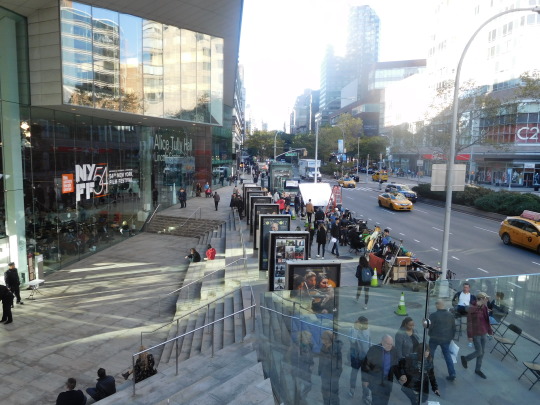
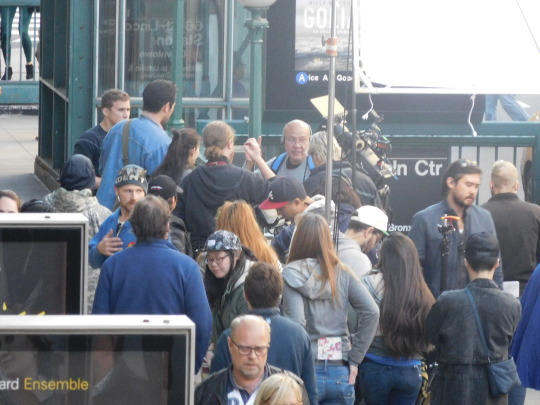
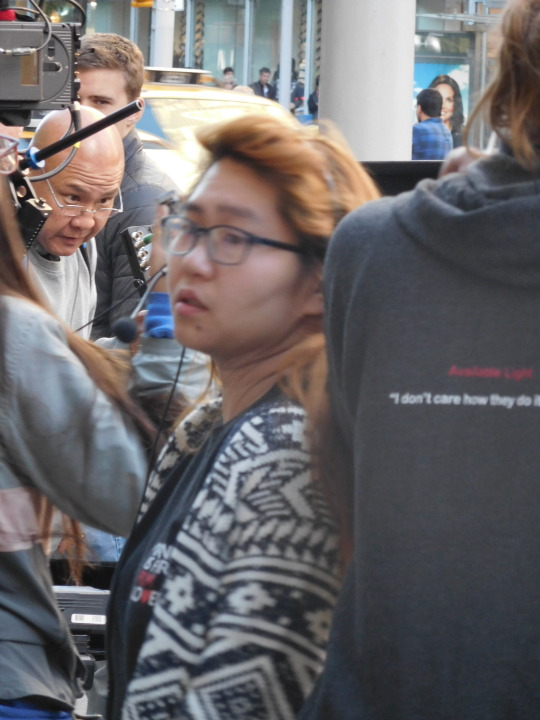
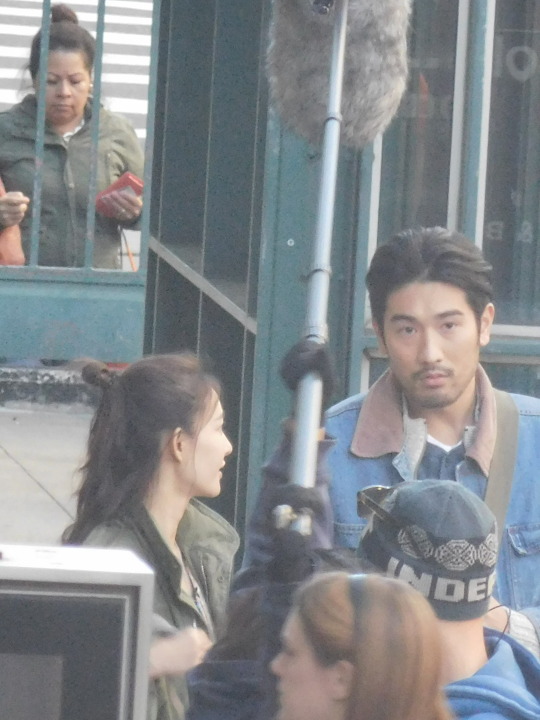
Here are some pictures from the shooting of a Chinese film called LOVE IS A BROADWAY HIT outside of Alice Tully Hall yesterday evening (October 10). God help them they were doing it at rush hour just before the area was flooded with people for the New York Film Festival. The director is Peter Lee. I am not sure who the actors are.
![]() |
| The bald gentleman center is writer/director Peter Lee |
![]() |
| Peter Lee checks a monitor |
Two Trains Running (2016) New York Film Festival 2016
It is 1964. As Freedom Riders invade the American South to end segregation, there are two other groups of young people, one from California and one from New England also traveling South, however not to change America but rather to find the lost performers who played the blues decades earlier.
Great music fills this story that plays like a middle of the pack American Masters or similar series documentary. If you love good music and the blues in particular then you are going to love this story of who a bunch of white kids who didn't know any better went into the lion's den in order to find and retrieve their musical heroes. It sounds crazy, but it did happen and it resulted in boom in the blues as many blues musicians resurfaced and influenced the next generation of rock and roll.
While this is most assuredly a solid little film, the film is hurt by a construction that makes it seem like many PBS documentaries. It also never completely blends the Civil Rights tale with that of the young man searching for the blues. Yes, its there but how it's framed keeps it on the outside to the music, even when it's the focal point of the film.
Speaking of the music, that is everything here. This film is full of music from start to finish, both classics by the founders of the genre but also the next generation(s) of blues players. Writing the film up several hours after seeing it I find that much of the film is not in my head, except for those where Sun House, Skip James and the other musicians play. Its a great tale, but I'd rather put on the soundtrack rather than see the film again.
A must see for all music lovers. All others can pick and choose depending on their mood.
TWO TRAINS RUNNING plays NYFF on October 13 and 14. For more information and tickets go here.
Monday, October 10, 2016
Nathanael Hood investigates THE UNKNOWN GIRL (2016) New York Film Festival 2016
With only a little bit of reworking, Luc and Jean-Pierre Dardenne’s THE UNKNOWN GIRL could have been an old school Hollywood film noir. It’s possibly the closest they have ever, or will ever, get to making a straight genre film. It’s a detective thriller without a detective or thrills; a film which somehow utilizes their trademark naturalistic style to create something both compelling and nerve-wracking.
The heroine is Jenny Davin (Adèle Haenel), a doctor who prides herself in her skill and emotional detachment from her patients. But one night after closing she turns away a young black woman banging on the clinic doors. The next morning she’s found dead on the side of the canal across the street. Internal autopsies suggest that she was pushed. Consumed by guilt, Jenny swears to track down the dead girl’s identity so she may be returned to her family. But all of the people she interrogates—patients, suspected bystanders, locals at an internet cafe—seem unusually quick and adamant in their refusals to cooperate. Soon she gets attacked in her car by a couple of thugs. It seems that, much like the severed ear in David Lynch’s BLUE VELVET (1986), the dead woman inadvertently throws our hero into a world of corruption and crime.
But there are no gas-huffing sociopaths in THE UNKNOWN GIRL, just regular-seeming people in over their heads. They all have their reasons for not cooperating. One teenager who may have seen the young woman doesn’t want to implicate himself or his friend in a crime. One older man doesn’t want word getting out that he may have solicited the murdered girl for fellatio. And others simply fear that any investigation might lead cops to their “side businesses.” Yet Jenny stays her course, quietly yet firmly begging for any information, even after local detectives tell her to stop.
For me, the most interesting films in the Dardennes’ filmography are the ones that depict their native Belgium as a country in flux, a macrocosm in which undesirables get cast aside to dwell on the peripheries of society. Their debut—and until THE UNKNOWN GIRL, my favorite of their films—THE PROMISE (1996) focused on a young boy growing a conscience about how his father helps smuggle, house, and exploit illegal immigrants. Their Palme d’Or winning film L’ENFANT (2005) follows a man who literally sells their baby on the black market. Adhering to this trend, THE UNKNOWN GIRL is both one of their most nihilistic and hopeful efforts: it shows a Belgium where nearly everybody has sinister secrets in their private lives; yet it’s also one where good people like Jenny Davin can still seek and find justice.
8/10
THE UNKNOWN GIRL plays at NYFF on October 12 and 13. For more information and tickets go here
The heroine is Jenny Davin (Adèle Haenel), a doctor who prides herself in her skill and emotional detachment from her patients. But one night after closing she turns away a young black woman banging on the clinic doors. The next morning she’s found dead on the side of the canal across the street. Internal autopsies suggest that she was pushed. Consumed by guilt, Jenny swears to track down the dead girl’s identity so she may be returned to her family. But all of the people she interrogates—patients, suspected bystanders, locals at an internet cafe—seem unusually quick and adamant in their refusals to cooperate. Soon she gets attacked in her car by a couple of thugs. It seems that, much like the severed ear in David Lynch’s BLUE VELVET (1986), the dead woman inadvertently throws our hero into a world of corruption and crime.
But there are no gas-huffing sociopaths in THE UNKNOWN GIRL, just regular-seeming people in over their heads. They all have their reasons for not cooperating. One teenager who may have seen the young woman doesn’t want to implicate himself or his friend in a crime. One older man doesn’t want word getting out that he may have solicited the murdered girl for fellatio. And others simply fear that any investigation might lead cops to their “side businesses.” Yet Jenny stays her course, quietly yet firmly begging for any information, even after local detectives tell her to stop.
For me, the most interesting films in the Dardennes’ filmography are the ones that depict their native Belgium as a country in flux, a macrocosm in which undesirables get cast aside to dwell on the peripheries of society. Their debut—and until THE UNKNOWN GIRL, my favorite of their films—THE PROMISE (1996) focused on a young boy growing a conscience about how his father helps smuggle, house, and exploit illegal immigrants. Their Palme d’Or winning film L’ENFANT (2005) follows a man who literally sells their baby on the black market. Adhering to this trend, THE UNKNOWN GIRL is both one of their most nihilistic and hopeful efforts: it shows a Belgium where nearly everybody has sinister secrets in their private lives; yet it’s also one where good people like Jenny Davin can still seek and find justice.
8/10
THE UNKNOWN GIRL plays at NYFF on October 12 and 13. For more information and tickets go here
Sunday, October 9, 2016
Nathanael Hood on Graduation (2016) New York Film Festival 2016
Dr. Romeo Aldea (Adrian Titieni) isn't a good man, but he is a decent one. In its best moments, Cristian Mungiu’s new film Graduation glimpses beyond his stoic, stern facade to see the decent man beneath. About two-thirds of the way through, there’s a scene where he drives home late at night. Apropos of nothing, he pulls over to the side of the road, walks into the woods, and breaks down sobbing. It’s his most overt demonstration of emotion in the entire film. As such, it helps keep Graduation from collapsing under the weight of its own solemnity.
At first it seems like the film will be a post-modern thriller à la Michael Haneke’s Caché (2005): Dr. Aldea’s family is menaced and attacked by an unseen, offscreen tormentor. But what begins as petty vandalism of their house climaxes with their daughter Eliza (Maria-Victoria Dragus) being sexually assaulted right outside her high school. These moments are designed primarily to shock and jar the audience as much as the onscreen characters—spasms of unexpected violence interrupt extended long-takes, whether it’s a rock through a window or a dog running in front of a car. Eliza’s assault may take place offscreen, but we learn about it at the same time Dr. Aldea does. It too comes completely out of the blue.
But after the first half-hour, the film settles into the mode which dominates the rest of its runtime, that of a heady morality play. It turns out Eliza was attacked the day before the start of her high school exams. Having been all but guaranteed a full scholarship to a prestigious British university to study psychology if she gets high marks, Dr. Aldea sets about his small town of Cluj, Romania to arrange some “insurance” in case Eliza is too shaken up to perform properly. Deals are struck and favors are called in as he plummets into the very heart of the institutionalized post-CeauÈ™escu corruption he so desperately wants to free his daughter from.
Much like in the causal universe of guilt and corruption invoked by Haneke, the world of Graduation seems to be punishing Dr. Aldea for past misdeeds. But they are never fully explained, never fully illuminated. There are hints here and there and even a curious red herring involving a CCTV photograph which may or may not implicate Eliza’s slacker boyfriend in the attacks. But it all leads to an anti-climax where the ambiguity that propelled Caché gets traded for a simple, clearly-defined ending.
After attending the film’s screening at the New York Film Festival, I was shocked to hear one of my fellow critics describe it as hypnotizing. But frankly, I never felt hypnotized nor all that compelled. It flows like a river of dried concrete, its inability to choose between traditional drama and post-modern narrative machinations preventing me from becoming fully invested in its story and characters. There are certainly films out there capable of doing both. But Graduation isn’t one of them.
5/10
GRADUATION plays the 11th and 12th at the New York Film Festival. For tickets and more information go here
At first it seems like the film will be a post-modern thriller à la Michael Haneke’s Caché (2005): Dr. Aldea’s family is menaced and attacked by an unseen, offscreen tormentor. But what begins as petty vandalism of their house climaxes with their daughter Eliza (Maria-Victoria Dragus) being sexually assaulted right outside her high school. These moments are designed primarily to shock and jar the audience as much as the onscreen characters—spasms of unexpected violence interrupt extended long-takes, whether it’s a rock through a window or a dog running in front of a car. Eliza’s assault may take place offscreen, but we learn about it at the same time Dr. Aldea does. It too comes completely out of the blue.
But after the first half-hour, the film settles into the mode which dominates the rest of its runtime, that of a heady morality play. It turns out Eliza was attacked the day before the start of her high school exams. Having been all but guaranteed a full scholarship to a prestigious British university to study psychology if she gets high marks, Dr. Aldea sets about his small town of Cluj, Romania to arrange some “insurance” in case Eliza is too shaken up to perform properly. Deals are struck and favors are called in as he plummets into the very heart of the institutionalized post-CeauÈ™escu corruption he so desperately wants to free his daughter from.
Much like in the causal universe of guilt and corruption invoked by Haneke, the world of Graduation seems to be punishing Dr. Aldea for past misdeeds. But they are never fully explained, never fully illuminated. There are hints here and there and even a curious red herring involving a CCTV photograph which may or may not implicate Eliza’s slacker boyfriend in the attacks. But it all leads to an anti-climax where the ambiguity that propelled Caché gets traded for a simple, clearly-defined ending.
After attending the film’s screening at the New York Film Festival, I was shocked to hear one of my fellow critics describe it as hypnotizing. But frankly, I never felt hypnotized nor all that compelled. It flows like a river of dried concrete, its inability to choose between traditional drama and post-modern narrative machinations preventing me from becoming fully invested in its story and characters. There are certainly films out there capable of doing both. But Graduation isn’t one of them.
5/10
GRADUATION plays the 11th and 12th at the New York Film Festival. For tickets and more information go here
Saturday, October 8, 2016
The Best Worst Thing That Ever Could Happen (2016) New York Film Festival 2016
In 1981 Stephen Sondheim and Hal Prince took a 1930’s film told in reverse about how life rarely goes as we plan when we are young and musicalized it. Performed by a cast aged 16 to 25 the show was a notorious flop- but the score found an audience and in the years since it developed a rabid following and became a theater classic. Thirty something years after the show closed Lonnie Price decided to make a documentary recording the memories of everyone involved. Miraculously Price was gifted with the rediscovered unused footage from ABC News who were filming a documentary on the making of the show.
Made with love by show biz legend Lonnie Price, this is a film that is going to be eaten up by theater geeks who love the show and want to see something of the original production (there is video). Price was in the original cast and, like the rest of the young actors never got over it to the point they still speak of the experience with awe. Talking to everyone involved in the show, including Sondheim and Prince, the film is an inside look at the show from the stand point of the cast. It’s a film that gives us an on the ground look at the making of a show.
The problem is that the film requires you to kind of know going in the show. We are only given a basic idea of the plot early and later on things are referred to as if we have a working knowledge of everything involved with plot and characters. There is no sense of the show, or of the time frame things happened in. We get lots of gushing about how great it was to be in it but we don’t know much about it beyond that. Because this is largely told by the cast we only know what the kids knew since neither Sondhiem and Prince say much about making it outside of the casting other than the odd comment. If you aren’t in love with the show going in the film just lays there.
I’m a theater geek but I don’t know the show. I’m not a huge Sondheim fan and for me it was nice, but this hagiographic nostalgia fest for the cast and fans left me kind of cold. It’s sweet but I really would have liked to know great deal more than this was the best experience of their lives. Its great that everyone who starred in it peaked early but it isn’t enough to carry a 100 minute movie- at least for a non-fan of Merrily.
A must see for fans of Merrily We Roll Along and Sondheim. For everyone else skip it
BEST WORST THING THAT EVER COULD HAPPEN plays Sunday the 9th with special guests at a Q&A and on Monday the 10th. For tickets go here.
Made with love by show biz legend Lonnie Price, this is a film that is going to be eaten up by theater geeks who love the show and want to see something of the original production (there is video). Price was in the original cast and, like the rest of the young actors never got over it to the point they still speak of the experience with awe. Talking to everyone involved in the show, including Sondheim and Prince, the film is an inside look at the show from the stand point of the cast. It’s a film that gives us an on the ground look at the making of a show.
The problem is that the film requires you to kind of know going in the show. We are only given a basic idea of the plot early and later on things are referred to as if we have a working knowledge of everything involved with plot and characters. There is no sense of the show, or of the time frame things happened in. We get lots of gushing about how great it was to be in it but we don’t know much about it beyond that. Because this is largely told by the cast we only know what the kids knew since neither Sondhiem and Prince say much about making it outside of the casting other than the odd comment. If you aren’t in love with the show going in the film just lays there.
I’m a theater geek but I don’t know the show. I’m not a huge Sondheim fan and for me it was nice, but this hagiographic nostalgia fest for the cast and fans left me kind of cold. It’s sweet but I really would have liked to know great deal more than this was the best experience of their lives. Its great that everyone who starred in it peaked early but it isn’t enough to carry a 100 minute movie- at least for a non-fan of Merrily.
A must see for fans of Merrily We Roll Along and Sondheim. For everyone else skip it
BEST WORST THING THAT EVER COULD HAPPEN plays Sunday the 9th with special guests at a Q&A and on Monday the 10th. For tickets go here.
Cinema Travelers (2016) New York Film Festival 2016
The film follows three stories- a group of men who lug their equipment and tent across the country and set up in carnivals and fairs, another group who drive their rotting and decaying truck to remote villages to put on a show and finally man who repairs the projectors. Not only does he fix them he has taken his 40 plus years of experience and created the perfect movie projector. The problem is film is going the way of the wind, with audiences dwindling thanks to satellite TV, the internet and the in ability to get newer films because there are no or few prints.
My heart broke and I found I had to look away- I didn't want this way of life to disappear.
At the same time he film is as glorious a celebration of cinema as has ever put on screen. In the opening moments the film we watch as the tent show is set up and readied. In the hectic fair grounds somewhere in India the men are waiting for the arrival of a print as people wander into the tent and wait. Finally it arrives and the film is threaded- the switch is thrown and the world falls away. In one of my new favorite sequences in any film ever we watch as the audience watches the film and film weaves their magic. Think of the end of CINEMA PARADISO but real. Like the end of that film, the beginning of this one made me tear up- seriously five minutes the projector starts, the sound falls away, the music starts, we see the faces of the audience and I had tears running down my cheeks.
This is a glorious film, beautifully crafted, stunning to look at. It is a film that does every damn thing right.
Yes it is very melancholy but at the same time it is alive and full of love. This is film that is as beautiful a representation of life as you are going to see. Directors Shirley Abraham and Amit Madheshiya have not only shot a beautiful film but they have assembled it together in a manner that should, if there was any justice get them an Oscar for editing at the very least. Rarely has any film so magically matched the rhythms of the world on screen. This film is a masterpiece of the sort that very well may end up being studied in years as one of the standards in documentary in editing.
I absolutely love this film. I can’t wait to see it again. Actually I want to pair it with ROAD,MOVIE from 2010 which was about a young man taking a mobile cinema across India in order to sell it. The pairing of the two films would make a wonderful celebration of the love of movies.
I can’t recommend this film enough. The film plays at the New York Film Festival and is one of the great hidden treasures of the festival (again it should have been the opening night film). An absolute must see.
One of the truly great films of 2016. A must see at the New York Film Festival
The film Plays October 12,13,15, and 16 at the New York Film Festival. For tickets and more information go here.
All the Cities of the North (2016) New York Film Festival 2016 Projections
Getting one screening as part of the New York Film Festival's Projection series (Tickets here) ALL THE CITIES OF THE NORTH will either thrill you or bore you to tears. Its a moody art film where not much is said and most of the spoken words are voice overs about other things
The film is nominally about two guys living together in an abandoned resort village They go through their paces while we get voice overs explaining various tangentially related subjects (building arranged as star systems and the like). A third man arrives and the balance is upset
Longish static shots, brooding silence and voice overs make this a 100 minutes of either joy or boredom depending upon where you fall in the cinematic spectrum. The fact that it is screening as part of the Projections sidebar says a great deal about the moodiness and demeanor of the film This is not a film for all audiences or even most audiences, it's slow obtuse way of doing things making it perfect for a self selecting audience
Personally I like this sort of thing when there is something to hook into, but for me there wasn't anything This was 100 minutes of guys wandering around and by the time it started to get interesting (relatively speaking) I was lost to it to the point that I was only half watching my Festival Scope screener while I doodled in my notebook
If you like arty avant garde stuff you'll eat this up. All other stay away
The film is nominally about two guys living together in an abandoned resort village They go through their paces while we get voice overs explaining various tangentially related subjects (building arranged as star systems and the like). A third man arrives and the balance is upset
Longish static shots, brooding silence and voice overs make this a 100 minutes of either joy or boredom depending upon where you fall in the cinematic spectrum. The fact that it is screening as part of the Projections sidebar says a great deal about the moodiness and demeanor of the film This is not a film for all audiences or even most audiences, it's slow obtuse way of doing things making it perfect for a self selecting audience
Personally I like this sort of thing when there is something to hook into, but for me there wasn't anything This was 100 minutes of guys wandering around and by the time it started to get interesting (relatively speaking) I was lost to it to the point that I was only half watching my Festival Scope screener while I doodled in my notebook
If you like arty avant garde stuff you'll eat this up. All other stay away
Subscribe to:
Posts (Atom)