Showing posts with label exploitation. Show all posts

Sunday, March 3, 2019

Child Bride (1934)

Exploitation classic thats more humorous now then either titillating or shocking. This is an anti-child bride film. Yes there was a time when young, even preteen girls regularly would get married to older men. This is the story of a young girl who may be doomed to suffer such a fate.

A serious subject, the film is now very silly with some acting styles that went out of style in the early days of silents (Watch the scene when Jennie gets up in the morning and try not to fall on the floor laughing.) Give the film points for having some realer characters than many backwoods films coming from Hollywood, but take a few away since this film is really just an exploitation film.

Notorious for a brief flash of nudity in a skinny dipping scene by the then 12 year old star (some prints excise it) its nothing even remotely titillating or sexy. Its actually done in such away as to be fleeting and not even clear. I probably shouldn't have even mentioned it except some people are shocked or horrified by it.

The film itself is better than it should be, however its still not very good. As I said much of it plays more humorous than serious and its so creaky that you can see the machine like plot clacking away towards its conclusion where you end up on the edge of your seat waiting to see if Jennie will suffer a fate worse then death.(Its much less over the top than say a film like Reefer Madness where you can laugh at it, which takes away much of the fun)

If you're a fan of creaky exploitation films give it a try. All others stay away.

CHILD BRIDE plays tonight at The Film Forum in NYC. For more information and tickets go here

Saturday, October 21, 2017

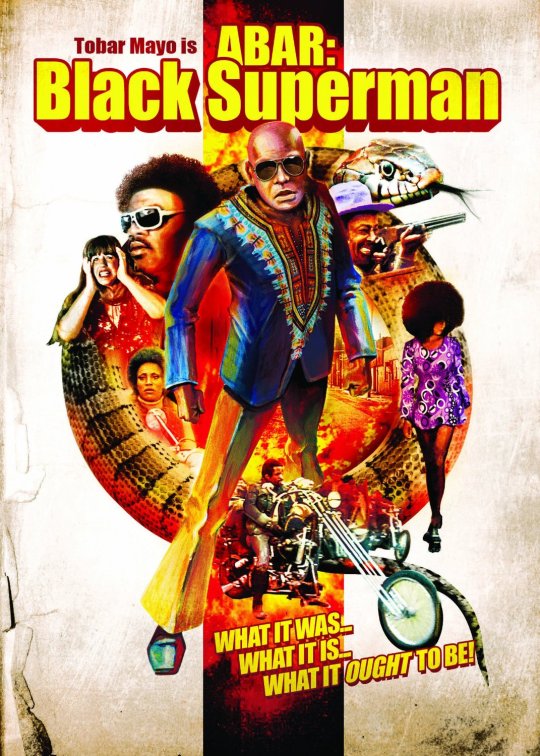
Abar The First Black Superman (1977)

This legendary film was nigh impossible to see for years. I had heard it was so incendiary that no one would run it. I heard it was lost because the distributor was so small it went bankrupt and disappeared. I heard all sorts of weird stories from people who had never seen it but had heard about it...

I eventually picked it up on low budget DVD and put it aside, but it wasn't until Turner Classic ran it that I actually saw it now I'm left wondering what the hell was that?

A black doctor studying heart disease moves into a white neighborhood and is abused by his neighbors. He refuses to move because he needs the large house for his experiments. When a near riot happens outside of his house he is rescued by Abar and his motorcycle driving men. Abar tries to talk the doctor to move back to the ghetto but he refuses.Eventually Abar becomes the doctor's bodyguard.  However once tragedy strikes the doctor gives Abar the serum he had been working on and Abar becomes a god-like being correcting the wrongs of the world.

While the film is very much a political manifesto, the film is also very much an exploitation film with a wicked guitar riff that plays during the occasional action sequences. The film is also completely and utterly out there with several unexpected and "WTF was that" twists and turns. By the time Abar becomes god-like you will be staring at the screen wondering what everyone connected with the film was thinking---and drinking or smoking. Its just out there. One line at the very end almost caused my father and myself to choke to death in complete and utter disbelief. Its one of those lines where you look at each other and go-"did she really just say that?" Oh yes she did.

I have no idea what to say.

Too long by 20 minutes and so goofball at times this film is not going to be for all audiences. At the same time if you want off the beaten path do see this ASAP.

Saturday, August 12, 2017

Wild Rebels (1967)


Wild Rebels is a small hidden gem of a film. A super little drive-in style film that probably is better known now due to being included in multi-film bargain packs as opposed to generating buzz from its theatrical run in the late 1960’s. It’s one of those films that is definitely worth seeing if you run across it, especially if you can forgive it’s micro budget.

The plot of the film as well-known stock car racer hitting a bad patch. After a wreck that causes his car to burn up he sells all his racing gear and walks off. He meets a biker gang in bar who are fans and he goes off to party with them. The gang is a group of nihilistic thrill seekers who do everything for kicks. When the gang asks them to be their wheel man in a robbery he walks off. Stopped by the police he is questioned by the cops who ask him to rejoin the gang and report on their plans…

The film is a weird kind of proto version of Point Break with the thrill seeking crooks and a thrill seeking “cop”. While it’s not a an absolute mirror of the Patrick Swayze Keanu Reeves film or its recent remake, it’s close enough that everyone I was watching this with all commented at the similarities and pondering if this is where they stole the idea from.

What I like about the film is that there is a strong sense of characters. Yes they are clearly good guys and bad guys but there is a sense of something beyond the typical. You really feel that the bad guys could have been anything they wanted to be, but that the freedom and thrills of being bad guy bikers and thieves suited them best.

For me the only real problem is the cheapness. The lack of cash results in some awkward moments at times, largely in the racing sequences where you can tell it’s not a real race and where cars magically go from crashed wrecks to racing infernos in a split second.

Recommended for a drive-in night at the family cinema

Friday, December 16, 2016

Naked Kiss (1964)

The opening of this film was used by Jim Jarmusch at the beginning of his On Cinema talk at the New York Film Festival. It has a our heroine beating the crap out of her pimp and talking the money owed her. Her wig slips off and she's revealed to be bald. It the first of any number of out there moments as Kelly get out of the game, be comes a nurse, finds a nice guy who isn't nice...

Highly regarded film is ultimately a sleazy piece of exploitation made by a name director., Samuel Fuller. As much as cineastes want to dress the film up, it's no better than any number of similar piece of trash cinema that played in cinemas across America at the same time.  This isn't to sell the film short only to say that the film isn't quite the work of art many have implied it to be.

Were the film not ultimately about a woman who kills a child molester could say that watching the film and it's excesses is fun but the subject matter and the unrelenting oppressive atmosphere makes it kind of difficult to watch. This is a dark film about a dark subject. Interestingly Jarmusch and Kent Jones who spoke to Jarmusch at NYFF kind of made a the twists and turns of the plot into a joke. While most certainly when detached from the film itself it can be viewed as humorous but seeing it in actuality makes it less funny.

Despite the film's reputation and release by Criterion this is more an interesting footnote in the career of Samuel Fuller then a full meal

Thursday, September 8, 2016

Escape from Hellhole (1983) (also released under several other titles)

This is a review of mine that was deleted from IMDB for reasons I'm unsure of.

Women are kidnapped or tricked into going to a mercenary camp where they are used as sex slaves for the men in training. After much torture and sex and violence and nastiness the women break free and a huge gun battle ensues.

Jaw droppingly insane this is the sort of film that they never made in the US which means it has to come from tsomewhere else- or in this case the Philippines. Wild wanton and wacky this is the sort of wonderful bait a switch "I can't believe I'm watching this sort of movie".

Far from the best film in the world its the sort of thing that forces you to admit you've seen something. Its the weird and wild stream of films like this that kept people going back to the grindhouse week after week. Worth a look for those who want to see what a real grindhouse film is like (as opposed to the Tarantino/Rodriguez versions) If you like the weird and the off beat you must see this film

Wednesday, August 3, 2016

Parasites (2016) Fantasia 2016

Three college kids end up lost on  skid row. After they get a flat they ended hunted by the homeless and dregs of society living in the area.

Writer/director Chad Ferrin says that the film is based upon John Colter’s capture and escape from a ferocious Blackfeet tribe in 1809. It would have been easier to say that this is kind of urban remake of NAKED PREY done in the style of low budget 1980's exploitation films. Saying it's based on Colter's escape gives the film a pretense that the film simply can't sustain.

For get the social commentary, for get the historical connection and just take this film on the terms it works best a throw back retread of the sort of things that closed out the drive-ins and grindhouses before VHS killed them. This is a low budget film about a bunch of "monsters" hunting a privileged sort of person and leaving a trail of dead bodies along the way.

High art this is not, an enjoyable popcorn flick for a rainy afternoon or midnight screening it is. See it as that and you'll have a good time- as anything else you'll ruin the fun.

Saturday, April 9, 2016

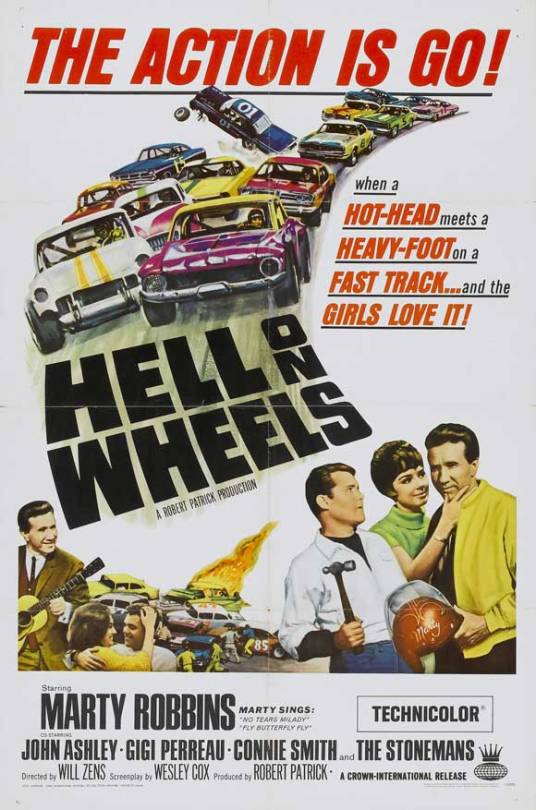
Hell on Wheels (1967)

Country singer Marty Robbins stars as a version of himself except that in addition to singing he also races stock cars.  Marty can drive anything and win, more so when his brother Del builds it. However when Del decides that he's tired of Marty getting all the glory he walks away from his brother to do his own racing. However he ends up working for moonshiners and heading toward trouble.

Better than it has any right to be drive-in style film is full of racing and singing.

To be honest there is a bit too much music, but it's understandable considering that Robbins is the star. The problem is not that the music is there or that the songs are bad, they are actually all pretty good, rather it's that the musical numbers are dully filmed with the camera more or less nailed to the floor.

The films other weakness is that the film in the film is the fact that the whole moonshiner subplot ends up getting lost. After the initial introduction of the moonshiners they disappear and we just follow some government agents who randomly appear to perform a raid. Its not until the final 20 minutes that the moonshiners show up again.

That said the film still is pretty good. Decidedly not high art the film still hold one's attention thanks to good performances, Robbins actually can act, and some brother against brother tension that remains real. And of course the racing is nicely handled with footage of real races intercut into the story so as not to seem out of place.

If you can watch this with the right frame of mind and realize that it was made fast, cheap and to fill a double bill in drive-ins across the American South you'll have a grand time.

Wednesday, April 1, 2015

A Grindhouse Memory: The Final Battles of the Human Hatchet (1977)

The popcorn was your lunch, that was how you planned it.

I’m speaking for those of us of a certain age who’d sneak away from our unexceptional teenage lives to take in a quadruple-feature in a dubious part of the big city, a blurred spectacle that would pummel us equally with depraved thrills and unexpected beauty. Back then, of course, there was no themed cable television or online media—you couldn’t subject yourself to marathon sessions of watching whatever turned you on without first making an actual pilgrimage. In the process you’d trade in your safe, bright, private home for one that offered a very public form of privacy, the houselights always set at a sickly semi-dim, a space that was never not knee-deep in grubbiness, full of slumped figures in seats snoring boozily through sprays of blood and splashes of widescreen nudity. You’d never know whether to pity them or fear them, these fellow audience members, lest they wake in a sudden incoherent rage, but it didn’t matter anyway because, above all, you were there to ignore each other. You’d enter at 11-something in the morning, stagger out at six-something, and if it was the summer, you’d be amazed that it was still light out (after a day of gloom), and if it was winter, you’d be amazed at the gentle darkness of the early evening (after a day packed with too-bright colors, with explosions of fire and flesh). Earlier, during the breaks between features, you’d take the measure of your own temporal disorientation by trying to recall what you’d seen two movies ago, and usually the answer wouldn’t come immediately—cognitively, you had joined the great haze of the half-hidden and the half-forbidden while, outside, in the world beyond the exit doors, real life slipped by unperturbed, as if on gliding silver casters. Time never seems to care that we waste so much of it.  

Years and years later we’d meet, this murk-enamored army of the once-young who could recall the grindhouses, and talk would inevitably run to favorite trailers and one-sheets; and, just as inevitably, the comment would arise, and find no objection, that theses previews and posters were always far, far better than the product they promoted. That’s true with most films, I suppose, but in these cases we were dealing with artifacts both more endearing and more misleading, the former true not despite, but because, of the latter. The advertising images were bolder, somehow more mythic for the way the films were condensed down to their essence—a steely look given and zoomed in upon, a battle cry, a driving musical signature over a montage of impossible stunts. Block letters and exclamation points blazing out of the screen at you. Voice-overs that took these movies extremely seriously and dared you to do otherwise; and the more absurd, the more transparently pandering, the more seriously still.

That said, there was a handful of times when this maxim didn’t hold, when what was delivered exceeded in every way what had been promised. And for me the most memorable of those times involved The Final Battles of The Human Hatchet (1977), aka The Final Battle of The Human Hatchet, aka simply The Human Hatchet.
Kung fu (or wuxia) movies of this period often incorporated elements of the grotesque and the baroquely cruel, and I’m not sure if that’s because the practice made for good business at the Asian box office, or because it so nicely fit the export market, where they could share a bill with homegrown exploitation flicks and not miss a beat. With The Human Hatchet, however, there was a big difference—here we had a proven director (Huang Feng, not that we tracked Hong Kong filmmakers in those days—if we had, we might have marveled that this was one of his three releases in that single year) and in addition, a topnotch star, Gordon Liu, shortly before he astonished
all of us with the classic 36th Chamber of Shaolin.
 
The appeal of many of the HK films of this era (not to mention countless Westerns, chanbara flicks wherein a ronin grudgingly rises to the call of honor, a million cop B-movies in which the protagonist is called out of retirement—or is about to retire and feels there’s no need to risk his comfortable future) concerns the importance of a reluctant hero. More precisely, a “damaged hero”—damaged by reputation, by physical injury, by age alone, by emotional scars, or some combination of these. The key is a form of incapacity—because that’s how so many of us saw ourselves, and maybe still do. Tomorrow we would wake from our slumber and find a better job, or any job, or be motivated to go to school, or just do some homework, or go on a date, or exercise—we were, in the meantime, intentionally lying dormant, that’s how the fantasy goes, waiting for the moment we’d supernova out of our half-lives and onto some grander stage of participation. That way, the longer we stayed inactive, with only sufficient agency to make our way into these caves of wonder and violence, the more volcanic would be our eventual eruption into the mainstream of humanhood.

Yes, I’m rambling now, I realize that. The point is that there was a tacit agreement back then between us cave-dwellers to keep any and all interaction between us to an absolute minimum. You’d use the imaginary as an intermediary, a gauzy, ephemeral sounding board—you’d laugh at what someone said three rows over, but you’d never meet, never acknowledge each other in ways that involved anything beyond staring straight ahead at the fiery things before you.

Which is why, as I’ll come to explain, The Human Hatchet was so remarkable, or at least my experience of it was (a distinction I feel compelled to make even though it’s pointless, ultimately). That and the fact that this was a movie that more than made good on the gaudy promises of its trailer, which I recalled vividly from a week or two previously—and so provided me with my very first sensation, and probably one of my last, of the state of grace. I don’t deserve this, I remember thinking. Maybe none of us do.

“Yes… This Is The One!” the trailer had announced breathlessly.

The letters arrived one by one rapidly from left to right, apparently writing themselves by virtue of your reading them. Under them, a close shot of a hatchet lodging in wood, the chunk sound underscoring the text, its single syllable pairing nicely with any of the single-syllable words on the screen. (Slouched down in my seat, I let the on-screen boast slip past my guard—then questioned it, even back then:  what was meant by “the one”? Didn’t the copywriter responsible for this know that my eyes and ears had an appetite that was all about quantity, that I was slowly amassing a vast topography of the imaginary by taking in any and all items of sufficient power and dazzle? Or was I wrong, had I really been waiting for one special cinematic story, some kind of messianic opus that would provoke a personal transformation, and had simply not realized it? Well, maybe, in a sense, I had been waiting for this kind of singular arrival, just so that now, decades later, I could recount it for you.)

“The Picture That Everyone is Talking About—”

Behind these words, and then eventually replacing them as the letters were wiped off the right side of the screen, there’s a provincial governor holding court; these trailers always included such shots, offering proof of production values as if production values mattered much to us. The governor, unidentified as such in the trailer, has the air of a warlord about him, imperious and grave with his elegant and precise facial hair, his grooming a kind of aesthetic weapon at his disposal. He speaks a line of self-serving pseudo-Confucianism—we know not to whom because of how things have been edited: “Knowing our place in life is what brings peace. Not knowing our place brings… war!” (Meanwhile, my place in life, at least for this specific moment and many like it, was all too clear to me. I was in my hibernation spot—I’d checked out the surroundings upon first entering the theater and monitored them at regular intervals as the long matinee hours marched dreamily on. I fortified my position by slumping and covering, by making myself at one with the surroundings, a process that was not free of challenges. Were the armrests acceptable as surfaces upon which I could lay my elbows and triceps? If not, I didn’t depart; rather, I'd let the sleeves of my coat drape over them, shielding my shirt or sweater from actual contact. The paramount rule, however, was never ever to let one’s fingertips stray to the lip of an armrest and beyond, so that they might come in contact with what could lie beneath. This was how you inoculated yourself against the slyly encroaching suspicion that you were part of the filth.)

“—And Soon You Will Be, Too!”

The cut on “war” brings us a glimpse of a full-on battle scene, with spear-toting guards going up against peasants and assorted villagers armed with pitchforks and other farm implements, the two groups collapsing upon each other in the center of the screen, the first casualty being the empty space that existed briefly before the clash. Which means that if you’re keeping score, so far we’ve had a glimpse of the budget and a sense of spectacle—all within ten seconds or so. Still not much to write home about it, but the trailer, it turns out, is merely getting these checklist items out of the way before proceeding to the heart of the matter. (At first there would appear to be an unintended lie in the trailer’s assertion—I most definitely would not be talking to anyone about this or any similar film. The kids at school? They had no sense of this—well, this world. They were busy gravitating to Star Wars and Saturday Night Fever, and I don’t fault them for that. Besides, there really was no relevant discourse at all, anywhere, except perhaps a few hand-stapled zines scattered across the country, some capsule reviews in the Cantonese language dailies, or box office stats buried somewhere in the back of Variety. This was culture without conversation. You would think, then, that when a new century later dawned and it seemed that everyone alive was thinking and commenting about pop culture, I’d have welcomed the company, but by then I was already accelerating in the opposite direction, longing to be silent and sparing after years of chatter.)

“Just Who Is the Human Hatchet…?”

A quick, satisfying shot of a hatchet blade cutting through the staff of three spears in one circular motion. Then the camera pulls back and we see, at last, (I know: but “at last” is what it feels like though we’re now only about fifteen seconds in) the title character, wild-eyed and, surprisingly (if you know the actor), with hair similarly wild. Liu has short-handled hatchets where both hands should be, and long, somewhat tattered sleeves conveniently covering fake stumps—it’s the old “taped-over fists” visual that was a staple in all the eras prior to when CGI enabled filmmakers simply to delete flesh. We’re all aware the actor is still intact, but we’re okay with equating the invisible with the absent because that’s the way this whole thing works. We let ourselves be fooled, and fooling us is what occurs from before the get-go: all of the posters and key art that promoted the film presented an image that is not remotely in the film—Tian Gao bare-chested and sans hands. Some graphic designer was ordered to gild the lily, and moviegoers fell in line.


More importantly, at least in terms of cinema history, this was years before Evil Dead II and Edward Scissorhands leveraged similar ideas about missing appendages. (Forgive the aside, but the premise of the latter always seemed a little dumb to me. Why would Vincent Price’s character have fabricated the hands last? Would you really make sure your creation had clothes, but not the means to take them on and off? It’s a conceit that makes sense only on the level of psychoanalytic male adolescence.) As you watched the trailer, you immediately wanted to know how he acquired these skills, these unique weapons—did he train like this, specializing in what seems to be a new fighting style? Was he a member of a temple of devotees/amputees? The trailer, however, was concerned with bigger issues, ones of identity, as evidenced by the rapid-fire array of options that followed in answer to the question it had just posed… (Much of what was exhibited in the cave was inane: that was a given. So it took special circumstances to prompt us to express our reaction to additional stupidity. I did it, too; not at first, and never the first one to do so while any given film screened, but, yes, I’d contribute. I had to be careful for my voice was distinctive, not like the others in attendance. And I’d keep it brief, words that were short and declarative. You see, you’d have to yell back at the screen once in a while, for good measure, to show you were not above doing so… to prove it to yourself, that is—no one else was likely noting your behavior. The practice of reacting out loud like this also kept you from going too far and too completely into the self-contained realms inside your head. Again: We talked to each other by shouting at the screen.)

“Warrior?”

And now the first shock of the trailer: Tian Gao, cleaned up, on horseback, in armor and imperial helmet, but more importantly—with both hands. He barks a phrase that seems to contain no words, charges along a narrow mountain pass, leaps from his steed to protect the governor’s litter with his own person. From higher up on the sides of a sand-colored canyon, against which the indigos and emeralds of the governor’s escort stand out like targets, a dust-covered but better camouflaged troop of unidentified enemies pushes rocks and boulders down, trying to force the litter off the road and take a fatal plunge. But Gao, with inhuman ferocity and power, is kicking, punching, and somehow guiding the rocks as they tumble down; on the ground near him are corpses in lighter armor—bodyguards who have apparently already sacrificed themselves. One of the attackers from above, disheveled, and as wild-eyed as we saw Liu with his hatchet-hands a moment ago, something painfully desperate about him, screams, “His hands are indestructible!”—and we cut.

What the trailer doesn’t have time to explain but which blossoms narratively up out of such ingredients is the fact that we first encounter Gao as the popular leader of the local imperial regiment; popular because he grew up in the area, popular also because he is simply likable: decent, honest, smart. Additionally the trailer does not bother, nor should it, with the connective plot tissue: that, as a result of warding off the attack shown, he receives an unheard-of double promotion (which in terms of the class system makes no sense whatsoever), both to special adviser to the governor and to a member of his personal guard (which just lost a few members, you’ll recall). In the movie we learn that the attack was launched by a ragtag group of rebel peasants, their agenda nebulous except that their hostility is directed against the governor himself, not the office he holds nor the political status quo more broadly.

In an unusual role in that it downplays his martial arts skills until the final reel, the governor is played by the wonderful and reliable Lung Wei Wang (aka Johnny Wang), here not quite so artificially aged as he is in other roles, with only single strands of grey/white mixed in with his jet black hair, not the usual full-on snow-white get-up. The idea is that the actor’s youth (in real life he was not yet thirty) is here used to a subtle thematic effect: he is meant to seem too young to be in such a position of power, which in turn means that perhaps he is far older and by some means only manages to appear much younger. “Those filth who died,” he says of the rebel dead, “—dump them in the pit.” He commands this in an off-handed tone, as if it’s standard operating procedure. After the bodies are burned, he’s shown gathering the ashes by moonlight, scattering drops of some mysterious oil upon them… and then re-burning them, chanting something that we cannot make out and which may not be in any known language. In a later scene that takes place in his inner sanctum he is inhaling deeply of a dense, black smoke, and the implication is that he has made a form of incense out of his enemies. Incidentally, these include the fellow who yelled the bit about Gao’s hands, a farmer whose brother later joins Gao when he becomes an insurrectionist; it is a decision-making moment drawn out both for suspense (will he attempt to avenge his brother instead?) and emotional drama: can there be forgiveness in the service of fighting evil? Well, yes, evidently there can be, and yes, this is political theory based on sentimentality, one of popular cinema’s most prevalent modes.

 “Outlaw?”

“Tian Gao, you are a traitor!”—this from a former comrade-in-arms poised on a rooftop in the governor’s compound, and it is the first time the trailer speaks our protagonist’s name aloud. Behind the outraged fellow are swordsmen—the elite guard to which Gao had been promoted earlier. It’s a rooftop that looks vaguely familiar from other period pictures from the same studio, the kind of rooftop from which people are always leaping up to and flying down from, their loose clothes billowing in vertical winds. In the movie this irate member of the guard adds, “We should have killed you when we could!” but here the dialogue is cut short by the action that immediately follows: he launches a terrific kick from the top of this two-story building while below Gao lunges forward and takes out a support beam with a criss-crossing blow from his two hatchets, and that entire section of the roof collapses. Guards in indigo and emerald fill the air; their swords fall separately. The kicker lands too distantly: where Gao had been. He turns, his sword leading the way, and Gao, now classically bald again, now a disciplined warrior but for the other side, delivers the same sort of criss-crossing strike, hitting the blade at two different points, and, instead of shattering it, bends it into an impotent curve. The effect is comical, accented by how the swordsman is gazing at the weapon in his hand, with a genuinely puzzled and slightly moronic sort of fascination. (I am making it up if I say that in this point in the trailer all of us sat up straighter and took notice; that’s how things should have been, how we should have reacted—and in memory I have revised it so that that is indeed what happened.  To be clear, the strident tone of nostalgia you may detect in everything I express is not due to my belief that the past was any more enjoyable than the present; it’s just that the memories are more malleable than anything else we can experience. It’s easy, for example, to drop out the anxiety—the dread from which the movies provided a consistent escape, and to recall only the escape itself. Thus we fix our own lives in post, get them to conform to whatever narrative we are currently telling: it’s not the story we tell ourselves that shapes our lives, but the story we tell ourselves about the story.)

The trailer, and this was back when trailers were gloriously achronological (unlike most of today’s), then shifts to an earlier point in the film: “So, Gao has joined the rebels’ cause now?” the governor muses. “Every man must serve a master, so I should not be surprised”—yes, there is foreshadowing taking place here, before the picture has even been released—“Very well, then,” he continues. “It is with heavy regret [sic] that you have my permission” —and there’s a sudden zoom in on him as he stands up (for no reason that we can see):  “—to kill him!”


What’s omitted in the trailer, naturally, is the entirety of the governor’s speech, which sports that same over-the-counter strength version of Confucianism noted earlier mixed liberally with Western-style social Darwinism; after remarking that he should not be surprised by Gao's treachery, he observes: “I serve only at the pleasure of the Qing. The Qing serve only at the pleasure of the gods, while the gods serve at the pleasure of the Tao. And the Tao serves all, if we allow it.” Pause. Then he says “Very well...” In short, where the trailer makes the ostensible villain seem decisive and remorseless, in the actual film he seems far more reflective, reaching his decision almost reluctantly; in fact, it’s as if he is not talking about Gao anymore but about himself—that is, if he were totally free and not in the service of a specific political structure and metaphysical scheme, he himself might arrive at a different decision. So we feel for the governor, as vile as he may seem, and this is true even if we realize how the cinematic moment is manipulating us: that’s the amoral beauty of the movies.

[...thanks so much for reading this far, but I'm afraid I may have overstayed my welcome; so please stay tuned for the literally unbelievable ending of The Human Hatchet in a follow-up post. -Peter]

Thursday, February 19, 2015

Film Comment Selects 2015: Electric Boogaloo: The Wild, Untold Story of Cannon Films

The phrase "Electric Boogaloo" is a perennial punchline. Add the phrase to any sequel title and you'll at least get a polite chuckle of acknowledgement. Like a movie nerd equivalent to Sriracha, "Electric Boogaloo" works with anything.

We have producer/director Menahem Golan to thank for it, and ditto his cousin Yoram Globus. Following the success of the breakdancing movie Breakin', Golan, in a fit of inspiration, announced to his fellow Cannon Films employees that they would be making a sequel, and the sequel's title would be Electric Boogaloo.

From the minds of madmen, legend--sometimes genius--is born.

And so it makes sense that Mark Hartley would title his enjoyable documentary about the rise and fall of Cannon Films Electric Boogaloo. The phrase is one of Cannon's most enduring legacies. Cannon's primary legacy, however, is its output. This was the studio that made some of the finest schlock of the 1980s: the disastrous rock musical The Apple, the TWA hijack revenge-fantasy The Delta Force, Tobe Hooper's unhinged nudie space-vampire epic Lifeforce, the Sylvester Stallone's arm wrestling mega-flop Over the Top, the ultra-violent fun of American Ninja, and the gonzo masterpiece of urban decay and urban warfare Death Wish 3.

Cannon movies were occasionally oversexed, often cheap and usually derivative, and yet they also embraced a kind of macho Reaganism that was in the air, and so many of their most well-known movies feature reconfigured cowboys (dressed as ninjas, soldiers, Chuck Norris, or Charles Bronson) who dispensed justice with brutal yet righteous certainty. The bad guys were often so bad that they didn't just get shot with guns at close range, but with rocket launchers.

Hartley continues to be the premiere documentarian of cult films and B-movies. His previous documentaries explored Australian exploitation movies (Not Quite Hollywood: The Wild, Untold Story of Ozploitation!) and the schlock made in the Philippines in the 1970s (Machete Maidens Unleashed!). With Electric Boogaloo, Hartley takes a similar approach to his other works, showcasing clips of some of Cannon's greatest hits and flops intercut with the various actors, directors, behind-the-scenes players, and enthusiasts.

At the center of Electric Boogaloo is a focus on Golan and Globus as these larger-than-life personalities. Some of the interviewees characterize the pair as wily hucksters (possibly dangerous ones) who happened to be in the film business. While making a movie in Israel, Golan supposedly threatened to shoot a pilot if he didn't land his plane for a scene. Yet none of the interviewees can deny that Golan and Globus loved of film as a medium. While so much of Cannon is associated with action and sleaze, the company also helped distribute Neil Jordan's In the Company of Wolves, Franco Zeffirelli's Otello, Barbet Schroeder's Barfly, and Godfrey Reggio's Powaqqatsi. The company's dalliances with prestige also led to bizarre failures like Jean-Luc Godard's King Lear and Norman Mailer's Tough Guys Don't Dance.

At some points, particularly toward the end, Electric Boogaloo's fondness for Cannon turns into misplaced reverence. Much of it may be due to the dissolution of Cannon and the death of Menahem Golan last November. Tenderness is expected, but there's an odd defensiveness in some of the fondness for Cannon that seems off. In particular, one of the interviewees claims that Cannon made good films but the company was the victim of snobbiness.

It's a major stretch to suggest that Cannon was the victim of high-brow cultural gatekeepers--Superman IV's problems are wholly its own, not the product of elitism--but maybe it's also a sign of the protectiveness people have for Cannon as an idea. The feelings are engendered in part by nostalgia for the company and for the antics of Golan and Globus as personalities, but maybe the love is rooted in Cannon's unabashedness when it came to its excesses. So much stuff these days is awash in ironic detachment as a kind of posture or as a self-defense mechanism, a kind of escape hatch from engaging meaningfully with actual base emotions that make people seem uncool. The classic Cannon movies were a lot of things, but they were rarely ironic (at least intentionally). They embodied the 80s and its big dumb teenage id.

Besides, who has time to be ironic when you've got a city of goons to shoot with missiles?

--------
Electric Boogaloo: The Wild Untold Story of Cannon Films screens tomorrow night (Friday, February 20th) as part of Film Comment Selects 2015. Director Mark Hartley and other special guests will be in attendance for a Q&A. For more information, click here or visit filmlinc.com.

Thursday, November 27, 2014

Mondo Cannibal (2003)

I’m not sure if Mondo Cannibal aka Cannibal World is a bad film or god bad film. It’s a gross, disgusting, poorly made button pushing satire that kind of works in weird way.

The film has a TV news host going to the jungle in order to bump up her and her stations ratings. It seems another TV station has gotten big ratings by showing the cruelties of the native populations. It’s thought that doing something similar would boost their ratings as well. While they find some nastiness the band decides that they should spice things up and before long the so called civilized people are committing ugly acts that they previously looked down on.

A direct to video film that riffs on Cannibal Holocaust and other jungle films, the film is weakly made film that exists purely for the poor gore effects it throws our way. Yea they kill an alligator and show lots of intestines, but the red is like paint and the effects are low grade. It’s disappointing.

The tone of the film is ugly. No one is particularly nice and everyone ultimately gets what the deserve. While it doesn’t give us anyone to root for it does create a tension in the last half where you stay tense waiting for the next ugly thing to happen. Since the film doesn’t care for anyone we don’t either, but in a film like this it still ups the ante since nothing is out of the realm of possibility.

Its so ugly on a human level you may want to take a shower when the film is done.

The interesting thing the films premise about the more it bleeds the more it leads is nothing new. However seeing this now 11 year old film I think the attitude is “less no duh” than “we’re not that far from this” which is scary. We should not be this close to this sort of satire.

This should not be considered an across the board recommendation. The audience for this film is pure for exploitation fans with a love of gory jungle sleaze films or mondo films. Everyone else, especially if you don’t have a strong stomach or weren’t dropped a lot a child should stay away.

Tuesday, September 2, 2014

Baby Needs A New Pair of Shoes (1974) aka JIve Turkey

This is a low budget, made on the cheap film that does possess some charm. The problem is that it meanders all over the place and never picks up any real steam. The plot begins with a sit down between Pasha and his Italian gangster counter part Big Tony (played by the top billed Frank DeKova aka Chief Wild Eagle from F-Troop in the first of his two scenes). Tony tells Pasha he has to hand everything over to him and his boys or they will kill him. Pasha's girl kills Tony's man, which you would think woulds spark a gang war, it doesn't, instead it spurs the Mayor to try and close Pasha down. This leads to the numbers operation being moved, police raids and some talk about fighting back. The Italian mob does try to kill Pasha but it never amounts to much. This is a black-ploitation crime drama that is short on action.

The problem seems to be that they had almost no money to make this movie. its suppose to be set in 1956 but people wear clothes from the 1970's and the streets are filled with cars made well after 56. I'm guessing that they couldn't afford any money for blanks, or if they did they didn't have very many. What violence there is tends to be fist fights or beatings, which can be very bloody. Its disappointing especially after the opening scene. I had the sense while watching it that this was suppose to be a larger, more detailed story (there are details hanging off the screen that seem to connect to a longer story) and it wasn't filmed because of money or the film was unfinished.

Its a messy movie but I liked it. The writing is at times sharp and witty, even if the cast isn't up to it. There are numerous lines of dialog that deserve to be quoted. You have a bunch of interesting characters that seem very real. I also liked that the plot never went where you expected it to go, even though it became clear early this was headed for left field by a completely new route. Its best described as a low budget attempt at something other than your typical crime drama (black or white). No it won't win any awards but if you're an adventurous film goer it deserves to be seen, if for no other reason than to imagine it remade by Mario Van Peebles, Quentin Tarantino or the Hughes Brothers. You probably won't rave, but it will stick in your head.

Wednesday, July 16, 2014

Six from Fantasia: GHOST IN THE SHELL, SOMETHING WICKED THIS WAY COMES, SWEET SWEETBACK'S BADASSS SONG, TEXAS CHAINSAW MASSACRE, DARK TOWN STRUTTERS and PROM NIGHT


With Fantasia starting tomorrow I figured to give you a couple of quick capsules on six classic films that are playing at the festival. All six are due to get longer write-ups but for now a few quick words on each.

Ghost in The Shell
While it's based on a manga it was Mamoru Oshii's world changing anime that altered the way we think about men and machines. The film and it's cybernetic heroine searching for the Puppetmaster .revealed to many the first glimpse of being able to plug into the net and surfing around. The film's visuals influenced thousands of animators and artists who took its ideas and ran with it. A classic in every sense of the word.

Something Wicked This Way Comes
Jack Clayton's adaption of the Ray Bradbury classic novel flopped when it was first released since the film could never hope to match the wild visuals of the novel (in the book Pan Grier's character turns into a balloon to hunt the main characters). The film is a memory tale of a young boy distanced from his older father who is forced to confront the dangers of he world via an evil carnival run by a Mr Dark. 30 years on the film's nostalgic feel is what we'd expect from a film decades old with the result that for many the film has grown in stature. I've always loved it and the chance to see it big should be jumped at.

Sweet Sweetback's Badass Song
Melvin Van Peebles' earth shaking "blacksploitation" film (his was one of, if not the first film in the cycle) about a man on the run changed filmmaking in ways that are still being felt. Van Peebles, one of the most intelligent and amazing men I've ever met gave the world a real black man and not some Hollywood's idea of one. Its a film that was made by an artist who wanted to get his vision on the screen and did so, thus changing the world which tried to follow his lead. A historically important film, it is also a damn fine thriller and for that reason it must be seen.

Texas Chainsaw Massacre
Tobe Hooper's classic of horror is getting a screening in a restored version. If you've never seen it on the big screen you have to go to understand why the film changed horror as we know it. Afraid of the blood and gore? Well the joke's on you there is none, Hooper let the title and his skill fool you into thinking this was a blood bath.

Darktown Strutters
People either love or hate Darktown Strutters. It’s a wild over the top blacksploitation film about a motorcycle driving girl gang. It’s the sort of wild and crazy hybrid that Hollywood would occasionally throw out with a semi straight face. It confused the hell out of some people and annoyed the crap out of others. Personally if I was given a chance to see it on a big screen I’d do so. (And forgive the brevity of the write up, but there is no way one can really be brief on this film so expect a long review down the road.

Prom Night
Prom Night is okay. The plot is the typical crazed killer comes back to get revenge on everyone and everything who wronged him. It was old hat even when it was made

Its notable as one of the few horror films that Jamie Lee Curtis did in the wake of Halloween shooting her into being a big name. It also has Leslie Nielsen in one of his last roles as a serious actor before Airplane destroyed his ability to be taken seriously. One cannot watch the film now with a straight face because of Airplane. Actually it’s hard to watch with a straight face now because the structure is so cliché that it generates limited tension.

Is it bad? No, but it isn’t anything special.

For information on these and other films go here.

Sunday, June 22, 2014

Rambling on about Death: The Final Journeys 1-6 and other death films

Gruesome series of DVDs of the Faces of Death variety, except all of this is real.

To be honest I'm not sure why I'm writing the films up,  they aren't really films in any real sense, they are more a collection of clips from other sources, news footage, police footage, car wreck films, autopsy instructional films, documentaries, other sources, all of which are sure to turn your stomach. The power of this series (which does get repetitive) is that the sequences seem to both be arranged randomly so you don't know whats coming next, and they go on for longer in other films of this kind, the sequences run long enough to let you know these are documents of real events.

No that's not correct I'm writing the DVDs up because nowadays this sort of thing is passe. One doesn't get a DVD of ghoulish scenes one simply goes on to You Tube and jumps around from nightmarish thing to nightmarish thing.  I'm not saying this to chastise anyone, I do get into dark moods and try to shock myself by going down rabbit holes, I also have a large collection of mondo type movies which have shocking stuff on them. Rather I''m troubled by how we now can have an endless supply of pain and misery. You could go for days on the Internet and never come up for air. I'm not too sure thats a good thing.

Back in the day when you would rent something like these DVDs or Faces of Death you'd get a movie, get some friends, brace yourself and take a 90 minute slide into hell- maybe- assuming the films weren't all made up. You'd watch the movie and then move on to the next thing, a Nightmare on Elm Street film or Dominque is Dead or something. You'd laugh off the grossness and move on.

Now you just keep going. If you watch this stuff on the internet you just keep going until the darkness devours your soul.

Death The Final Journey's is at least 6 mind bending films which run about 6 and a half hours. For some unknown reason I watched all of the DVDs in one sitting one afternoon. yes I used the scan mode. There was a point in the first film where I knew I had had enough and decided just to scan through it all. Call me wuss, but there is only so much of this I can take and if I didn't go through the discs then I never would touch them again. I wanted to confront the darkness

You're probably wondering why would anyone choose to watch stuff like this?

I have no good answer. For me it's pure curiosity- I want to see whats out there- at the same time I  want to challenge myself- how much of this can I take. Why do I need to challenge myself in that way? No clue, but every time I do it it seems like a good idea at the time. I suspect that looking at stuff like this is related to watching horror films, its away of facing fear or death or something from a safe distance

Do I recommend these films? If  you want to go old school and want to run the risk of loosing your lunch I do. On the other hand you may not want to let your mother or your sainted aunt know you're watching stuff like this.

Sunday, July 21, 2013

Island of the Fishmen (1979)


One of the American versions of this film called Screamers was billed with the tag line You will see a man turn inside out. For my money that’s a really cool way to advertise a film, and made me want to see the film asap.

The reality was something else, with Joseph Cotton acting as a Dr Moreau like character turning men into amphibians. He hopes to be able to help people by making it possible to tap into the oceans. The man Cotton is working for wants to use the mutants for his own ends.We see weird things but no one turns inside out- at least in the original cut of the film.

I have no idea what it all means since I don’t think the film makes any real sense. It’s a period tale with lots of underwater fish men running amok on a way off island. With an all star cast (I use the term loosely) acting (I use the term loosely) in an Italian financed film. It’s a great deal of fun if you are into these sort of things, which I am.

Actually I shouldn’t be so snarky since I really like this film a great deal. It’s a creaky gory monster movie that I like to put on now and again at 4 in the morning and I can’t sleep. It’s a film filled with nostalgia for me, not so much the film itself, rather in that it’s the sort of movie that I grew up watching and which they don’t make any more…basically it’s a mad scientist film on the order of the Blood Island films, which instantly puts it into a warm place in my heart..

When the film played in the US there a good number  snips made and a new opening was shot with Cameron Mitchell and a bunch people ship wrecked on a cave on an island. They are massacred by a bunch of monster men who break into the their cave. It has nothing to do with the rest of the film, but it was an even gorier way to start the film with heads ripped off...and it had scenes of the man turning inside out. (those scenes are not on DVD unless you have the VHS of Screamers)

Yes it’s my kind of base fun.

Weirdly several years…er fifteen years later they made an atrocious sequel called The Fishmen and Their Queen. The original plan was to get a copy of that film and then review the pair together, but Queen is beyond bad. Its one of those awful films that tries even the patience of bad movie lovers. I think my reaction while watching it was repeatedly screaming my eyes my eyes what have done with my eyes. Which is not the reaction you want from your audience.

My advice is where fishmen are concerned you go to the island but ignore the Queen

Both films are out on DVD

Tuesday, May 21, 2013

Bestialita aka Dog Lay Afternoon (1976) (potential adult content)

This review of the film originally appeared on IMDB. Its of a film that will curl the toes of most people. Implied subject matter aside it's actually a good thriller. If you're iterested you'll have to do some sleuthing because I have no idea where to get the film. I picked it up from the now seemingly gone Revenge is My Destiny website. And if you do go looking be careful since the title can, especially if misspelled, bring you to places that you really don't want to go to (trust me I had this post up earlier today and realized I misspelled the titled and then in looking for the film, without just checking the DVD, I ended up with listings that were kind of frightening.)


In these "enlightened times" I'm hard pressed to know if one should admit to having seen this movie, but considering that its actually a pretty good erotic sleaze film, I'll happily say I saw it.

The plot is told mostly in flashback. It begins with a young girl seeing her mom have (simulated) sex with a dog. Dad comes home drags mom and the girl away and then sets fire to the house with the dog inside. The film then jumps forward as we watch a man waiting for something. The story then flashes back as we see the man and his wife arrive at an island full of party people. Periodically the man and woman catch sight of a young woman with a dog. The woman looks like a younger version of the woman at the start. I'll leave it for adventurous film goers to unravel what happens next, though I will say while its often sexy it all ends badly.

Despite this film being in Italian, a language I don't speak, I rather enjoyed this movie. Sure its sleazy but at the same time it seems to be a well done drama with an "off-beat" edge. I had no problems following the plot. I liked that after the opening you were very much of balance wondering what sort of madness was going to show up. Granted its a cheap trick but it did help to keep things properly tense.

Obviously this is NOT for all tastes. I think most people will have shut it off during the opening credits (which quite frankly is where anything offensive is, mostly the film is just an erotic triangle.). If you can get past them and don't mind sleazy sexy drama I think you'll enjoy this, on some level, if you're open to it...

...Just don't look for an English version of this film. I can't imagine anyone being bold enough to attempt to release this in either England or the US, its opening is just a bit too much for most people

Monday, May 20, 2013

Hanna D The Girl in Vondel Park (1984)


I think the only way this film could be more exploitive would be to have a rip roaring gun fight, and while that doesn't happen this is still manages to be one really sleaze exploitation film.

This is the story of Hanna. Her parents have split, her mother is a drunk with a younger boyfriend (who would much rather sleep with Hanna). Many of her friends are junkies and worse. Hanna gets money by letting people see her naked. Eventually her home life goes from dysfunctional to destructive (a short hop) and Hanna needs to escape. She begins to use heroine and eventually takes up with a guy who pimps her out. As her life begins to slide she meets a nice young man who falls in love with her and she tries to get clean. However her old life is still lurking out there.

This is a very sleazy film. Its a walk on the wild side. I have no idea if its true or not but the picture it paints isn't particularly pleasant. As an exploitation film its an okay time killer. The lead is good looking both in and out of her clothes. The gory details of the life of our heroine is suitably unpleasant. The problem is that after a while the film simply becomes very talky and repetitive. How many times will people shooting up shock? How many sex for money encounters where the girl secretly cries do we have to see before it stops effecting us? It all wears thin after a while and we become desensitized to anything by the second half (although the retrieval of the drugs in the rehab center is an exploitation classic)

If you want a sleazy exploitation film, and don't mind it repeating itself in the second half then see this movie. If you want anything else stay away.

Sunday, May 12, 2013

Forbidden Adventure (1937)


The Forgotten Horrors 2 entry for this film talks about how producer Dwain Esper submitting this film to the censorship board and being advised to make cuts. He made the cuts requested and got the seal of approval he wanted…only to send out the unedited version out for release. You have to love the man’s balls, if not his schlocky exploitation movies.

The premise of the film is to reenact a screening of footage for the Los Angeles Explorers Club of footage shot in 1912 of a trip into Cambodia to Angkor by a pair of now deceased explorers. The producers freely admit that they reconstructed some sequences in the studio based upon the diaries of the explorers to act as linking material for the actual footage. I’m sure this is what accounts for the seemingly endless shots of the topless women carrying equipment through the jungle.

Uneven but interesting mix of documentary and silliness about life in the jungles of South East Asia, is worth seeing for how far off lands used to be seen and for a peak at the time capsule view of a world long gone.

The narration and the genuine documentary footage are compelling. Its clear that what we are seeing is a world that no longer exists. The coming of civilization and wars having wiped out much of his forever. This real life stuff is amazing and the reason to see it.

The made up stuff showing the bearers and the stand in explorers stuff grows tiring. There is only so much “censoring” that I can stand (dark shadow branches are over everything) and it becomes more annoying than anything.

And yet the films unique sights make this worth seeing…

(The Image/Something Weird release includes the shorter, better, British release. A more straight forward film, it's less exploitive and more real.)

Friday, April 5, 2013

Steve McQueen's first film Girl on the Run (plus word on the Naked Road)

Steve McQueen’s first screen appearances occur about 2 minutes into the film where we see him using a strength tester and then again about 18 minutes in when he and his girl wander through the carnival setting and the camera follows him. Say what you will, but it’s clear the camera loves him and he stands out from the first instant.

The convoluted plot of this kind of film noir has a reporter and his girl on the lam at the carnival where the reporters boss was killed. Everyone thinks the reporter did it, but he didn’t. As the couple try to work out who the killer is the cops swarm all over fairgrounds.

Shot on sets and with shot choices similar to contemporary TV shows than a feature film, this film feels like one of the anthology TV shows of the period but stretched to 65 minutes. Actually it’s not so much stretched as grafted onto footage of various women dancing in the burlesque tent.

And there is a good deal of dancing, probably half of the film is not more are the girls dancing in the tent or outside it. It’s amusing at first but after a while it gets repetitive with all the gyrations looking the same.

As for the mystery or crime drama, it’s actually not bad. It could have used some beefing up since there are several times where people explain what happened off screen before the movie started. If the movie had been smart it would have shown us everything instead of telling it to us. Its not bad but it really should have been better.

Do I recommend the film?

If you see it with something else (it’s in a Weird Film Noir set from Image) or on TV since it does show up on TCM.

Speaking of the Image set one of the other films on the set is the really weird film The Naked Road. This little mind bender has a couple stopped for speeding and brought into night court. Since the man doesn’t have the 100 bucks to pay the fine, he leaves his girlfriend as collateral while he gets the money (no really). While he’s away another guy pays the judge to release her and they go off to dinner together where he drugs her and then takes her away to convince her to become a hooker. Told in long static shots this film is a supreme head scratcher. You’ll keep wondering what they were thinking. After the first couple of minutes nothing happens other than lots of talk.

I can’t recommend the film unless you’re a bad film fan, but if you like head scratchers give it ago.

Friday, November 9, 2012

Dust Up: In (Some) Theaters and on DVD

The never-boring Dust Up, which recently enjoyed a one-week run at Brooklyn’s reRun Theater via Tugg (the crowd-sourced version of on-demand), is out on home video on November 13. My recommendation, if you’re a fan of B-movies and exploitation flicks, is simply this: catch it. It’s quite possibly my favorite new entry in those categories for 2012.

The DVD label that's releasing Dust Up, Breaking Glass Pictures, has for some time been championing the kind of offbeat, often ultra-indie productions that play festivals here and there, and then can all-too-easily vanish without a trace. The quality of those releases can be hit or miss, as you might imagine, but I never regret checking them out, and with writer-director Ward Roberts Breaking Glass has an undeniable talent to unleash upon the viewing public.


Deftly mixing dimestore noir and sun-fried Western to serve up a demented pastiche of action movies, Roberts tells a simple tale with familiar tropes but does it so engagingly that you’ll be reminded of why you gravitate to those elements in the first place. And this is not as easy as it sounds. Let’s consider the basic narrative material: a stoic, one-eyed recluse battles a drug-dealing bar owner in the desert, tries to protect the cutest baby in recent movie memory, and trades deadpan one-liners with his “Native American” buddy. As you may have already surmised, there’s certainly the possibility that the end product here could have been a dismal, ‘90s-style, sub-sub Tarantinoesque effort filled with cloying irony, forced banter, and self-conscious “shocks.” And while, yes, there’s certainly some self-awareness in the script—how can one produce an exploitation flick in this decade of this century with the same straight-ahead approach as forty years ago?—Roberts clearly takes his cinema aesthetics seriously. The result is a highly entertaining gore-spangled romp that recalls Russ Meyers as well as early Sam Raimi and early Coen Brothers but never seems beholden to them. In this effort, it should be noted, Roberts is ably assisted by the wonderful cinematography of Shannon Hourigan, who renders all the colors hyper-vibrant but never garish, and by Kirkpatrick Thomas’s consistently fun score.


I’ve seen the film referred to as “Amber Benson’s Dust Up,” which is natural given the name recognition of the former Buffy star, but this does little to showcase what is arguably its chief strength: the remarkably winning job done by its entire cast. There’s not a bad performance in sight, and even in the minor roles, where one senses that friends, crew members and non-professional actors may have joined in the high jinks, there’s never a false note. Benson and Aaron Gaffey turn in very solid work as the leads, which includes impressively handling the range in shifts in mood and tone that the story throws their way. But what really makes the film for me are the terrific jobs by Jeremiah W. Birkett, Devin Barry, and Travis Betz—all three of them hilarious and memorable. And since at least one of this trio seems to appear in nearly every scene, Dust Up kept a smile on my face for pretty much for the duration of its runtime.

Wednesday, October 17, 2012

Skin'em Alive(or in Italian: Scorticateli vivi (1978)

Rudy is a young man with money problems. He doesn't have any. Worse he owes the mob. After being beaten up and given 24 hours to pay, Rudy visits his girl before heading off to find his brother who is in Africa. Rudy's brother is Franz, a mercenary that Rudy thinks has a hidden stash of diamonds Rudy can use to go to America. Franz is unhappy to see his brother and tells him he's doesn't have any money either ("The only thing that I have that you don't is an accent"). Franz throws his brother out, however before Rudy can leave Franz is kidnapped by some rebels. Rudy (who hates violence) decides to go off with the mercenaries to rescue his brother.


I've seen this film and I'm struck by the twin problems of not being able to either adequately describe or discuss this movie. Trust me, if you ever see this movie you'll have the same problem. Then again I don't really think anyone really should have this problem since I don't think anyone should see this movie.

The first term that comes to mind when I think of this movie is vile. Lets face it this is a vile movie. Its a racist sleazy piece of trash that is jaw dropping in its inhumanity. I've seen a good many movies in my time but this one is ugly.

The ugliness comes from the fact that all of the people in this film, with the exception of Rudy's girlfriend, are ugly people. They all are bottom of the barrel sleaze-balls. Who can you root for? No one. You can't even cheer for the leader of the mercenary band because he's a bit ineffectual and he's also out there killing and raping.

Did I mention there is a great deal of killing and raping? Most of it is white on black, with the mercenaries mowing down everyone that gets in their way. They kill the men and rape the women. And you really can't side with the blacks because they are shown to be little better than savages with acts of violence that are equal to if not worse than their white attackers. You will hate everyone. Its very nihilistic, though I'm not sure that was the intention.

I don't know what to say. By the time half the movie had run I wanted to take a shower, by the end I wanted to be dipped in something to clean and sterilize my being (okay its not THAT bad but close) Technically the film isn't bad. The plot kind of works. The acting is okay, though most of the emotions are either "feigned indifference" or "sadistic glee" which I would think are pretty easy to fake. The explosions and action scenes aren't horrible either.

Its not a completely awful film from top to the bottom, and thats the troubling thing. Its actually an incredibly sleazy exploitation film thats just about as low as you can go, but its watchable. You may not like whats on screen but it is watchable, especially if you tend toward low brow and low grade movies. I've given the film a 3 out of 10 for that very reason. Honestly, I don't think most people are going to like it, or even want to watch it, but if you like to have your buttons pushed by sleazy racist exploitation movies this is going to be your ticket. If you don't like having to take a shower after watching a movie then stay away (The farther the better)