Showing posts with label orson welles. Show all posts

Monday, October 5, 2020

Hopper/Welles (2020) NYFF 2020


Ever wonder what would happen if Orson Welles  invited Dennis Hopper to dinner? It happened in 1970 when Welles was working on The Other Side of The Wind and Hopper was finishing The Last Movie. Welles filmed the conversation with an eye of putting the material into his film. What transpired was over two hours of thought provoking conversation that covered film, politics, religion and many other assorted subjects.

This film is magnificent. It is a glorious time capsule of a moment in time where two well-read  filmmakers sit and talk to each other as equals. The result is one of the most compelling films on film I’ve ever seen.  There is no dumbing down since both men are not interested in anyone who is going to see the film, they are just talking. I walked away from the film with a greater respect of Welles and Hopper. Not that I didn’t have great respect before- but here were clues to the films they made that I had never run across before.

One of the things I love was the discussion of the two men talking about the audience. Hopper was shocked at the varying reaction to the end of Easy Rider in different parts of America, as well as a slight confusion that people viewed his and Peter Fonda’s characters as heroes, in his mind they were outlaws. This spins off into a discussion about how they view the people in a theater called an audience (Welles says “fuck them” contemptuously). They don’t fully understand the faceless mob and as a result seem to be making the films for themselves and for the select people who get what they are doing. (though Hopper expresses the desire to get some of John Wayne’s audience). Hopper said that he puts things into his films for himself.

The conversation spins off into unexpected places. There is a long discussion of god. Welles pushes Hopper about politics and asks him why doesn’t speak out and he says that where he lives it would be difficult (the FBI is constantly warning him about his neighbors). I love how the quiet discussion of the things that Hopper had done, marching with Martin Luther King and elsewhere is counterpointed with his kind of disbelief at how Jane Fonda who was viewed as a counter culture icon but all he saw her doing was going to the beach and parties with Roger Vadim.

What I absolutely love about the film, beyond it being intellectually stimulating, is that there is line after line I want to steal. In all seriousness after paying to see the film at the New York Film Festival I contacted the publicist for the film and asked for a screener because I wanted to see it again so I could write down all of the great lines and use them in various situations.

Who the hell needs My Dinner with Andre, I’ll take a dinner with Dennis Hopper any day.

One of the best films at the New York Film Festival it is also in the running for one of the best films of 2020.

Highly recommended- even more so if you love the movies, the filmmakers or just great conversation.

Friday, September 28, 2018

Other Side of the Wind (2018) NYFF 2018

Orson Welles' THE OTHER SIDE OF THE WIND is a mess. There are some brilliant moments in the film, and it kind of falls together as it goes on, but it's "attack" Hollywood doesn't really amount to much.

The film is supposed to be a kind of found footage film of the last night in the life of a famed director who died in a car crash. The footage was shot by all sorts of fans and press who were invited to his birthday party where the titled film, his latest project still unfinished due to the lead actor walking off, would be screened for them.

The film attempts to lay waste to the studio system, film fans, sycophants, actors, European films and everything else that was annoying Welles.

I honestly don't know what to say about the film because after a single viewing I really haven't gotten a handle on it. I know that people who have seen the companion film THEY'LL LOVE ME WHEN I'M DEAD have liked it more because that film acts as a keystone for understanding OTHER SIDE. Seeing it without the keystone the film is a jumble of ideas and scenes that work in fits in starts but never fully come together.  I've been told that Welles was trying to bash European cinema of the late 60's  but I don't think it worse since the film plays as a kind of American riff on 8 1/2 with a perfect aping of the style. If it's a bash it doesn't work because one of the things I really liked was Welles aping of the style to make a film that wasn't entirely his style.

The problem with the film is it is a lot of clips and snippets of conversations that kind of tell the story of the party and the attempt to figure out how to finish the film. The problem is some pieces are better than others as are some of the performances. You can tell that bits were pulled from all through the years long shooting since Rich Little keeps showing up in scenes. For those who don't know Little was originally cast in Peter Bogdanovich's role so his appearance becomes a tad surreal.

I do have to say that as much as the film is a mess, I do weirdly like it. There is an intelligence at work and the film is clearly an attempt to be about something. Yes it is frozen in the late 60's early 70's sensibilities but at the same time there is a genuineness to it. There are also some wicked exchanges and discussions that are raw and naked and very funny.

Is the film worth seeing? Yes. More so if you can see it on a big screen where the aspect ratio changes can really be felt. Just remember that the film is more an interesting footnote than a lost masterpiece.  Honestly, cast aside, had this not been an Orson Welles film we would never have seen this at all.

Monday, December 28, 2015

CHIMES AT MIDNIGHT is hitting theaters once more starting Friday


This is a piece I did way back in 2010 when Unseen Films  was not even 6 months old. It was a piece that had been suggested to Ken Fries by writer JM DeMatteis at a comic show. The piece not only concerns Orson Welles CHIMES AT MIDNIGHT but his version of Don Quixote and his way of making films.  With CHIMES finally hitting theaters Friday after a long absence I'm reposting this piece in the hope of getting you to go see it.


Chimes at Midnight is considered by many people to be one of Orson Welles' best films and one of the best or the best Shakespearean adaption on film. For me it’s not quite the greatest Shakespearean adaption ever on film, however I do think it contains some of the best work Welles did on film, as well as flashes of of some of the best Shakespearean moments on screen.

The film was the out growth of a stage production that Welles was doing which stitched together all of the Falstaff pieces from Shakespeare in order to create the story of the man from start to finish and which would give him a role that he could hold center stage for the whole evening. Welles took the production, and with the aide of some of the greatest English actors and actresses put it on film.

Let me begin with a confession by way of a long rambling aside.

While often hailed as one of the greatest filmmakers of all time Welles more often then not couldn't get the money to make a film. He would work through out the 1950's,60's and 70's trying desperately to get the money to make a movie. If you can't believe that an artist as great as Welles sold out and made some of the terrible films he did, you need to understand its because he needed the money to make the films that were closest to his heart. The result was that his personal films were more often then not were long in production, shot all over the world in a style that is best summed up as unique, at worst as choppy (in some films characters talking to each other never appear together because the shots were filmed years and continents apart), and very often many, if not all, of the voices were done by Welles after the fact because the sound was lost, never existed or retakes required an actor who was unavailable.

The sad thing about the films he made like this is that they have been cut up and mixed up by a variety of companies that did or did not own the rights which further complicates opinions about the films. A perfect example is Welles' Mr Arkardin which has been so chopped up that Criterion released a DVD edition with three of the many known versions.

If you look at the films he made in this manner or from this period it's pretty easy to spot them since they all have a certain feel coming from the choppy shooting schedule and economy of style. Some times the style and the feeling works and some times doesn't. In Chimes at Midnight the feeling works, Othello and Mr Arkardin its less successful

Another example is also his long in production film of Don Quixote which was put together in some form after his death.

Welles was working on Don Quixote for two decades. From the surviving footage it can be seen that the film had both a period setting and a modern day portion I really can't say more since Welles was cutting and re-cutting the film all along the way and so many people saw so many different cuts and sequences that its impossible to know if there ever was one grand plot line or if Welles was making it up as he went along (I vote he was making it up). And in typical Wellesian fashion Orson never had all of the footage in his possession so several sequences are apparently being held by investors who never saw any return on their investment.

After Welles died the surviving available footage (several sequences were unavailable due to investor liens) was cut together by director Jess Franco who worked with Welles on some productions and it was received with very mixed reviews. Some people loved it some people hated it. I think its a complete mess and if it weren't for some stunning sequences- say they windmills- I would argue that Welles wasn't that great a director as we thought. (Franco, who has taken numerous brickbats for his cutting of the film, has rightly stated that he did the best he could with what he was given.)

In all honesty I would dismiss the film and Welles except that since I saw the film I read several interviews by Welles and his collaborators that lead me to believe that the film was never supposed to be finished. Actually what I feel is that Welles at a certain point stopped making "films" as such and just began to crank out movies that he finished because he was contractually obligated to do so. Welles loved film and had these ideas and he just shot the film because it gave him joy to do so. I don't think he really wanted to ever finish anything because if he did he's have to stop making movies. Don Quixote was never finished because it was his toy and he never had to finish it. The rest of his films were finished because he had to contractually; or in the case of the Shakespeare films like Chimes and Othello because they were the Bard, whom he respected and had a beginning a middle and an end.

Chimes at Midnight is one of the films from the wilderness years that it seems very few people have seen. It is out on DVD but the company was small and unless you were looking for it you probably never noticed that it was available, assuming you knew the film existed at all.

The film is based upon Welles Five Kings play which condenses Henry IV,V,VI and bits of Richard III into one story. The film refocuses everything so its all about Falstaff from his appearance in the plays to his final exit.

Its a film that is clearly Shakespeare and yet strangely not. The film is very much real and alive and not the formal static productions that you see with many Shakespearean adaption (I loath Olivier's films for that reason). Yes Welles resorts to a formalness of presentation at times, but that is because he's using it for effect, mostly during the sequences having to do with the actual royal court.

At times the small budget seems to have forced the film into close up and into tight odd camera placements that work wonders putting us into the action. With out a typically huge Hollywood crew Welles could get int places that are small and cramped and feel very real. The fact that Welles shot the film in a stark black and white makes the film come even more alive since the film looks more like old photographs or movie footage that might actually have been of the events.

The performances are really strong, as they should be with people like John Gielgud, Ralph Richardson and Margret Rutherford in the cast. These people are English acting royalty and the words of the Bard are like the very air to them. Even Welles, in a role that was very close to his heart, is amazing. Here is one of the few times where he was actually giving a performance and disappearing into the role instead of just saying the words and ham boning it up.

The real joy of the film is that it isn't really Shakespeare. Its not the plays we all know in the order we all expect and as a result the film springs to life with a vibrancy that many films of Shakespeare's plays do not have. By cutting loose the words and the rough story from the source plays Welles has created a living breathing film that makes the words not lines of dialog but the actual words of the characters on the screen. The film has the feel more of events that really happened instead of a rigid series of events that are following a preset course. Its best summed by the question when was the last time you watched a Shakespearean performance and didn't know what was going to happen next? (I am of course assuming that you knew the material going in)

Regrettably the film is all but lost now because it's so off the radar. Unless you saw it before or unless you are a Welles fan odds are you've never seen it. I know being in love with the Bard is no guarantee you'd know about the film since a guy at work who can quote chapter and verse had never heard of the film until I mentioned it. This is a film that is in desperate need of rediscovery. As it stands now the film is out on DVD in the US from a very small company. I have a copy of that DVD but at the same time it was hard to come buy since it took my looking at several retailers to find it. Fortunately I've heard that a major restoration of the film is in the works and with some luck this film will get a major push back into the consciousness of film and Shakespeare lovers.

Definitely worth a look, especially if you don't like Shakespeare since this is a film that may finally make the words of the Bard click with you.

Opens at Exclusively at Film Forum in NY and Cinefamily in LA on January 1, 2016

Friday, December 4, 2015

The Unknown Orson Welles: The Deep [work print ]


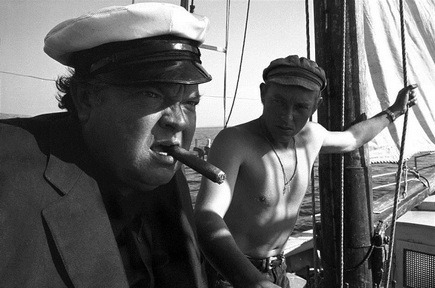
Believed to be the closest of any of the Orson Welles unfished projects to completion THE DEEP has been the source of much speculation among Welles scholars and fans. If the problem was merely a little editing and some rerecording of voices it really should be viewable…right?

Well, yes and no- certainly it wasn’t until Stefan Droessler, the head of the Munich Filmmuseum, had it cut together from three different work prints. And now the film is still unfinished with almost no music, a lot of missing voices and some repetition. It’s in a state that caused Welles scholars it was shown to to balk at its flaws and a good number of walk outs at the recent Museum of Modern Art screening. I’m not sure what anyone who saw it and hated it or walked out was expecting since it was never meant to be seen like this or be as long as it is (just about 2 hour hours), but if you saw it and took Droessler's advice at the start to see the film for what it could be finished its a major kick in the pants and a solid thriller.

Before the MOMA screening the head of the Munich Film Museum talked about the film. He explained that when he got the job the first thing he wanted to see was THE DEEP. He figured that with it being the closest to completion of any Welles unfinished project he could see a near finished film- what he saw instead was several rough work prints with odd tics to them, With every version pat was in color partly in black and white depending upon what was cheapest to print. Some sequences had been “finished” some hadn’t. Welles also cut together multiple takes in sequence so he could decide later which to use. The sound existed for some pieces but not others. Most of Welles voice was gone because of being shot on location with a noisy camera it was all going to be post dubbed so no one cared-at the time(though Welles can be heard dubbing Laurence Harvey for the work prints) . Most troubling was that while the film followed the script closely there was two dream sequences that they had no notes for.

Stefan Droessler said that using the script and notes he had the film put together to see how it played. For him it was clear that the film was very close to being completed. It was clear that the film really is there and that with work,  especially a recording of a new soundtrack, the film actually could be released. This almost complete version was the was shown to Welles scholars that was balked at itans was  was being shown that night to those of us at MOMA.

The film is based on DEAD CALM by Charles Williams which served as the source of the Philip Noyce film DEAD CALM with Nicole Kidman, Billy Zane and Same Neill. Welles’ version is closer to the source novel with the addition of two additional characters played by Welles and Jean Moreau.

The plot of the film has a young couple( Michael Bryant  and Oja Kodar) on honeymoon becalmed off the coast of Africa. When they see a ship in the distance they sail over to say hello. Along the way they run across Hughie played by Laurence Harvey who is rowing over in a dinghy. He says big ship came from now deserted and sinking. It seems his wife and another couple died as a result of severe food poisoning. When Bryant insists on going to get the documentation for the ship to help with insurance and so he can actually be certain that he can tell authorities what happened Harvey balks, saying all paper work was ruined by the water and goes below to sleep. However when Bryant crosses to the ship and finds Jean Moreau and Orson Welles locked in the sinking ship, he knows something is wrong and he races to get back to his own boat only to find Harvey had taken control and is using the motor to sail off. Bryant then attempts to give chase in the sinking ship.

For me the film the film is a revelation. Forced to work within the limitations of boats on the ocean Welles was forced to get away from his short hand techniques and signature shots. As Joe Bendel said he couldn’t go for his typical low angles because you can’t knock the bottom out of a boat unless you’re aiming to sink it. In a weird way I think this could have been one of Welles best films largely because it isn’t like all his others- welles was forced to be creative to go beyond the typical and it helped.

As it stands now it does need a lot of work. The film is mostly silent. Welles character can be seen to talk but his voice was never dubbed in. Conversations repeat giving a weird dream like quality to bits of it. Several sequences-the burning of the boat for example go on way too long and clearly contains every scrap of film shot for it. I understand why people walked out of this cut. It is over long at times dull. It can be a tough haul especially in the first half.

But if you realize that this version would be cut down and can see the forest for the trees then you realize that this is something special. It’s a really good little pulp thriller. If it doesn’t have the deeper meanings of earlier Welles films it maybe more entertaining. To me the only obvious problems are minor ones, in particular the obvious false modesty of the naked Kodar as she comes on and off the boat.

Interestingly while the film suffers from some missing footage, seemingly just insert shots, we were told that the film was supposed to end with some footage of Harvey’s and Welles characters being attacked by sharks. The footage has gone missing and Welles was apparently upset the red blood they used looked green on film. To be honest film works better without it- not seeing what happening is much more haunting.

I really like the film and I can’t wait to see it finished….

…and that actually may happen.  Droessler said that they are trying to work out the rights to finish the film. .Additionally they would have to figure out how to dub the film, with most people being afraid to dub Welles. I don’t know why since he frequently dubbed everyone else.

Should you get a chance to see this version and think you can work with its limitations see it. It’s a kick in the pants